
So Far, No Response to Matt Morgan's Offer for Merrywood
The attorney and Winter Park resident now says he is willing to pay $12 million for the property in hopes of preserving the historic home
July 27, 2026
By Beth Kassab
Matt Morgan, who increased his offer this month from $10 million to $12 million for Merrywood, says he has not received any response from the sellers.
That means the future of the nearly 90-year-old estate designed by James Gamble Rogers II remains in limbo as an August vote nears for the City Commission to decide if the current buyer with a contract on the property will be allowed to split the large lot on Lake Osceola in two. Winter Park’s land development rules generally prohibit subdividing lakefront lots so Tara Tedrow, the buyer with the contract, is seeking special permission.
Morgan told the Voice he has not heard back since putting his offer in writing more than two weeks ago.
Mick Night, the Sotheby’s real estate agent handling the transaction on behalf of the longtime owners and for Tedrow, did not respond to requests for comment. Tedrow also did not respond to messages seeking comment on Morgan’s offer.
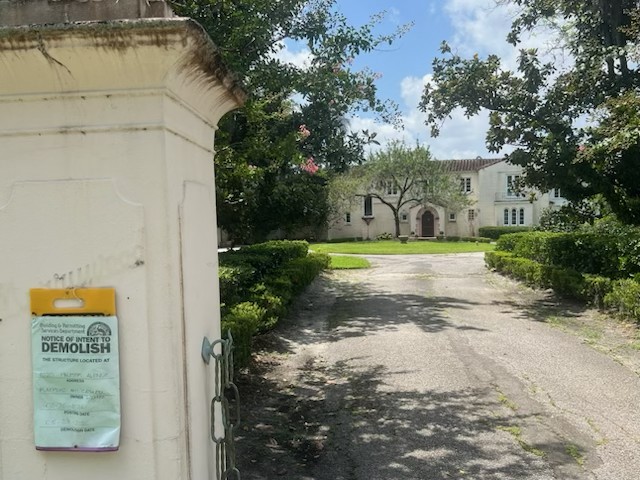
A demolition permit remains posted at 1020 Palmer Ave., though city officials say a list of tasks that must be done before the bulldozers roll in have not yet been completed such as certifying the water and power is shut off, an inspection for pests and draining the air-conditioning system.
Morgan, a Winter Park resident known as a key face of the Morgan & Morgan law firm, first made an offer on the property in August 2025 for $10 million. Night said the offer was too low and that, at the time, he was unaware of Morgan’s desire to preserve the home.
The Voice first reported his offer earlier this month after Morgan came forward in response to news reports that the house was all but guaranteed to be torn down after Night told the City Commission that no one wanted to pay to maintain it despite nearly a year of searching by himself, Tedrow and local preservationists for a way to keep Merrywood. The City Commission voted 3-2 on June 24 in the first of two required votes to approve the lot split.
Shortly after that meeting, Morgan said his original offer still stood and then increased what he said he is willing to pay to $12 million, a price he said he based on his understanding of the amount Tedrow agreed to pay under her contract that is contingent on the city approving the lot split.
“In my view, my offer solves all of the current problems,” Morgan told Mayor Sheila DeCiccio and commissioners in an email on July 10. “Tara Tedrow has expressed her desire to have the historic home preserved and also build a personal residence on the other lot, which is very close to her childhood home. At the time of the hearing, my desire to preserve Merrywood was not known. After hearing there was a strong desire to preserve the home by the contract holders, I immediately came forward to offer this solution. My current offer is pending and I have not heard back yet, but I am very optimistic. My offer allows [current owners Ray and Cathy Gilmer] to receive their current contract price either which way.”
He said he would be willing to purchase the entire lot or a portion of the lot, if the split is allowed, that is needed to keep the home in place.
“I am offering to purchase the estate portion at the same pro rata value established by their own contract while preserving one of Winter Park’s most significant historic homes,” Morgan wrote. “The city no longer has to choose between fairness to the owners and preservation of Merrywood. It can accomplish both without changing its Comprehensive Plan for a single property.”
Morgan’s email to city officials was in response to an email from Night to the mayor and commission with the subject line “Merrywood Rumors.” Morgan said Night is a “man of integrity” in response to Night’s defense of his assertions to the City Commission that there were no alternatives to demolishing Merrywood.
“First of all, I stand by any representations at the recent June 24 hearing about the lack of interested buyers or offers to preserve Merrywood, regardless of errant rumors being circulated surrounding the Matt Morgan offer made last August 2025,” Night wrote.
He went on to explain that he did not discuss preserving the home with Morgan at the time of the original offer last year and that the sellers did not consider $10 million “within the range of what they were willing to sell the property for, then or now.”
Those points were reported in the Voice story about Morgan’s offer on July 6, four days before Night’s email to city officials.
“Matt and I have spoken several times in good faith this week, with a mutual interest in continuing to do anything either of us could to save Merrywood, in addition to the collective and well-publicized ongoing efforts for almost a year now,” Night wrote on the afternoon of July 10.
In Winter Park, the local historic register offers protections against buildings being demolished. But joining the register is voluntary and must be done by the owners. In the case of Merrywood, the longtime owners deliberately kept the property off the register in the event it would be worth more as a tear down.
The city’s historic preservation rules do not govern or prohibit interior renovations and apply to the look and materials on the exterior.
Vacant land on Winter Park’s picturesque chain of lakes is scarce.
But how much the property is worth has been the subject of varying views during the discussions over whether the home should be saved.
Night said at a public meeting that the entire lot is estimated between $13 million and $15 million. He said during a June 22 work session with the city commission that it would be just the seventh transaction higher than $10 million in Winter Park.
Commissioner Elizabeth Ingram asked Tedrow during the June 24 meeting what a “realistic amount” would be for the portion of the lot that included Merrywood if the lot was divided into two pieces.
“Real estate prices are going to be determined on a per acre basis,” Tedrow said. “And if you look at market comps, again I don’t set market comps those are set by recent sales data … I mean, you’re looking at just for the Merrywood site, you are over $12 [million].”
It’s unclear how Tedrow’s figure for just a portion of the lot of more than $12 million reconciles with Night’s estimate of $13 million to $15 million for the entire lot and the reported price of $12 million for the contract held by Tedrow for the entire lot contingent on approval of a split.
City officials allowed one other lakefront lot split in recent years that also involved a Gamble Rogers home, but with two key distinctions from Tedrow’s request. In 2024, the commission changed the Comprehensive Plan in a way to allow for a lot split at 1290 N. Park Avenue, but in that instance the newly created lot was not on the lakefront and the owners were required to designate the existing 1930 home on Lake Maitland as historic on the city’s register.
City staff recommended approval of Tedrow’s request also come with a condition that Merrywood be designated historic, but both the Planning and Zoning Board and City Commission rejected that condition after they were told by the owners, Tedrow and Night that the home is in disrepair and no one was willing to purchase it and restore it. Morgan made his offer public after those votes.
The number of Gamble Rogers houses in Winter Park is shrinking each year as they are torn down for new construction. Fewer than 25 quality examples are estimated to remain.
Gamble Rogers is also known for designing the Florida Supreme Court, Olin Library at Rollins College and Greenada Court on Park Avenue, a Mediterranean-style courtyard with a fountain and tables often occupied by shoppers sipping Barnie’s Coffee. Casa Feliz, one of his most well-known works because it’s now a popular event venue and museum, was nearly torn down 25 years ago until the community rallied to raise money and move it to its current post just off the Winter Park Nine.
His body of work resulted in Gamble Rogers being credited with influencing the aesthetic and feel of Winter Park, which the New York Times has described as “more like a village than a suburb” because of its elevated planning, design and walkability and as a “sophisticated alternative to Disney.”
“As with [Frank Lloyd] Wright’s work in Oak Park, Illinois, and [Addison] Mizner’s work in Palm Beach, Rogers’ work in Winter Park created an architectural character for the town,” wrote Patrick W. McClane and Debra A McClane in “The Architecture of James Gamble Rogers II,” which featured a section on Merrywood. “It can be argued that the publication of many of his designs also exerted at least some influence on a national level by exposing Florida architecture to a national audience.”
WinterParkVoiceEditor@gmail.com
I am so disappointed in the City Officials: if Merrywood falls to bulldozers we have all lost a piece of Winter Park. Given that there is a legitimate and overly fair offer for the property that the structure stands on is proof the city and seller never had any intention to preserve history.
I lived in a home in Gainesville during the 1970’s and committed our home to the historic register. Today, the home remains but is derelict, a shambles. There appears to be no incentive, public nor private, to reinforce its value as a historic gem of its time. The “wait and see” attitude that permits such negligence (in this case, sale money and potential profit) needs to be more fully addressed by our city leaders. Inaction, like with the U. S. legislative branch, is tantamount to cowardice.
This information raises serious questions about this process. The public was told there was no viable buyer willing to preserve Merrywood, yet there was an offer that reportedly matched the contract price while preserving one of Winter Park’s most significant historic homes.
Winter Park should not change decades of planning policy by granting a rare exception to its lakefront lot-split rules when there is a credible alternative that preserves Merrywood without sacrificing the City’s long-standing protections. Before approving an exception that could set an important precedent, the City Commission should insist on complete transparency and fully consider every reasonable preservation alternative.
I applaud Matt Morgan for stepping forward with a proposal that appears to protect both the owners’ financial interests and an irreplaceable part of Winter Park’s architectural heritage. Thank you Matt!
There is no historic value to Merrywood. It is an old dilapidated house on a big lakefront lot designed by a locally famous architect. The owner should be allowed to get market value just like any other property owner. If Morgan or others want to “save Merrywood” then buy it but don’t expect taxpayer subsidy or government pressure.
I am curious. No taxpayer subsidy or government pressure. I understand that. What about the lot split?
What article did you just read?
The owner is not entitled to a lot split, but the evaluation of the lot split request should not be based on the alleged “historic” nature of the house.
This saga has more twists and turns than a Russian Novel , including a seller,a buyer, a broker, and a potential additional buyer negotiating a high dollar Real Estate transaction partly through the media with a hundred “experts” who have no financial interest in the deal explaining to all the meaning of “fairness”. More popcorn please.
Casa Feliz has always held a special place in my heart. My ex-husband and my brother both worked for Mike Hodge, owner of A & M Contracting—the first company I worked for after graduating from UCF. Mike and his team accomplished what only a handful of contractors in the country believed could be done: they successfully relocated Casa Feliz to its current location, preserving an irreplaceable piece of Winter Park’s history.
Years later, my best friend was married there, and I had the honor of standing beside her as her maid of honor. ❤️
This beautiful home represents so much more than just a historic building—it tells the story of our community, our history, and the people who worked so hard to preserve it. I truly hope Casa Feliz can continue to be protected and cherished for generations to come.
I would rather Matt Morgan buy 7 Oaks Park then it could be a park” For the People ” unlike what it is today.