by Beth Kassab | May 11, 2023 | City Commission, News, Orange Avenue Overlay, Uncategorized
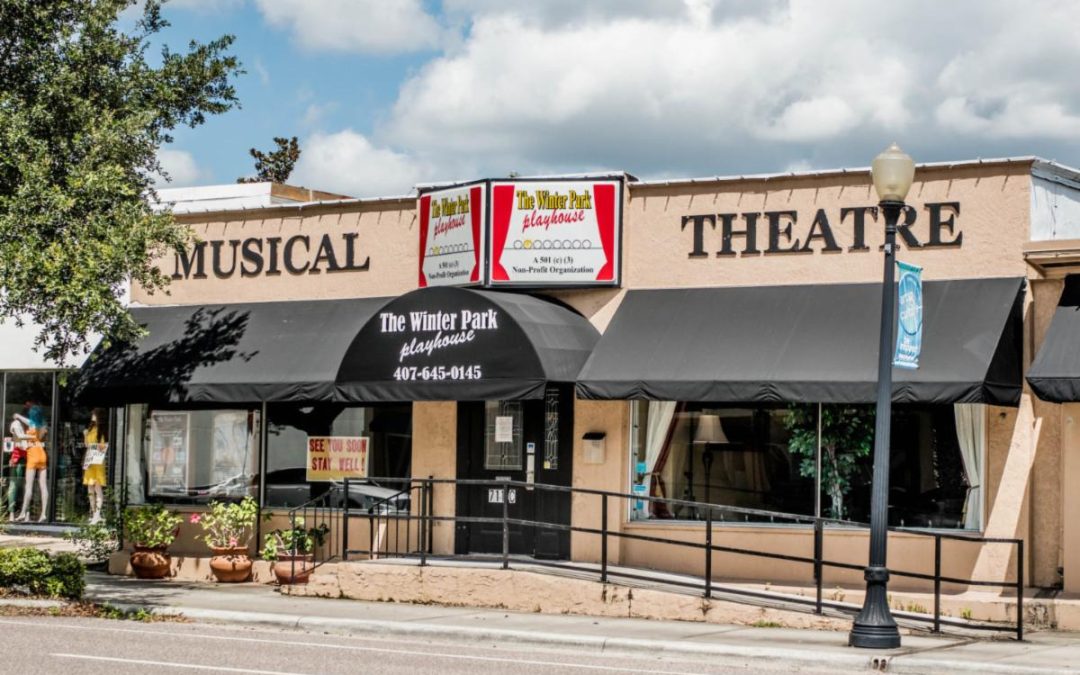
Commissioners: Can we buy Winter Park Playhouse building?
The potential purchase is an alternative to a new building at Seven Oaks Park as the City Commission also considers concepts for the old library
By Beth Kassab
Winter Park City Commissioners on Wednesday tossed around the idea of using Community Redevelopment Agency funds combined with Orange County Tourism Development Tax dollars to buy the building occupied by the Winter Park Playhouse, currently on the market for about $4.25 million.
The potential purchase came up as an alternative to allowing the theater, which is set to lose its lease at 711 N. Orange Avenue as early as next year, to build above the parking lot at the new Seven Oaks Park.
That concept has been discussed since February, though some commissioners have been hesitant to commit to the idea because of the likely need for more parking in the future as well as concerns about how the structure would alter the look and feel of the park.
“I want to do everything we can do to keep [the playhouse], but we don’t know what 10 years is going to bring for Seven Oaks and that whole area could change,” said Commissioner Sheila DeCiccio.
Heather Alexander, executive director of the playhouse, said she is open to the city’s help to purchase the current building, but also remains interested in building at the park or even the old Winter Park Library site.
Ultimately, commissioners voted to put on hold for two weeks a Request for Proposal for the air rights above the Seven Oaks parking lot.
Earlier in the meeting, the commission voted to go forward with asking for redevelopment concepts for the old library and, once again, voted to give preference to proposals that keep the old building rather than demolish it. Commissioner Todd Weaver pushed for the change, arguing it would be wasteful and harm the environment to take down the 1978 building. That amendment passed by a 3-2 vote with Mayor Phil Anderson and DeCiccio dissenting.
Last year the commission issued an RFP for the site and required the building stay put, but abandoned the concept for office and other uses earlier this year.
This time they voted to allow residential units as part of the plans, though some commissioners expressed reservations about the city retaining ownership over a building with apartments or condominiums.
Six nonprofit groups expressed interest so far in being part of such a proposal. Groups are still invited to write letters of interest, Anderson said.
He also advocated for a community meeting to be held on the redevelopment of the old library so people who live nearby can have a better understanding of what to expect and weigh in on the concepts.
To comment or read comments from others, click here →
by Beth Kassab | May 9, 2023 | City Commission, Library, News, Uncategorized
Six nonprofits seek space in old library
Vocal arts group, space museum and theater among contenders to redevelop New England Avenue property
By Beth Kassab
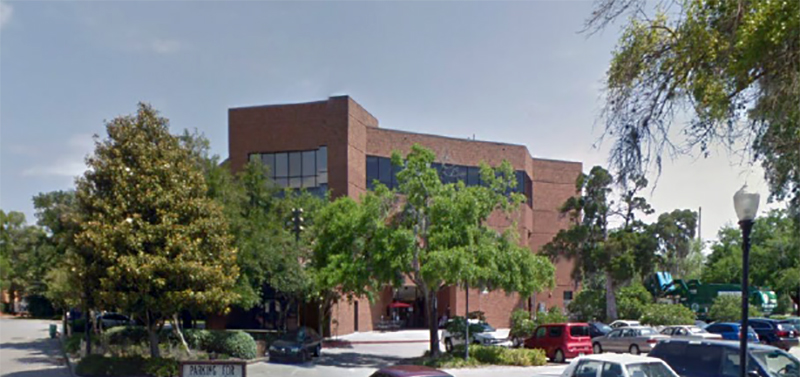
A half dozen nonprofits declared interest in the old Winter Park Library site, answering the city’s call for concepts to remake the old building into a space with an arts and culture component.
The letters of interest to reuse or demolish the 33,000-square-foot former library are scheduled to be discussed at Wednesday’s City Commission meeting along with a separate call for concepts to develop space above the parking lot at the new Seven Oaks Park.
The commission set several guidelines for concepts related to plans for the 1.75-acre library site. Preference will be given to ideas that keep the first floor free of any residential units, don’t require any off-site parking and preserve the oak tree on the east side of the building.
Parking is likely to become a central issue in light of the commission’s recent approval of Rollins College’s plans to build a new art museum and business graduate school nearby as the Alfond Inn undergoes an expansion.
The ideas submitted for the old library site include:
- Central Florida Vocal Arts and Opera del Sol. The nonprofit currently without a permanent space is looking to use the entire building to create an arts cooperative that would include the Florida Symphony Youth Orchestra and Emotions Dance. The group led by Theresa Smith-Levin stated it is willing to negotiate a lease for the space and does not intend to use it as a main performance venue. Central Florida Vocal Arts included several letters of support for its concept and said it has funding support from several high-profile philanthropic organizations such as the Edyth Bush Foundation, United Arts of Central Florida and the Ginsburg Foundation.
- SkyBuilders 4 All. The group led by Executive Director Carissa Villa describes itself as seeking community development and housing solutions and says it will need about 1,000 square feet for office and project space. The group also provides personal and business financial education.
- Saving Our Aeronautical Resources Museum. SOAR is a new nonprofit created to inspire kids to go into STEM fields with a special emphasis on space exploration. The group says it will have “generous contributions” from NASA, the U.S. Air Force, Boeing and Kennedy Space Center for an estimated $3 million “build out.” The total cost of the museum is $10.5 million, according to the documents submitted. The idea is to host school field trips and other groups to engage more kids in scientific fields. Ravi Margasahayam, an aerospace engineer who spent 35 years with NASA; Gary Duce, president of Space Training Academy & Research and Susan Omoto, executive director at Casa Feliz, are behind the proposal.
- Winter Park History Museum. The well-known group is looking to expand its current space from about 900 square-feet to about 5,000-square-feet for a mix of permanent and rotating exhibits and office space.
- Winter Park Playhouse. The community theater that is losing its lease next year has expressed interest in potential space at Seven Oaks Park, but also submitted a letter of interest for the old library. It is seeking to use about a third of the old building for a 150-175-seat theater.
- Winter Park Sidewalk Art Festival. The group is looking for about 1,500 square-feet for permanent office and meeting space to manage one of Winter Park’s best-known annual events.
To comment or read comments from others, click here →
by Beth Kassab | Apr 27, 2023 | City Commission, News, Uncategorized, Zoning and Development
Rollins museum and grad school expansion win approval
Residents concerned expansion would create more traffic and worsen parking woes
By Beth Kassab
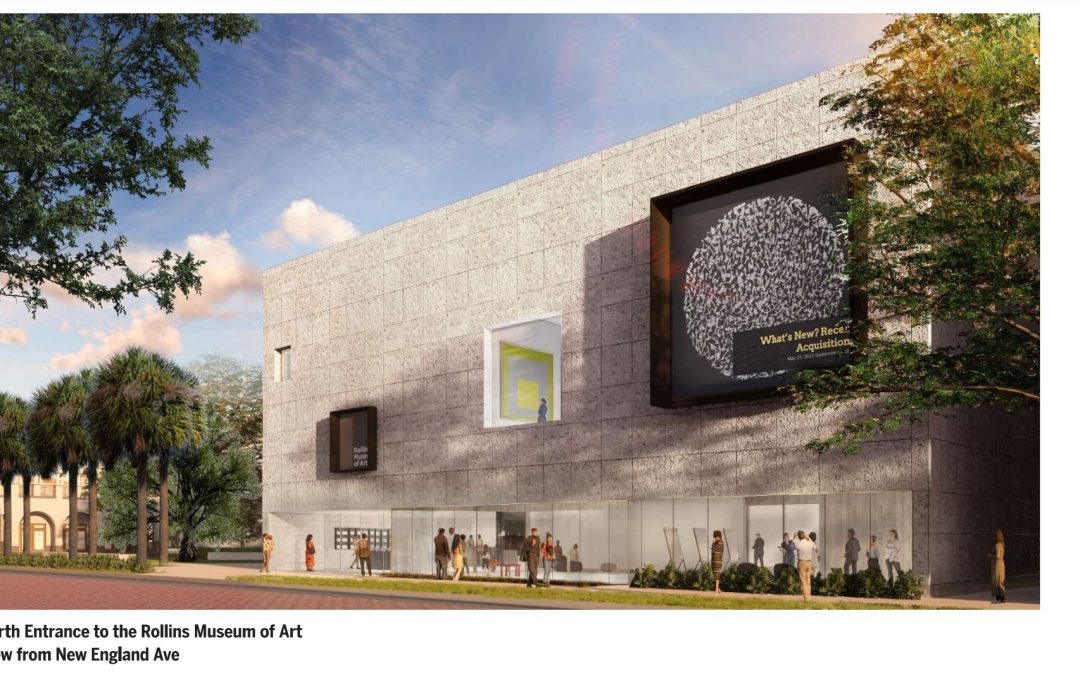
Winter Park Commissioners unanimously approved a revised plan by Rollins College to build a new art museum and expand the Crummer Graduate School of Business north of Fairbanks Avenue near the college’s growing Alfond Inn despite concerns from residents and others about parking, traffic and noise.
The concept for the block bordered by New England, Interlachen, Lyman and Knowles avenues was approved by the commission three years ago before the pandemic delayed the project.
On Wednesday, commissioners approved changes that include a lawn on the corner of Interlachen and New England that would preserve trees, a smaller Crummer building and slightly smaller signage on the outside of the museum along with a condition intended to help alleviate concerns from nearby residents of $1 million-plus condo units about what they said could be noisy and unsightly roof-top air-conditioning units.
Planning & Zoning Director Jeff Briggs said the city’s studies have shown the impact of the project on traffic and parking would be minimal despite the loss of the surface parking lot currently on the property.
“It’s important that we don’t let the details get in the way of the big picture,” Briggs said. “We are the city of the arts and culture and how lucky can we be to be getting a world-class art museum brought to the city for free with Rollins paying for it?”
He said the plans are consistent with the city’s long-time goal of attracting “the educated elite” and the site “on the doorstep of the central business district could not be a better location for that to happen.”
But residents along with the president of the Women’s Club of Winter Park, which operates next to the site owned by Rollins, questioned that assessment because they said the surface lot on the property today is crucial to accommodate crowds in the area off Park Avenue, especially during weddings and events.
“This parking is heavily used,” said Carey Stowe, who lives in The Residences condo tower on Interlachen. “I think the whole traffic situation is getting glossed over just a little bit,” noting that he estimated about 100 spaces will be lost, a significant change not just for people who live nearby, but for anyone who likes to shop or dine on Park Avenue.
Briggs said Rollins freed up parking spaces in the Truist Garage just south of the block in question when it built a new 900-space garage for students and staff on the corner of Fairbanks and Ollie avenues.
Later in the meeting, after Rollins’ plans were approved, Commissioner Sheila DeCiccio said she’s heard a flood of complaints about the lack of parking off Park Avenue and asked the commission and city staff to consider building a new parking garage behind City Hall, roughly three blocks from the new museum.
“Let’s take a look and see if it’s something the commission is interested in pursuing,” DeCiccio said.
Mayor Phil Anderson suggested city staff “dust off” earlier plans for the potential garage and bring them forward for a review.
Rollins will provide 30 parking spaces on the museum and Crummer school site.
Rollins President Grant Cornwell told the commission that the project is “strategically very important to the college” to showcase it’s top-rated MBA program as well as its art collection. While the college owns 6,000 pieces of art, it’s only able to display 150 or so at a time at the current museum.
“We feel we have a civic obligation and we have a great desire to lift that collection up and bring it into the center of Winter Park,” Cornwell said.
Margery Pabst Steinmetz, a philanthropist known for the hall that bears her name inside Orlando’s Dr. Phillips Center and who serves on the board of the Rollins Art Museum, said the current gallery is “bursting at the seams” and called on the commissioners to take a long view of what will be left behind when they are gone.
“I’d like us to think about a day when none of us are here … 100 years from now, what will be left in Winter Park?” she asked. “The cultural institutions of the city. I think we will all be very proud looking down from somewhere that this was created and it continues to serve our city in huge ways. I urge you to vote yes on this project.”
Becky Wilson, an attorney with the Lowndes firm representing Rollins, said the college has already agreed to leave certain buildings on the property tax rolls despite its nonprofit status to help generate revenue for the city and will provide five additional parking spaces for a total of 15 in a garage for people who live in the Residences condominiums. She also said the college has agreed to use the same acoustic engineer who helped dampen sound from air-conditioning units at the Alfond Inn that were the subject of a lawsuit between the condo owners and the hotel operated by the college.
City commissioners voted for city staff to have some oversight of the noise and view of the rooftop air-conditioning units planned for the museum and new Crummer building.
To comment or read comments from others, click here →
by Beth Kassab | Apr 22, 2023 | Election, News
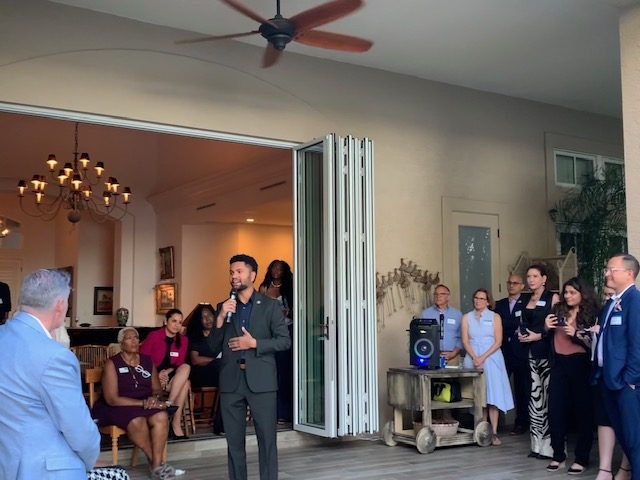
Karen Castor Dentel announces run for elections supervisor at luminary-filled Ruth's List event
Gen Z Congressman Maxwell Frost and State Attorney Monique Worrell headlined the event at a Winter Park home to support women candidates
By Beth Kassab
Orange County School Board member Karen Castor Dentel said Friday night she will run for Supervisor of Elections next year as Bill Cowles retires from the position he’s held for more than 25 years.
Castor Dentel, who made the announcement at a Ruth’s List fundraiser in Winter Park, said she is drawn to the position because of the “current state of politics” and a desire to push “clear communication with voters and educate them about the process” amid a national landscape littered with misinformation.
Cowles, who was first elected in 1996, said in February that he will retire when his term ends in early 2025. So far Castor Dentel is the only person filed to run in the race that will be on the November 2024 ballot, according to the supervisor’s website.
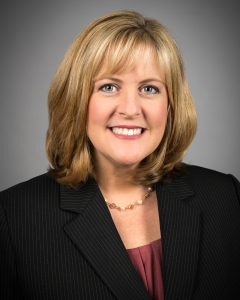
Karen Castor Dentel
She was one of a handful of candidates who announced races after U.S. Rep. Maxwell Frost, who represents Winter Park in Congress, and Orange-Osceola State Attorney Monique Worrell talked about why more candidates are needed to combat what Worrell called “an unprecedented time” as “democracy is slipping away.”
“It’s been a rough couple of weeks,” Worrell said amid chuckles from the crowd gathered around a pool deck overlooking Lake Maitland.
The comment was a reference to criticism from Gov. Ron DeSantis, who said her office was negligent because she didn’t prosecute a man for a misdemeanor marijuana charge in 2021. That same man is the suspect in a triple shooting in February that killed a 9-year-old girl, a woman and a Spectrum News 13 reporter.
Worrell said mass incarceration will not build a stronger society and she questioned DeSantis’ claim that he presides over the “free state of Florida.”
“I submit to you that Florida is not free,” she said, noting that DeSantis and a “Legislature beholden to their dictator” have pushed new restrictions to what K-12 students can learn about gender identity, made it easier for Florida, which has the highest number of Death Row exonerations, to execute people and passed a ban on most abortions after six weeks.
Worrell, a mom to three boys, revealed that when she was 39 years old she became pregnant with a daughter she had “waited for my whole life.” But when she was 10 weeks along her doctor told her that tests revealed the baby was unlikely to survive.
She had to make a decision about whether to continue or end the pregnancy.
Ultimately, she said she decided to continue the pregnancy and delivered a baby girl who died just three weeks later.
“If I had to make that decision again I would possibly make a different decision,” she said.
Worrell, who gave birth to her youngest son about a year after her daughter’s death, said she shared the deeply personal story for the first time because she knows the toll restrictions on reproductive freedom can take on women and families.
“It’s an insult to call Florida free,” she said, noting the importance of Ruth’s List, which helps elect Democratic women who are in favor of abortion rights.
Ruth’s List was founded in 2008 by former state chief financial officer and gubernatorial candidate Alex Sink. The organization, which has raised $7.5 million over 15 years, is named for Florida Congresswoman Ruth Bryan Owen — elected in 1928 just eight years after women gained the right to vote.
Frost, known as Gen Z’s first congressman elected last year at age 25 to represent greater Orlando, including Winter Park, Maitland and the UCF area in east Orange County, said Ruth’s List is crucial in supporting progressive candidates.
He said he took an interest in politics at age 15 “because I didn’t want to get shot in school” in the wake of the Sandy Hook Elementary School massacre in Newtown, Conn.
“Generation Z … we truly are the mass shooting generation,” Frost said. “… We need to elect politicians who will see the world through the eyes of the most vulnerable.”
To comment or read comments from others, click here →
by Beth Kassab | Apr 19, 2023 | City Commission, Library, News
In Brief: More money for public art, Dinky Dock changes and the new fate of the old library
Recent action by the City Commission will pave the way for more art as well as changes at two high-profile landmarks
After years of trying, Winter Park’s Public Art Advisory Board won approval this month for what will likely be a small, but steady stream of funds from the city budget to help pay for art in public spaces.
The City Commission unanimously approved a plan to dedicate 10% of any increase in the Unassigned General Fund each year to the project. That’s the same formula the city uses to devote money to the acquisition of park land, a plan that has raised about $1 million since it went into place in 2003 at an average of more than $50,000 a year.
While a lot of variables can impact the city budget each year, officials said they expect the public art fund to perform at a similar level.
Members of the public art board pleaded with members of the commission last week to approve the proposal and expressed concern that the “city of culture and heritage” didn’t have dedicated funding for art. The City Commission rejected a proposal last year to create a stream of art funding from building permit fees.
“We have nothing to make our ideas happen,” said Elizabeth Ingram, a member of the Public Art Advisory Board for about a year who also grew up in Winter Park. “It’s disappointing when there isn’t anything to bring those to our city. I don’t think we can rely on private donors anymore.”
Tinker Marsh, another member of the board, also expressed surprise that board did not have any dollars to spend on its mission.
“We really need to make Winter Park the first-class community we know it is,” Marsh said.
The board has discussed recommending works of art for the new Seven Oaks Park, Martin Luther King Jr. Park and other city gateways.
Commissioner Marty Sullivan called the funding plan a “good start.”
“This is a very good move in the right direction,” he said.
New plans for the old library
Since the new Winter Park Library and Events Center opened, ideas and debate have swirled around what to do with the old library site on the corner of East Fairbanks and Lyman avenues.
Commissioners rejected a proposal earlier this year to repurpose the old building by transforming it into office and business incubator space among other uses.
Now, however, there appears to be agreement among the commission to ask developers for new ideas and, this time around, allow residential units and also permit the building to be demolished rather than reused.
Commissioners agreed at a work session last week to consider putting out a new Request for Proposal as soon as next month.
A spokeswoman for Rollins College said the school is not currently interested in the site and is considering a workforce housing project elsewhere.
Workforce housing is a hot topic in Winter Park as home prices have soared beyond the means of many of the people who work for some of the city’s largest employers such as Rollins, the hospital and City Hall.
More parking at Dinky Dock
The number of parking spaces at the popular Dinky Dock public boat ramp will increase by 50% to 33 regular spaces and 12 trailer spaces, under a plan approved by the City Commission.
Repairs will also be made to the dock’s boardwalk.
The city will spend about $154,000 on the project from the more than $15 million it received from the federal American Rescue Plan Act or COVID stimulus money approved by Congress in 2021.
To comment or read comments from others, click here →

Recent Comments