by Concerned Reader | Feb 17, 2023 | City Commission, News
Mayor says future power sources to be city’s ‘biggest’ decision
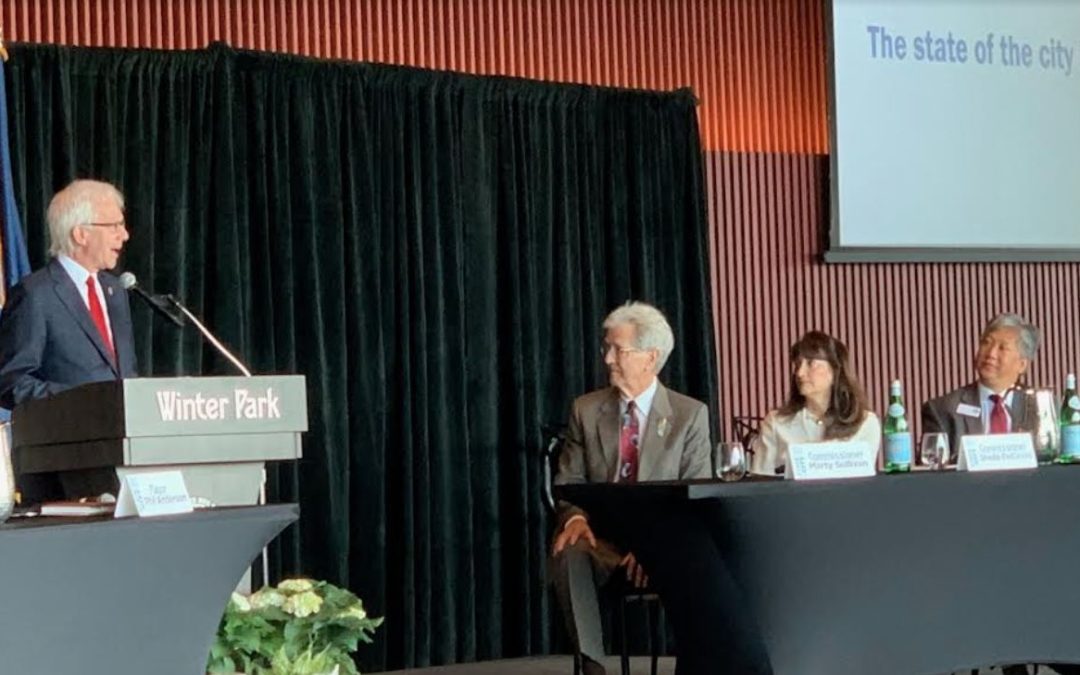
Winter Park’s 55th mayor, Phil Anderson, delivered his state of the city speech focusing on the environment and ‘small-town feel’
Mayor Phil Anderson zeroed in on imminent decisions over Winter Park’s environmental policies in his “State of the City” address on Friday, calling the choices about how to provide electricity to residents and business the biggest decision “for the next 50 years” and said flooding from Hurricane Ian was a “wake-up call” prompting changes to how to move water through the region.
A study is underway to determine what sources of power – natural gas, coal, nuclear or solar — Winter Park’s electric utility should purchase. Winter Park is one of only 33 municipal-owned providers in a state where more than three quarters of the population is served by one of the large investor-owned utilities such as Duke Energy or Florida Power & Light.
“This is probably the biggest policy decision that this city is going to wrestle with for the next 50 years,” Anderson said, noting he wants to reduce the city’s carbon footprint “responsibly.” “We’re going to do this right.”
He also noted the need to work with other nearby governments from Osceola County to Jacksonville to address how the region will contain onslaughts of water brought by major storm events such as Ian, which dumped more than 15 inches of rain on Central Florida in September 2022.
Anderson noted that “by the old math” such a rain event would happen only once every 500 years. “We think the old math may not work and we’ve got to do something about it,” he said, though he said it was unclear how much the changes would cost.
Winter Park, which has about 30,000 residents, remains on strong financial footing with a budget of just under $200 million. That’s more than an 11% increase over the previous year, including $1.6 million of new revenue from the newly-acquired Winter Park Pines Golf Course.
Anderson emphasized his desire to protect the city’s “small-town feel” and neighborhoods as well as the health of the shopping and dining corridor along Park Avenue. Part of those efforts will include enhancements to the city’s parks and potential traffic calming measures.
Proposed changes to State Road 426, a major east-west carrier of traffic through the heart of Winter Park to the growing Seminole County city of Oviedo, are likely to be a subject of debate this year.
A group of citizens known as ‘Fix 426’ is advocating for safety changes and the Florida Department of Transportation is considering ways to address concerns on S.R. 426 between Park Avenue and Lakemont Avenue, a stretch of the road carved through the city’s chain of lakes and neighborhoods with a series of sharp curves.
“People do not feel safe walking those roads,” Anderson said. “Because of grassroots organization we are seeing great progress and great ideas being shared. We may not get everything we’d like to see but we are going to get a lot of things we need to see.”
To comment or read comments from others, click here →
by Concerned Reader | Feb 16, 2023 | Events, News
Todd Weaver to remain in office
Close vote determines resignation wasn’t sufficient
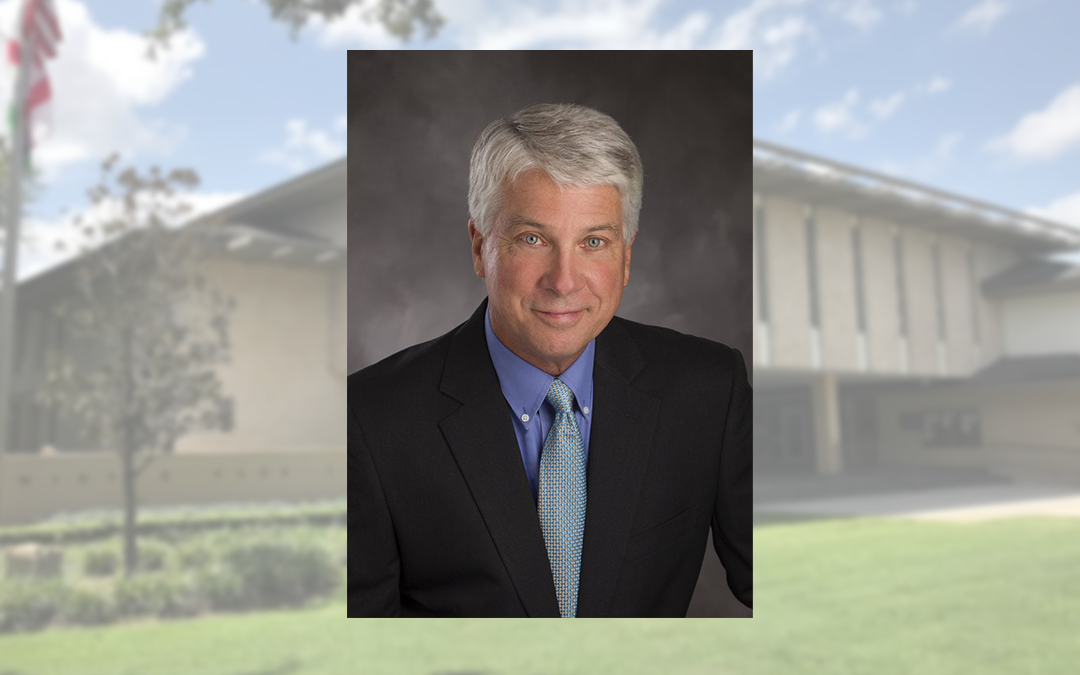
Todd Weaver will remain on the Winter Park City Commission after three of the five commissioners voted to determine an email he sent earlier this month titled “Stepping Down” was not a “legally sufficient” resignation.
The 3-2 vote concluded nearly two weeks of debate over Weaver’s future since the he sent the message to supporters and senior city staff on Feb. 3 only to say days later that he didn’t want to resign after all and asserting in a commission meeting last week that the email was merely an “announcement” rather than a resignation.
A contrite Weaver apologized for the hubbub at a special meeting on Wednesday to decide his fate.
“I apologize for being the cause of this special session,” he said, noting that he was sleep deprived and contending with new work duties outside of City Hall on the morning he sent the letter. “I should have given it a little more time before I hit the send button … it was just a stupidity move on my part.”
At stake was whether Weaver could serve the remainder of his term until 2025 or if the City Commission would appoint someone new to fill the seat until the next general election in 2024. The city attorney said at last week’s meeting that if Weaver’s note was considered an immediate resignation then it was unlikely he could take it back.
Jockeying among interest groups and candidates to fill the post began within hours of Weaver’s email.
An opinion from a labor attorney sought by the city on the matter questioned Weaver’s credibility and concluded his message was a clear resignation.
“In my view, Mr. Weaver’s recent statements appear to be a crude attempt by him to recharacterize the events of him drafting and sending the email,” wrote Benton Wood of law firm Fisher Phillips.
Mayor Phil Anderson and Commissioner Sheila DeCiccio voted in favor of calling Weaver’s action a resignation and pointed to the attorney’s opinion as well as language in Weaver’s letter, including his use of the past tense when talking about his tenure and his signature on the email, which noted his time as a commissioner from 2019-2023, two years before his term is scheduled to end.
“The clear thrust of the communication is to inform residents he’s stepping down,” DeCiccio said.
Commissioners Marty Sullivan, Kris Cruzada and Weaver himself voted to keep Weaver in place and rejected the legal opinion.
Sullivan said Weaver clearly wanted to continue to serve and it was in the best interest of Winter Park residents to have a commissioner elected by the people rather than one appointed by the commission.
Ten residents spoke during the public comment portion of the meeting and were split over whether to keep Weaver, a proponent of more sustainability policies in the city, on the board.
“Have you ever changed your mind about something?” asked resident Pat McDonald, noting that at last week’s commission meeting the people on the dais conceded they wanted to change course on plans for the old library building when they ended an agreement with one developer to solicit new ideas. “Let’s just assume it was a resignation letter. He changed his mind.”
At least one resident noted her “trust is not within Mr. Weaver anymore.”
Cruzada said he found Weaver’s email to be “ambiguous” and assigning meaning to it would be a “slippery slope.”
“When I read the email, it was kind of like reading a book with no ending …,” Cruzada said. “It’s not as crystal clear as I would like it to be … Do I cringe about how we got here? Yes, it’s regrettable. We’re all human. We all err every now and then.”
To comment or read comments from others, click here →
by Concerned Reader | Feb 9, 2023 | Headline, News
Did Weaver Resign . . . or not?
Commission to decide at special meeting Feb. 15
by Beth Kassab / February 9, 2023
Commissioner Todd Weaver, who announced Friday he is “stepping down,” said at Wednesday’s City Commission meeting that he now wants to remain in the job, though the board delayed a decision about whether he can do so.
Weaver, who was re-elected last year for a second three-year term, sent a mass email on Friday that said he is struggling to manage commission duties along with his business obligations and also told the Orlando Sentinel on Friday, “I’m juggling too many balls.” He signed the email with his name and “Winter Park City Commissioner 2019-2023,” two years shy of when his term would be up in 2025.
But on Wednesday he argued the email, which carried the subject line “Stepping Down” and was sent from his campaign address to constituents, supporters and others including the city clerk, was not a resignation.
“Nowhere in that notification to residents did it say I was going to resign or resign on a certain date,” Weaver said. “It was just reaching out and showing my appreciation to all of you and all of city staff … Yes, I’m struggling a little bit with time, but I’ve made some adjustments in my personal life … I’m here tonight and I want to serve.”
In question now is if the five-member commission considers Weaver’s email an official resignation. If so, City Attorney Kurt Ardaman said Seat 4 would be considered vacant and Weaver’s participation and votes on city business “could compromise the integrity of the commission’s actions.”
Ardaman said only the commission can determine if the email constituted an immediate resignation.
A vacant seat would mean the commission would appoint someone to serve until the next general election in March of 2024 when voters would select a candidate to fill the final year of Weaver’s term. No races will appear on the city ballot this year because commissioners Sheila DeCiccio and Marty Sullivan were automatically re-elected when no one filed to run against either incumbent.
Jockeying for the vacancy had already begun by the start of Wednesday’s meeting. The Winter Park Chamber of Commerce sent a letter to the Commission on Friday within hours of Weaver’s email calling for the board to appoint “someone from the African American community.”
“It has been an unacceptable 130 years since a Black person has served on the Winter Park City Commission and you now have a perfect opportunity to correct that inequity,” stated the letter from chamber President Betsy Gardner Eckbert.
Commissioner Marty Sullivan advocated to call a vote to keep Weaver on the commission.
“It’s very clear, I believe, that Vice Mayor Weaver chose to rescind that and chose to continue to stay on the commission,” Sullivan said. “It’s clear from [City Attorney Kurt] Ardaman that it’s up to us to decide whether he stays on the commission so I think it’s out of order to delay that decision on our part.”
But Mayor Phil Anderson won a vote 3-2 to delay the decision until a special meeting devoted to the matter next Wednesday. Weaver and Sullivan cast the dissenting votes.
Anderson requested an opinion on the matter from the city’s labor attorney before the next meeting.
Ardaman said that if commissioners interpret the email as an immediate resignation, then it’s likely not possible for Weaver to rescind that decision. But if they determine his intent was to resign in the future then he could potentially walk it back.
Weaver participated in votes on the remainder of the city agenda on Wednesday.
To comment or read comments from others, click here →
by Concerned Reader | Jul 30, 2022 | News
Anonymous Threat Against Prospective Voice Editor
Hand-delivered, unsigned
by Anne Mooney / July 30, 2022
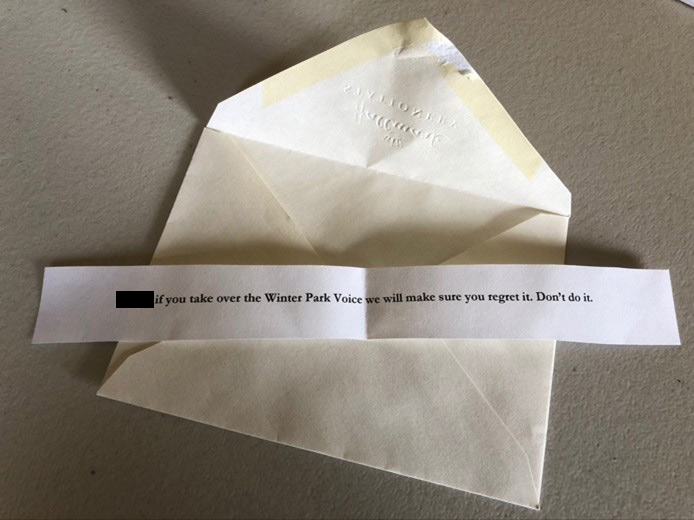
On Monday, July 25, a small, unmarked envelope – the kind that comes with a greeting card – was found slipped under the office door of a prospective Winter Park Voice editor, who has asked not to be identified in this article. Inside the envelope was a small strip of paper, shown in the photograph below, which contained the following message.
“[Name] if you take over the Winter Park Voice we will make sure you regret it. Don’t do it.”
On Friday, July 29, the would-be editor arrived at the work place to find the letters “F * C K [NAME]” spray painted on the grass in dayglo pink.
Word is on the street, apparently, that it was my intention to step down this fall as editor of the Winter Park Voice and that someone was in line to take my place. We had planned to announce this in early September once we had completed the administrative details of the transition. That will no longer happen, as the person in line to take over has withdrawn in the face of this intimidation and harassment.
No Responsibility Taken for Threat
There were no markings on the envelope. There was no signature on the message. And spray paint is anonymous. It is impossible, therefore, to know who the “We” is that was going to make sure the new editor regreted taking over the Voice. All we know about the person or persons who wrote and delivered these threats is a: he/she/they is/are a bully, and b: he/she/they lack the courage to sign their name(s).
On a personal note, it is disturbing and disheartening to realize, in our beautiful city, there is anyone so mean-spirited and angry that they would threaten the incoming editor of an online local news organization – before that person has written word one.
For now, the Winter Park Voice remains dedicated to unbiased, accurate reporting of the news and events of the city. If anyone has issue with our reporting we welcome and encourage debate in our forums and guest columns.
As these events occurred on City-owned property, the Winter Park Police Department has been made aware of the situation.
To comment or read comments from others, click here →
by Concerned Reader | Jul 14, 2022 | News
Beware the Cock of the Walk
Orlando Residents Complain of Winter Park Peacock Invasion
by Anne Mooney / July 14, 2022
This reporter has always maintained the wisdom of remaining at a Commission meeting until the very end, because that’s when the best stuff happens.
Last night’s meeting was no exception. After a riveting budget presentation by the City Manager, followed by discussion of a couple of opaque ordinances regarding future land use on a residential lot, Commissioner Sheila DeCiccio reported receiving an email from an Orlando resident to let the City know that Winter Park’s iconic peacocks are moving south. The Orlando resident, whose car roof had been commandeered as a peacock roost, demanded the City come get the peacock and return it to Winter Park.
Symbol of Winter Park
It’s true, the iconic peacock is the oh-so-visible symbol of Winter Park. It is also true that the peacocks are wild birds, and Winter Park can no more relocate itinerant peacocks than they can move menacing mockingbirds or repatriate recalcitrant robins. Fish and Wildlife insists the wandering peacocks are not part of their portfolio either.
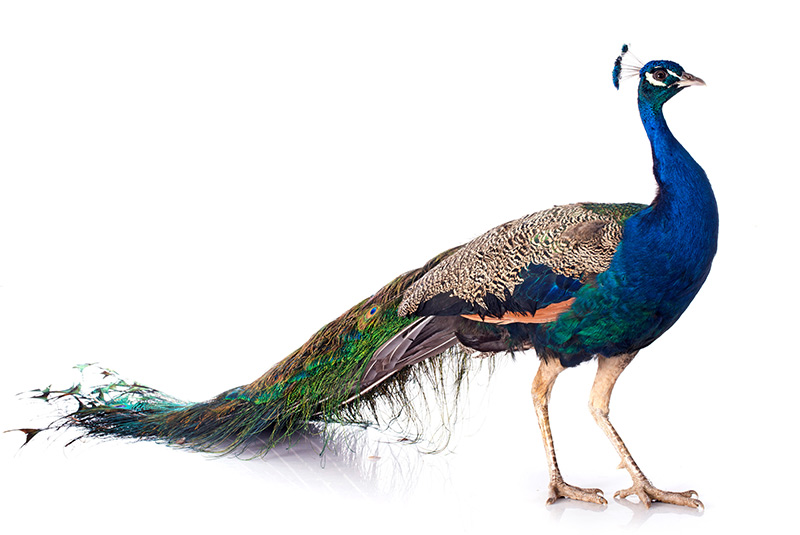
A peacock’s physical traits alone can justify a healthy respect for the birds. Though only male peafowl possess the bright trains of tail feathers for which the species is known, both peacocks and peahens are big, with some birds clocking in at close to 4 1/2 feet tall, with a wingspan of the same length. Peafowl have sharp beaks and talons, and emit a piercing shriek that can startle even a practiced avian caretaker.
Peacocks – territorial
Peafowl, especially the male peacocks, are aggressively territorial. Nesting peahens who have laid eggs will attack anyone who gets too close to their nest, and peacocks – who prefer to keep a harem of peahens to themselves when mating – will attack encroaching males. Combined with the peacock’s low intelligence, this has caused wild peacocks in urban areas to attack dark-colored luxury cars. A bird sees his reflection, interprets it as a second bird and attacks, which can spell ruination for the paint job on an expensive car.
2022 a good year for baby peafowl
DeCiccio reports the Windsong neighborhood in particular has experienced a bumper crop of baby peafowl this year. And, with the rapid increase in population, the Windsong peacocks have taken to claiming streets as territory and will try to prevent vehicles from intruding on their streets. She says the only way she knows to make the birds move out of the way is to bait them with food, such as a slice of bread. “Otherwise, those birds are not moving,” said DeCiccio. “If anyone goes around, it will be you, not the bird.”
Peacocks – slow and not terribly bright
While peacocks also have been seen chasing people to take their food, the good news is that because of their huge tails, they’re quite slow. Commissioner DeCiccio, who is currently wearing a boot to protect a broken foot, says even with the boot, she can outpace a peacock.
Peacocks are protected in Florida
Peacocks are not endangered, but they are protected under Florida laws. Many Florida cities boast large populations of the birds. Native to India and Southeast Asia, peacocks thrive in Florida and, like many exotic species, love ‘em or hate ‘em, they’re here to stay.
To comment or read comments from others, click here →

by Concerned Reader | Jun 6, 2022 | News
15th Annual Shred Event
Are you drowning in paper? Tax returns from the 1980s? Love letters you wouldn’t want to discuss?
Get rid of that old paper. Commerce Bank & Trust on Orlando Ave. can help.
15th Annual Shred Event
No binders, trash, metal clasps or disks.
JUST PAPER, PLEASE!
When: Friday, June 17, 2022 from 9:00 – Noon
Where: 1201 South Orlando Avenue
Winter Park, FL 32789
407-622-8181
Limit 6 boxes per vehicle;
call 407-622-8181 for larger quantities.

To comment or read comments from others, click here →

Recent Comments