by Beth Kassab | Mar 30, 2026 | County News, News, Police and Public Safety, Schools
New Law Could Require New Fines and Data Collection on Electric Bikes and Scooters
Lawmakers approved the measure earlier this month and it is awaiting Gov. Ron DeSantis’ signature. Locals hope the changes are a first step toward better safety.
March 30, 2026
By Gabrielle Russon
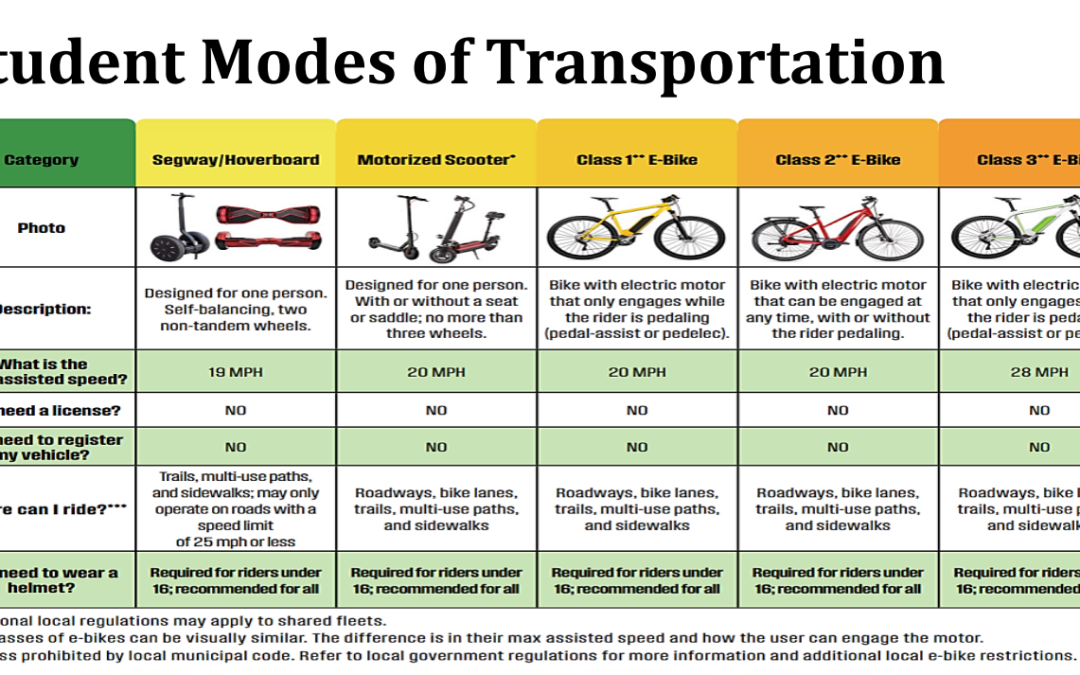
Local officials concerned about electric bike and scooter crashes and near-misses in Winter Park said a new bill is moving in the right direction to improve safety.
The Legislature unanimously passed Senate Bill 382 this month. The bill is awaiting Gov. Ron DeSantis’ signature in order to become a law and go into effect.
State lawmakers said the bill is necessary following a series of crashes across the state that killed young people.
“While nothing can undo the tragedies that brought us here, I believe some good will come out of this,” said state Rep. Yvette Benarroch, R-Marco Island, fighting back emotion on the House floor before the final vote on March 9. Benarroch had sponsored the House companion bill.
SB 382 would set in motion a statewide task force to create recommendations by Oct. 1 related to how to regulate “micromobility devices” like e-scooters and e-bikes that travel slower than cars but faster than pedal bikes. The task force would report back to DeSantis, Florida Senate President Ben Albritton and Florida House Speaker Danny Perez.
Orange County School Board Member Stephanie Vanos, who represents Winter Park in District 6, called the bill “a good first step” but added one concern is the task force is missing school leaders’ voice.
Vanos had urged lawmakers to pick an educator to join the task force since so many e-bike and e-scooter users are children to and from school.
“This is an issue really affecting the schools the most,” Vanos said.
But lawmakers ignored her request after she testified in Tallahassee during the 60-day legislative session.
The members of the task force will instead include representatives from the Florida Sheriffs Association, the Florida Police Chiefs Association, Florida League of Cities, Florida Association of Counties, someone from the medical field with experience treating pedestrian injuries and a representative from an organization focused on rider safety.
Vanos said she hopes the task force recommends how to better educate young riders, which she called an essential element for improving safety.
Children currently are not required to go through rider safety training and don’t need any certification or permit to use an e-bike or e-scooter. Some as young as elementary or middle school are driving them.
One provision in SB 382 had been stripped out from the final bill version that would have required a valid learner’s drive license or driver license for anyone to ride a Class 3 e-bike, which goes up to 28 mph.
Orange school officials discussing that issue had raised concerns about how schools would know if student e-bike riders had the right credentials and also brought them to school every day, Vanos said.
Orange County government is scheduled to discuss e-bike safety at a May 19 work session and has been working with the school district, Vanos added.
Vanos also hopes the state task force tackles recommendations for making infrastructure improvements, like wider sidewalks so riders and walkers have more room to co-exist.
Under the bill, Winter Park Police Department would be required to start documenting e-bike and e-scooter crashes to help the state officials better understand the scope of the problem.
Currently, law enforcement agencies report the crashes differently, making it difficult to get uniform statistics statewide.
All local police departments and sheriff’s offices around the state, as well as the Florida Highway Patrol, would need to report each crash’s date, time, the micromobility device rider’s age, if he or she had a valid Florida learner’s driver license or regular license and more.
Vanos praised the bill for trying to collect more data.
“That’s a really good first place to start,” Vanos said. “What do the accidents look like? Where are they? What are the ages of the children? What time of day? … What type of micromobility device are we seeing the most accidents on? I do think that those are important things.”
Finally, the bill would also allow police to issue $30 nonmoving traffic violations if an e-bike goes faster than 10 mph on a shared path with pedestrians 50 feet away. E-bike users would also be required to yield to pedestrians and give an audible warning before passing them.
If the bill is signed into law, “it doesn’t change the way we police them, but it does change the fact that we can ticket them now,” said Winter Park High School Resource Officer Lindsey Ellison. “It gives us more enforcement which is something that we do need because there are unfortunately bad eggs out there that choose to not abide by the law. This gives us more ammunition to give them consequences.”
Ellison said the fines put more pressure on parents to be vigilant that their children obey the law.
At his job, Ellison looks for rule breakers and is known for keeping a snack stash to pass out to hungry teens. Regularly, he reminds students to wear their helmets and slow down. Usually every week, he gets a complaint about an e-bike or e-scooter from a pedestrian who said one zoomed past her on the sidewalk or a teacher driving to school who was cut off by one.
The problems mounted as e-bikes and e-scooters have skyrocketed in popularity in the past few years.
If 200 Winter Park High students ride bikes and scooters to school, about 90 of them are electric, Ellison estimated. Ellison added they are owned by students, so the devices are not the kind you can rent around town.
“The reason they want to pass bills like this is to keep people safe. It isn’t to add more regulations and more red tape for you not to buy these e-bikes,” Ellison said of SB 382. “We want people to buy e-bikes, we want them to enjoy them. We just want them to do it as safely as possible.”
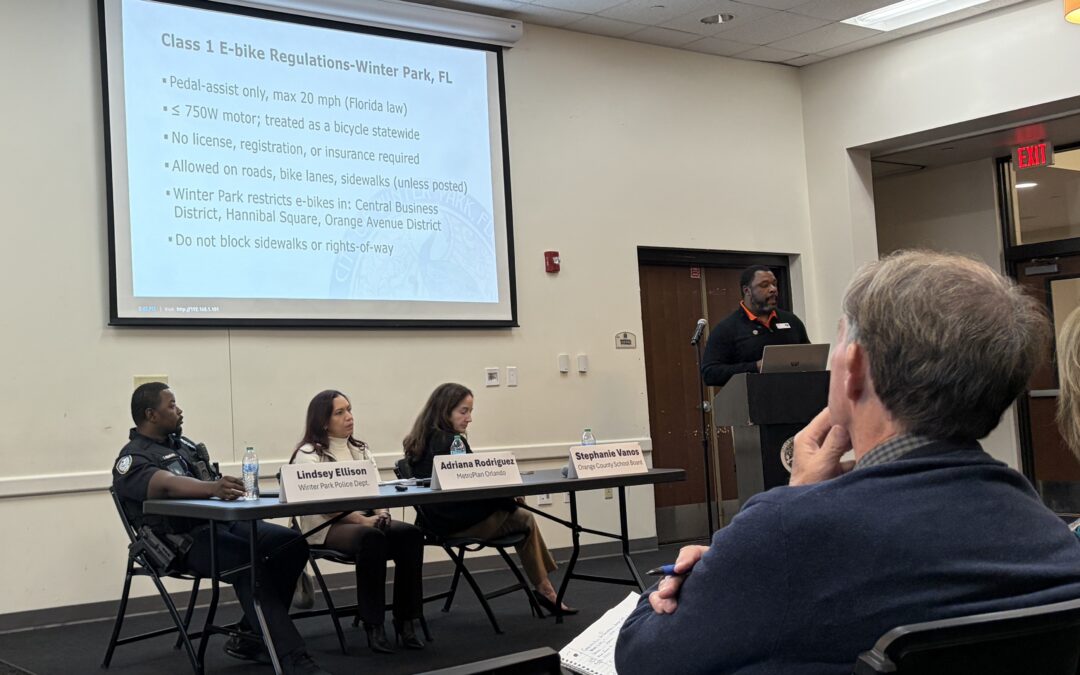
Vanos, Ellison and MetroPlan Senior Transportation Engineer Adriana Rodriguez spoke at a recent Winter Park community meeting to help parents better understand the rules, the dangers and the different types of micromobility devices.
MetroPlan is launching a pilot program this year to pay for online e-bike safety training for 500 students in Orange, Osceola and Seminole school districts. No Winter Park schools are currently involved, but Rodriguez said she hopes the pilot program will expand so more young people can participate and learn how to ride safely.
She added the public can also pay $34.95 to sign their children up for the same training through the American Bicycle Education Association.
AdventHealth Winter Park does not track the number of e-bike injuries, but one doctor said medical professionals are treating head injuries, upper extremity fractures and abrasions as the most common injuries from crashes “As an emergency medicine physician, I’ve seen firsthand how important helmets are,” said Dr. Mitchell Maulfair, the Winter Park hospital’s director of emergency services, in a statement. “As e-bikes have become more popular, it’s important to remember that they’re capable of higher speeds, which can increase the risk of injury if riders aren’t taking proper precautions.”
WinterParkVoiceEditor@gmail.com
To comment or read comments from others, click here →
by Beth Kassab | Feb 25, 2026 | News, Police and Public Safety
Police Seek More Info on Winter Park's First Homicide in Years
A man was found with a gunshot wound on Railroad Avenue on Feb. 17 and died after he was transported to a hospital
Feb. 25, 2026
By Beth Kassab
Winter Park Police say an individual “involved in the shooting” of an 18-year-old man in Winter Park last week has come forward, though no arrests have been made as police continue the investigation.
A woman who lives on Railroad Avenue called police just before 2 a.m. on Feb. 17 after what she thought might be the sound of gunshots woke her out of bed. She said she looked out her window and didn’t see anything and also texted several neighbors, but they didn’t respond immediately because of the early morning hour.
She told the dispatcher that she heard “a whole bunch of gunshots and then someone just drive off,” according to a recording of the call that redacted the woman’s name. She estimated she heard four or five loud pops.
Police responded and found the victim, J’Vion Raishon Giorgio May-Taylor, with a gunshot wound and unresponsive on the ground in front of a building on Railroad Avenue, on the far west side of the Winter Park Nine Golf Course near the corner of Pennsylvania and Webster avenues. Officers started chest compressions and used an automated external defibrillator on the 18-year-old before paramedics transported him to a local hospital, where he died, according to an incident report.
Officers canvassed the neighborhood, but the portion of the report that describes any findings is redacted because police said the investigation is ongoing.
Police Chief Tim Volkerson said the homicide is the city’s first in at least four years.
Police are still seeking help from anyone who may have information about what happened. You can remain anonymous and call CRIMELIME at 1-800-423-TIPS (8477) or provide an online tip at www.crimeline.org
WinterParkVoiceEditor@gmail.com
To comment or read comments from others, click here →
by Beth Kassab | Feb 20, 2026 | City Commission, County News, Police and Public Safety, Schools
New Rules for Electric Bikes and Scooters In the Works for School Campuses
Winter Park residents turned out to a community meeting this week to hear an update on safety as complaints about the fast motorized devices have soared. Orange County schools are considering new rules
Feb. 20, 2026
By Tilly Raij
With new rules at the state and school district levels still uncertain, about two dozen people gathered this week to discuss how to make electric bikes and scooters safer in Winter Park.
City Commissioner Craig Russell led the community meeting Tuesday and walked residents through a primer on current regulations and etiquette that could reduce accidents and close calls on sidewalks and roads.
“If you don’t know how to operate the device, my suggestion is don’t get it for your 8-year-old,” said Russell, who is also a teacher and coach at Winter Park High School. He said he has seen students injured on the electric devices.
He emphasized that parents often don’t know the rules when their children begin riding.
The meeting followed increasing complaints from residents about people riding bikes and scooters too fast and recklessly on roads and sidewalks, especially near school campuses.
Orange County School Board member Stephanie Vanos, who also spoke at the meeting, said new rules could be on the horizon across the district.
She said options under discussion include requiring parents and students to take a class and sign an agreement related to riding and parking on campus, similar to the agreements high school students sign to drive and park cars on campus.
Vanos, who represents Winter Park in District 6, said students would receive a sticker to place on their device to show they participated in the training. Faculty members also have communicated with students about electric scooters and bikes.
“Right now, no, there is no requirement that students have to take any kind of education, or parents, but I will say that at many of our schools, particularly some of our middle schools and high schools, the principals are sharing information on e-bike safety and scooters with the students,” Vanos said.
Earlier this month, the school board heard a presentation noting survey results that show nearly 12,000 students ride bikes or scooters to school in Orange County. While most schools require students to walk their devices on campus, only about half issue violations to those who fail to do so.
In addition to permit stickers, district staff members recommend adding rules to the Code of Conduct and installing new signs on campuses requiring students to dismount bikes and scooters.
Last year, the school board held a discussion and presentation on the soaring popularity of bikes and scooters. Since 2017, electric scooter injuries in the U.S. have surged by 400%, with Florida ranking among the top states in emergency room visits for such injuries, staff members told the board at a November work session, citing data from the Consumer Product Safety Commission. Accidents involving children younger than 15 have more than doubled since 2023.
Russell’s presentation this week also covered rules governing e-scooters and e-bikes in certain areas of Winter Park. The devices cannot be ridden on sidewalks in the Park Avenue area known as the Central Business District, Hannibal Square and the Orange Avenue Overlay District.
Carelessly transitioning from sidewalks to roads, crossing crosswalks without looking for oncoming vehicles and ignoring pedestrian signals are among the most frequent safety concerns involving local riders, he said.
Russell shared best practices and described the “Be KIND” acronym for remembering how to properly operate an electric scooter or bike. The letters stand for “keep your eyes up, initiate courtesy, navigate safely and do the right thing.”
Adriana Rodriguez, senior transportation engineer for MetroPlan Orlando, told residents the organization is working with the American Bicycling Education Association to create a series of educational modules aimed at 500 students ages 12-15. Topics will range from safety to road rules and will incorporate graphics and illustrations, ending with a quiz. Students will receive a certificate of completion, and the results will be analyzed by grade level to determine whether the initiative should be expanded.
With about three weeks left in the regular session of the Florida Legislature, officials also are waiting to see whether new state laws emerge.
Proposals — Senate Bill 382 and House Bill 243 — that initially would have required licenses for certain classes of electric bikes have been scaled back to create a safety task force and include provisions such as: “A person operating an electric bicycle on a sidewalk or other area designated for pedestrians may not operate the electric bicycle at a speed greater than 10 miles per hour if a pedestrian is within 50 feet of the electric bicycle.”
Provisions related to motorized scooters were removed from the proposals.
Russell said education will remain essential to improving safety.
“Our goal is simple — to keep our kids safe, our sidewalks safe and our community involved,” he said.
WinterParkVoiceEditor@gmail.com
To comment or read comments from others, click here →
by Beth Kassab | Jan 27, 2026 | News, Police and Public Safety, Uncategorized
Police Release Image of Possible Suspect in Winter Park Church Fire
Police asked the public for information in the case of a person who cut down a banner with a rainbow flag on the lawn of First Congregational Church of Winter Park and set it on fire near the church doors
Jan. 27, 2026
By Beth Kassab
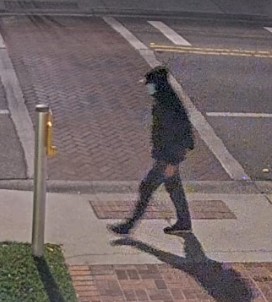
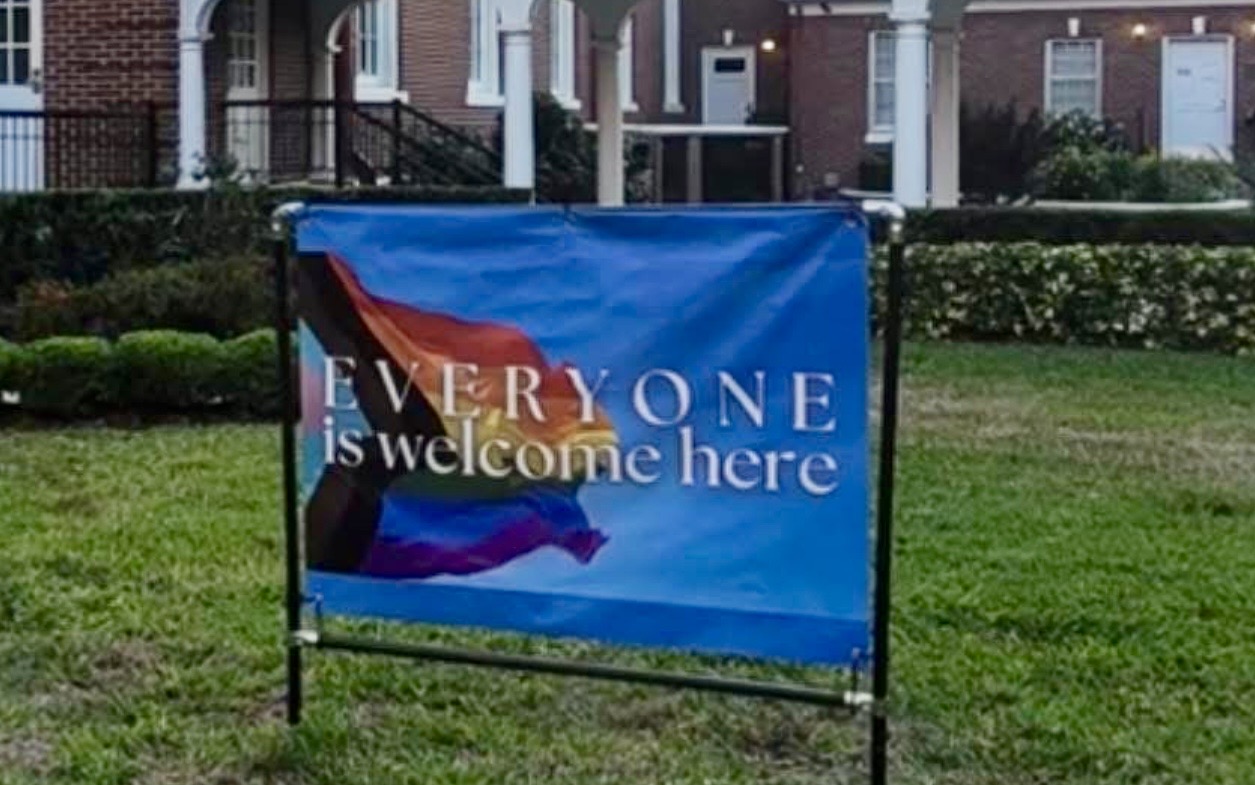
The Winter Park Police Department on Tuesday released an image captured from surveillance video that shows a possible suspect in the fire set at First Congregational Church of Winter Park that targeted a banner that said “Everyone is welcome here” over a sky blue background with a rainbow flag.
The photo appeared to show a man on a sidewalk in dark clothing wearing a hat and possibly a face mask. The man is also wearing dark shoes with white soles. It wasn’t clear from the information released by the police department where the image was captured or when.
An image released by police shows a potential suspect in the church fire that burned a welcome banner.
The department did not address why it waited a week since the fire that left a pile of ash and minor damage on the eastern double doors of the church to solicit help from the public in identifying a suspect.
“All avenues of investigation are being followed to identify the suspect and determine if the crime committed had a biased-based motive,” a release from the department stated.
Florida statutes call for tougher penalties on misdemeanors and felonies if there is evidence the defendant acted out of hate or prejudice based on the “race, color, ancestry, ethnicity, religion, sexual orientation, national origin, homeless status or advanced age of the victim.”
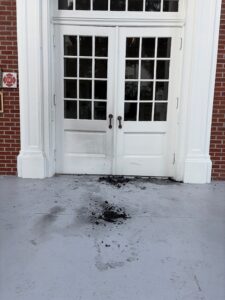
A pile of ash and smoke and heat damage can be seen at the church doors after the banner was set on fire. (Photos courtesy of First Congregational Church of Winter Park)
On Sunday, Senior Minister Shawn Garvey delivered an emotional sermon with a number of notable community members in the pews to show solidarity with the church such as Anna Eskamani, who represents Winter Park in the Florida House, former Mayor Steve Leary, who recently ran for Orange County commissioner, and a number of officials from Rollins College and the Mayflower, a senior community.
Garvey read a statement from Orange County Mayor Jerry Demings that said, in part, “though they destroyed the sign, they can never destroy what’s in your heart.”
Garvey told the congregation that, a times, the church’s long history of social justice work and Christian teachings are principles that “sometimes bring the heat, literally.”
“Bring it …,” he said. “…. If the building disappears, we’ll meet somewhere else. Who cares? They won’t break us.”
Garvey said the church’s newly installed surveillance cameras captured the suspect “making a beeline” toward the welcome banner just before midnight on Jan. 20. The church is widely known for its acceptance and support of the LGBTQ community often represented by the rainbow flag on the banner.
The video shows the person cutting down the banner and bringing it to the church doors before setting it on fire.
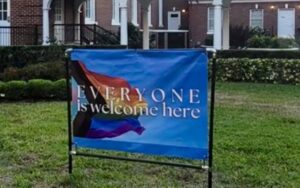
The banner stood on the lawn of First Congregational Church of Winter Park since about Easter until it was cut down and set on fire last week.
A police report released Tuesday says an unidentified witness called police about 11:50 p.m. after smelling smoke and seeing the fire while walking to the Alfond Inn, which is just across Interlachen Avenue from the church.
The fire was quickly extinguished and city Fire Marshal Jim Santoro and Det. Daniel Fritz from the state Bureau of Fire, Arson and Explosives arrived to investigate.
Santoro told the Voice that the state bureau along with Winter Park Police would take the lead in the investigation. He said the fire appeared intentionally set, though it wasn’t immediately clear what was used to start the fire.
He said such cases are unusual in Winter Park.
“This is not very common,” Santoro said. “We probably only get something like this every couple or three years and I’ve never seen one exactly like this and I’ve been with the department 36 years.”
The police report listed potential charges of attempted arson, petty theft and damage to church property.
Police are asking anyone who has any information about the incident to contact Winter Park Det. R. Budde at 407-599-3658 or Crimeline at 800-423-TIPS(8477).
WinterParkVoiceEditor@gmail.com
To comment or read comments from others, click here →
by Beth Kassab | Jan 24, 2026 | News, Police and Public Safety, Uncategorized
Winter Park Church's 'Everyone is Welcome' Banner Cut Down and Set on Fire in Apparent Hate Crime
The incident at First Congregational Church of Winter Park happened earlier this week and appeared to target the church’s welcoming stance toward LGBTQ rights
Jan. 24, 2026
By Beth Kassab
A potential hate crime is under investigation after a banner in front of First Congregational Church of Winter Park with the words “Everyone is welcome here” on a sky blue background and a rainbow flag was cut down by an unidentified man with a knife, placed at the sanctuary door and lit on fire.
The incident happened just before midnight on Tuesday and was caught on security camera footage, said Senior Minister Shawn Garvey, who said he was grateful that a passerby noticed the flames just a few minutes later and called Winter Park Fire Rescue.
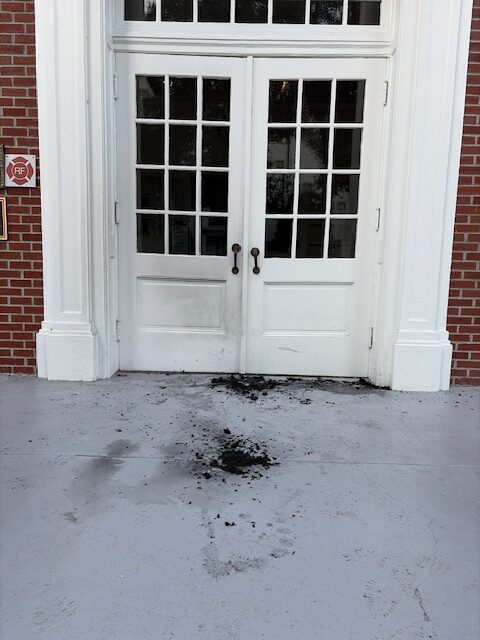
A pile of ash remained in front of the doors to the church after the banner fire was extinguished by Winter Park Fire Rescue. (Photos courtesy of First Congregational Church of Winter Park)
“The Fire Department was right there and put it out quickly,” he said. “It could have been worse … at that time of day nobody was on property.”
A pile of ash was left in front of the smoke-stained and heat-damaged white double-doors of the sanctuary. The empty frame that held the banner still stood on the church’s lawn along Interlachen Avenue.
Winter Park Police are investigating, he said, what appeared to be a hate crime against the church’s open and supportive message toward LGBTQ members and the larger community. Winter Park Police could not immediately be reached for comment on Saturday.
The church first added the banner to its lawn around Easter of last year.
“Regrettably in the history of our church, dealing with expressions of hate like that are nothing new,” Garvey said.
The Ku Klux Klan burned a cross on the lawn of the church’s former parsonage (across the street from where the Alfond Inn stands today) in the early 1950’s in response to a sermon that made a case for desegregation in Florida. The church was founded 1884 by New England abolitionists as part of the United Church of Christ, and its members founded Rollins College. It served as a gathering spot for Rollins President Hamilton Holt and Civil Rights leaders like Harry T. Moore and Mary McLeod Bethune to rally against segregation.
More recently, Garvey said, the church saw 50 people line its sidewalk during worship about eight years ago to protest the church because members supported the right to abortion and other reproductive rights. And in the wake of the killing of George Floyd by a Minneapolis police officer in 2020, he said he received angry phone calls about a sign at the church that expressed solidarity with those impacted by Floyd’s death.
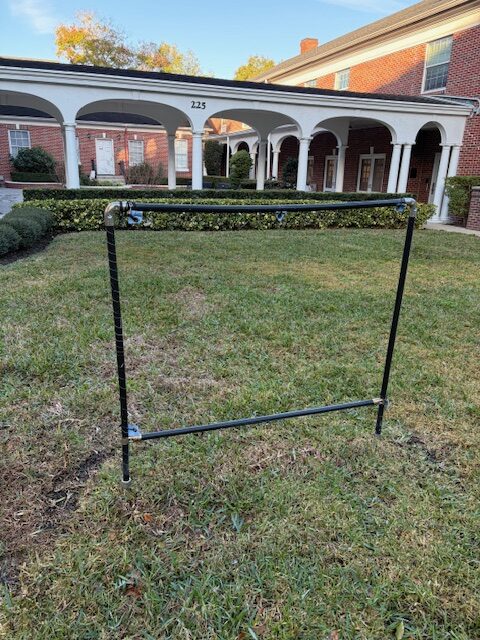
An empty frames stands in front of the church from where the “Everyone is welcome here” banner was cut down.
Garvey said the church’s social justice history is an important part of its fabric.
“Even though it’s sometimes scary and upsetting we still feel called to follow that history,” he said of the congregation that has about 350 members. “The gospel of Jesus speaks strongly to being a voice for the voiceless.”
The church’s web site states that “all of the baptized ‘belong body and soul to our Lord and Savior Jesus Christ.’ No matter who – no matter what – no matter where we are on life’s journey – notwithstanding race, gender, sexual orientation, class or creed – we all belong to God and to one worldwide community of faith.”
More than 140 years into the church’s history, he said, some core challenges remain the same.
“As far as we’ve come and all the work we do, hate is just hate and insecurity is insecurity,” he said.
The video footage captured Tuesday by new security cameras the church installed just weeks before does not show a clear image of the face of the man who cut the banner, which had stood on the church lawn since Easter, and lit the fire. He was wearing a black baseball cap.
He appeared to approach the church on foot from the north and walked directly toward the banner. When a car passed by, he appeared to briefly pretend to be on his phone, before continuing toward the banner where he cut it with a knife and then approached the sanctuary doors to light the fire, Garvey said.
At Sunday’s service, Garvey plans to address the incident and share a number of supportive messages, including one from Orange County Mayor Jerry Demings, he’s received in recent days.
He said people are expressing heartbreak and anger over what happened. But also pride at the church’s presence in the community.
During times like this, Garvey said, the church can “often feel like an island, but we’re not.”
The membership will take up a discussion to determine how or if the “Everyone is welcome here” banner is replaced.
“In our years together since I came to be with you, we’ve gone through a lot,” he told the congregation in an email on Friday. “Through all of it, we have remained strong and grown stronger in our faith and in our commitment to one another. This week is yet another thread of the ongoing tapestry of what we truly are as this church and always have been throughout our history here in Winter Park. We will continue to be the inclusive, loving presence of God as we know it through Jesus and not allow events like this week to deter or frighten us.”
WinterParkVoiceEditor@gmail.com
To comment or read comments from others, click here →

by Beth Kassab | Jan 15, 2026 | Arts and Culture, City Commission, News, Police and Public Safety, Schools
Have Complaints about Electric Scooters and Bikes? Meeting Scheduled for Next Month
Plus Blue Bamboo’s leader offered a short update on the group’s financial status in the wake of multiple changes at the organization operating at the city’s old library
Jan. 15, 2026
By Beth Kassab
Residents who have questions or concerns about safety related to electric bikes and scooters, which have soared in popularity in recent years, are invited to attend a community meeting at Winter Park Community Center on Feb. 17 at 5:30 p.m.
The meeting comes in the wake of a rising number of accidents and concerns surrounding the motorized devices that are increasingly common in and around school campuses.
Commissioner Craig Russell, who is also a teacher and coach at Winter Park High School, has taken the lead on the topic with a series of safety videos aimed at students and parents and, now, plans for a larger community discussion.
Russell said at Wednesday’s City Commission session that the meeting in February will be about sharing the facts and providing any available updates on the Legislative session, where a proposal (HB 243 and SB 382) is being debated that would put more regulations on e-bikes and scooters and their often young drivers.
“I just want to continue with our public safety effort,” Russell said. “It’s not going to be me telling parents what to do. It’s an informational session.”
The Voice reported last month that Orange County School Board members tossed around potential new regulations such as requiring licenses, training and speed limits at a meeting in November.
Since 2017, electric scooter injuries in the U.S. have surged by 400%, with Florida being a top state in emergency room visits for such injuries, staff told board members, citing data from the Consumer Product Safety Commission. These accidents have more than doubled since 2023 for children under 15.
Update on Blue Bamboo
Commissioners heard an update on Wednesday from Jeff Flowers, who is leading the Blue Bamboo Center for the Arts project that is leasing the city’s old library building.
The group’s founder Chris Cortez died last month after a short illness with glioblastoma, the most aggressive form of brain cancer.
Flowers, a chemist and arts philanthropist who served two stints on the Maitland City Council, noted the challenges the group has faced with the loss of Cortez and difficulty finding tenants for the second and third floors of the building. He said there have been three “very serious” sublease prospects, but no deals yet.
“We are in serious discussions now with another,” he said. “It’s not there yet, but it looks good.”
He said the Blue Bamboo tallied 8,300 people attending shows over the past six months and $180,000 in ticket sales. He said revenue totaled about $340,000 including concession sales and donations.
The Blue Bamboo is required to pay the city $132,000 a year in rent for the building, an amount scheduled to rise to $276,000 next year, according to the lease agreement.
The group has access to a $900,000 grant from Orange County for additional work on the building, but is required to raise matching funds and was counting on help in the form of fundraising and rent from Central Florida Vocal Arts before that group walked away from the deal in August when it was not satisfied by the terms of the sublease offered by Blue Bamboo.
Flowers has loaned Blue Bamboo more than $1 million so far to retrofit the first floor of the building into a performance space and other work.
“The message is look, the Blue Bamboo is here to stay,” Flowers told the commission. “We’ve surmounted every barrier thrown at us.”
Mayor Sheila DeCiccio thanked Flowers for appearing at the meeting and quickly moved on to the next topic after no other commissioners offered any comments or asked any questions.
WinterParkVoiceEditor@gmail.com
CORRECTION: The original version of this story included the wrong location and time for the meeting on e-bikes and scooters. The meeting will be held at Winter Park Community Center at 5:30 p.m.
To comment or read comments from others, click here →

Recent Comments