by Beth Kassab | Jul 29, 2026 | County News, Police and Public Safety, Schools
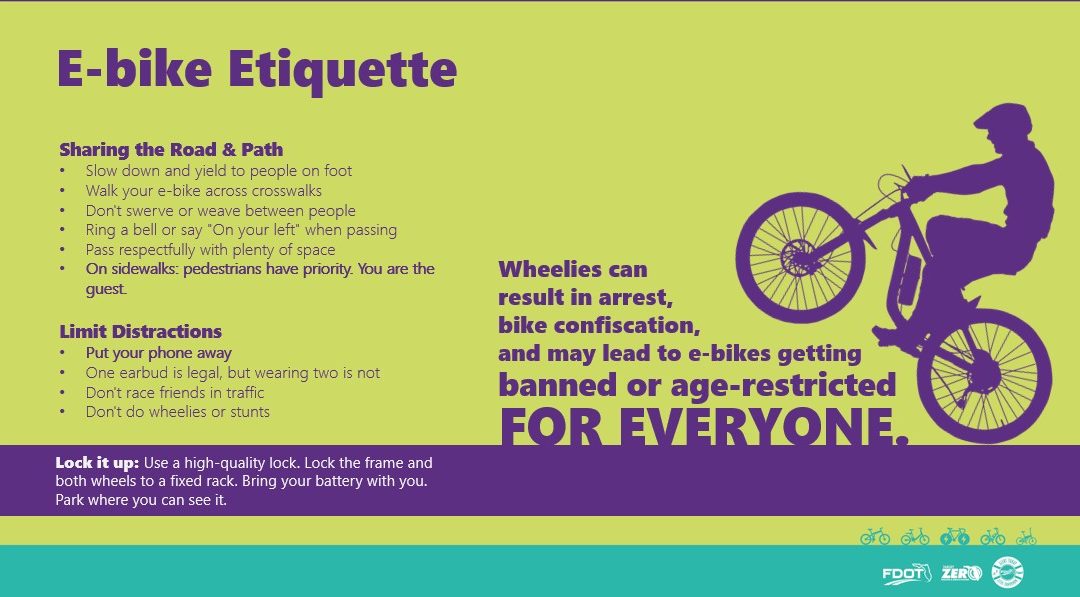
Orange Schools Ban E-Bikes and E-Scooters Unless Students have Driver's License or Permit
The change voted on this week prompted pushback from parents who say their students rely on the devices. Winter Park is drafting its own ordinance related to electric bikes and scooters.
July 29, 2026
By Gabrielle Russon
Two weeks before the new school year starts, the Orange County School Board voted Tuesday to ban kids from riding e-bikes and e-scooters unless they have learner’s permits or driver’s licenses.
The school board’s unanimous vote Tuesday came after a divided debate where school board members insisted the new rules are necessary to stop the rising number of crashes and protect children. Meanwhile, some parents and students argued the board is overstepping its bounds with a new policy that will make it harder for kids to get to school.
“This is one of the hardest decisions to make, and I think because there are so many strong compelling arguments on both sides,” school board chair Teresa Jacobs said.
Critics called the policy rushed since the first day of school is Aug. 11, giving families little time to prepare.
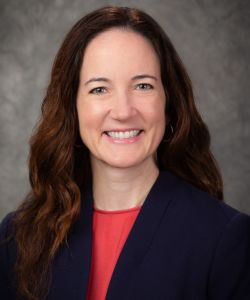
Stephanie Vanos represents Winter Park schools.
“I’m here to ask you to slow down before making a decision that could have unintended consequences for many families. Micromobility devices are a vital form of transportation for many students,” said parent Heather Grimmer who lives in Avalon Park. “We all want to protect our children, but protecting them doesn’t mean always taking something away.”
School board member Stephanie Vanos, who represents Winter Park schools, argued the school board held four public meetings over the last year on the issue ahead of Tuesday’s vote.
“This has been a thoughtful and deliberate process,” Vanos said. “I would be surprised if anybody on this board actually wants to ban micromobility devices. I don’t think anybody does.”
But Vanos contended the district is “forced into this” because state and local cities and Orange County haven’t taken action to regulate the devices.
“The reality is we’re here now and school is starting and there’s nothing in place,” Vanos said.
For school board member Maria Salamanca, the ban will stop elementary and middle schoolers who are too young to drive from having to make split-second decisions on the road when a mistake can lead to a tragedy.
“I cannot in good conscience vote to encourage these devices in our campus,” said Salamanca, who represents Lake Nona schools where a 13-year-old boy was killed after an e-scooter crash on Mother’s Day. “It’s really dangerous.”
E-bikes and e-scooters are a growing concern throughout Winter Park and Orange County. The city of Winter Park is in the process of creating its own ordinance to crack down on reckless riders.
Tuesday’s meeting shows the challenge of regulating the popular devices. Nearly 12,000 OCPS students regularly went to school on e-scooters or e-bikes, according to a district survey in December. About 42% of those students were in middle school, 32% in high school and 26% in elementary school, the survey found.
Nate Clark’s four kids are among those depending on e-scooters since they live too far to walk and too close to catch a bus to Baldwin Park Elementary or Glenridge Middle School, both not far from Winter Park.
“If this passes tonight, I don’t know how they’re getting to school on Aug. 11,” Clark told the school board.
The ban is “unnecessary” and “unfair,” he said, arguing state law treats e-bikes or e-scooters as bicycles — not cars. Why is the district treating them differently?
Other parents urged the school district to focus on teaching safety rules, improving infrastructure or enforcing helmet rules instead of banning them outright from elementary and middle schoolers.
“Let the kids scoot,” said Mike Bustillos, a former teacher who advocates for a more walkable community. “We shouldn’t be removing freedom and mobility options from kids in order to make things more comfortable for cars. Kids today have precious little freedom to roam the way that I did when I was a kid.”
School board members pushed back on the criticism. Before e-scooters and e-bikes existed, working parents found ways to get their kids to school, said school board member Melissa Byrd.
“I do not believe that taking away e-bikes and e-scooters is going to cause students to not be able to get to school,” she said.
Superintendent Maria Vazquez said she supports phasing in the ban for the first month of school to get families time to figure out other transportation options.
Vazquez and school board members also expressed a willingness to revisit the ban later this year.
“I am going to vote in favor of this policy now with the hopes that our counties and cities are going to come up with some great policies and rules and we can go back and revisit this and change it,” Vanos said. “Hopefully that will happen soon.”
WinterParkVoiceEditor@gmail.com
To comment or read comments from others, click here →

by Beth Kassab | Jul 22, 2026 | City Commission, News, Police and Public Safety, Taxes
Winter Park Contends with Higher Police and Fire Costs and How to Maintain Roads
The city’s proposed 2027 budget is also cautious of future cuts to property taxes if voters approve a measure on the November ballot. Winter Park homeowners would save less than $2,000 a year, but the city could ‘lose some of the things that make it feel extra special’
July 22, 2026
By Beth Kassab
The Winter Park City Commission is poised today to adopt the same property tax millage for the 19th year in a row, but the steady rate belies an increasingly complex financial picture for one of the region’s most high-profile cities as it contends with soaring costs for its police and fire departments, a demand from residents for better roads, increasing prices for electric and water customers and a governor and state Legislature looking to slash property revenues.
The All-Funds Budget, which includes the General Fund as well as the utilities and other funds, is proposed to increase this year by nearly 6% to $247 million. The General Fund, which pays for essential services such as police, fire, parks, public works and administration, is growing by about 5% to $94.6 million.
The growth in money collected by the city is being driven by higher bills for electricity, water and stormwater — the result of policy decisions in recent years and up for debate again this year by a City Commission facing big expenses to prevent storm flooding and to continue to underground all of the power lines for the city-owned electric utility. Property taxes remain a driver of growth in the general fund, where the taxes make up just under half of the revenue pie.
City Manager Randy Knight cautioned that a measure on the November ballot initiated by Gov. Ron DeSantis and the Florida Legislature to significantly alter how local governments are funded by reducing property owners’ tax bills could eat into the kinds of services the city provides by 2028, when it is set to take effect if it passes with the required 60% approval from voters.
City officials are forecasting a hit of at least $5.4 million in the first year. Translated into savings for individuals residents, homesteaded property owners would pay about $818 less per year to Winter Park. The total tax savings per year for Winter Park homeowners if the ballot measure passes would be $1,783, including the reduction paid to the city as well as the reductions in taxes paid to Orange County and St. Johns River Water Management District. (Taxes paid to schools would remain unchanged under the tax proposal on the ballot.)
“It will have an impact on city services that will be felt,” Knight said in his annul budget memorandum to the City Commission. “Winter Park will still be able to provide essential services, but the city may lose some of the things that make it feel extra special … A loss of over $5 million is like losing almost half of the Parks Department, so it will not be a small issue to determine how best to prioritize spending, but it is likely that a combination of service reductions and revenue increases will end up balancing the budget in future years.”
With just six months to go before his retirement after decades at the helm of the city and 36 years since he helped prepared his first budget in 1990 as the city’s finance director, Knight was reflective in his final budget memo of past challenges.
“As we face potential impacts from the so-called tax reform, I want to remind you that we have faced tough times before and always endured,” Knight wrote. “The 2004 hurricane season cost approximately $18 million for recovery and wiped out our reserves. The 2008 housing bubble coupled with tax reform resulted in a huge hit on city revenues. The Pandemic shuttered businesses and locked down communities, but we survived and thrived. Today Winter Park is the envy of the region, with commercial properties with the lowest vacancy rates and highest asking rents, exceptional schools, and beautiful walkable residential communities and amenities. Over 3 million visitors come to the crown jewel of downtown Park Avenue each year and our financial reserves have grown to over $24 million.”
A graphic from Winter Park’s proposed budget document shows how money in the General Fund is spent.
But the budget document also described in stark terms how expenses for basic needs like police and fire are simply outpacing revenues.
Record-high pension costs for police officers and firefighters as well as a new labor contract with the Fire Union that included a 12% pay increase in 2026 will account for 70% of new costs in the proposed 2027 budget.
“Of the $4 million in the increase in personnel wage and benefit costs in the General Fund estimated for the next fiscal year, almost a third (30%) is due to increases in public safety pensions for police and fire
retirement plans,” according to the budget proposal.
The city will have to spend $1.2 million more on the pensions, according to the document, the result of “changes in actuarial tables, the addition of new employees and the weak 2022 stock market year that still affects their formulas.”
“Staff is reviewing the possibility of making adjustments to the pension plan in the future to attempt to mitigate this growing cost,” the document said. “With property tax reform on the horizon, having a quarter of the entire annual growth in revenue going solely to public safety pensions, is not sustainable.”
Police pay has increased by nearly 50% in Winter park in recent years and the proposed 2027 police department budget is $23.2 million, up from $14.9 million in 2020. The department will keep a community services position vacant next year to help reduce some costs, according to the proposal. The city has 121 full-time police staff and three part-time staff slated for 2027, up from 115 full-time staff and 13 part-time staff in 2023.
The budget for the fire department is up from $13.2 million in 2020 to a proposed nearly $19 million for next year. The department has grown from 81 full-time staff and two part-time staff in 2023 to 84 full-time staff and three part-time staff.
Winter Park is not alone in what has amounted to an arms race in public safety pay across Florida as departments have struggled to recruit and keep candidates for jobs that require personal risk, physical stamina and no work-from-home privileges in a post-pandemic world where many offices have emptied out.
For example, the pay for a starting deputy at the Orange County Sheriff’s office in 2020 was $49,296, according to the office. By 2025 it was $62,566. That’s in addition to increases in bonuses, the number of paid holidays and minimum compensation for off-duty pay and longevity pay.
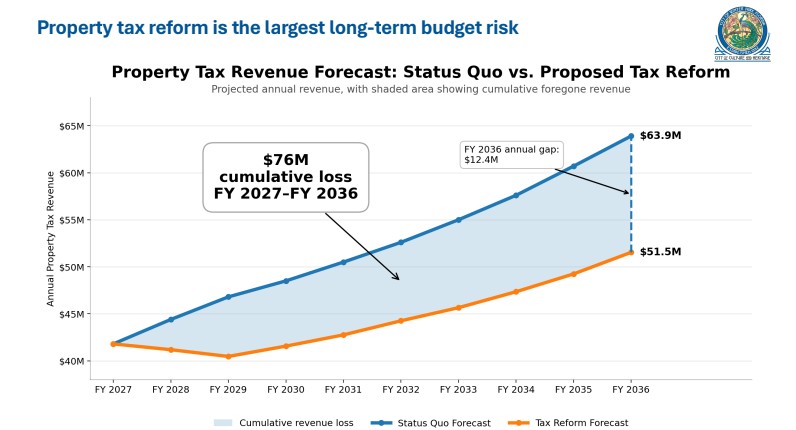
A graphic from the city’s budget presentation shows the potential cumulative effect of the property tax measure on this November’s ballot.
In addition to public safety costs, roads emerged as Winter Park’s other main budget priority this year.
That’s the result of a survey of residents with about 800 responses that identified the quality of both brick and asphalt streets as a major need for improvement.
“This has been an area in which funding has been added in the past, but it has been insufficient to keep pace with the level of street deterioration and the cost of repairs,” read the budget memorandum.
The budget includes more money for contractors to resurface roads and doubles the amount for road materials with an additional $500,000. Winter Park has fallen short of its own goal of redoing 9 lane miles o road each year, typically completing just 4 or 5 lane miles with the exception of in 2025. The new goal will be to achieve repaving of 7.5 lane miles each year.
City Commissioners are slated to vote on the property tax rate this afternoon. More discussion and debate over the full proposed budget is scheduled for August with a final budget vote in September before the start of the new financial year in October.
WinterParkVoiceEditor@gmail.com
To comment or read comments from others, click here →

by Beth Kassab | Jul 9, 2026 | News, Police and Public Safety, Schools
Orange School Board Looking to Ban Electric Scooters and Bikes at Elementary and Middle Campuses
Talk of the proposed ban came this week as cities like Winter Park are attempting to finalize their own micromobility ordinances ahead of the start of the school year
July 9, 2026
By Gabrielle Russon
Orange County Public Schools board members appear poised to ban electric bikes and scooters at elementary and middle schools while only allowing high schoolers with driver’s licenses to ride them.
The board met during a Tuesday workshop to discuss a proposed policy as cities like Winter Park are also crafting new rules aimed at stopping more crashes from happening. The school board did not take any action Tuesday but could vote on the final policy at a July 28 meeting ahead of the 2026-27 school year in August.
“If we can do something to make our community safer, I believe a ban on micromobility devices coming to and from school is a way to do that,” said Board Member Melissa Byrd.
Board Member Angie Gallo, who is running for chairwoman of the school board, called banning them at elementary school “an absolutely no-brainer” but was more hesitant about prohibiting high school students because she feared it might be government overreach.
“We’re banning something that their parents bought for them,” said Gallo, adding she needed more time to make her decision before she supported restrictions for teenagers.

Angie Gallo
Banning e-scooters and e-bikes for just elementary students but not middle school students could be a “hot mess” in the handful of K-8 schools across the district, added board Member Alicia Farrant who is also running for the board chairwoman role and supported only allowing high schoolers with driver’s licenses to ride them.
Outgoing Gov. Ron DeSantis vetoed a bill last month that some viewed as a first step in addressing the problem. The Legislature does not reconvene until March, so local governments and schools are moving ahead to set their own policies and ordinances without guidance from the state.
Winter Park city commissioners voiced support again at their own meeting this week for adopting their own ordinance before the start of the school year in August, though the proposal hasn’t been finalized yet.
Commissioner Craig Russell, who works at Winter Park High School, said he hopes Winter Park can help set a standard for the state with rules that enforce safety without leaving kids with traffic citations on their records. Winter Garden, in West Orange County, already has an ordinance in place that affects the West Orange Trail that runs through its downtown.
For 90 minutes, OCPS school board members debated what was the appropriate age to allow riding e-bikes and e-scooters. Some questioned who should take the first step to regulate the electric devices — the school district, local governments or the state?
“We can’t control the sidewalks or the roads leading up to the campus,” said Gallo, who supported the district’s push to educate students on road rules. “In my mind, this is a county and a city issue that they need to deal with and provide ordinances that we would follow along with and adhere to. But just us banning them, I don’t think that that makes kids more safe on the roads as they move around Orange County.”
Board Member Stephanie Vanos, who represents Winter Park schools, agreed that the district should lean on local governments to lead on policy decisions. However Vanos viewed the safety situation as too urgent not to act now.
“I’m also honestly just not willing to wait for it,” Vanos said.
In the wake of DeSantis vetoing the bill, Farrant said the district should take the lead.
“We can either point fingers or hope somebody else does it,” Farrant said. “We need to rise up as leaders and do what we can to do our part.”
“We still can only lead so far,” OCPS Board Chair Teresa Jacobs countered as she said she hoped the state would pass a law. “An electric vehicle ought to be regulated similarly to a car.”

The recommendations were discussed at an Orange County School Board work session earlier this week.
Stephanie Vanos
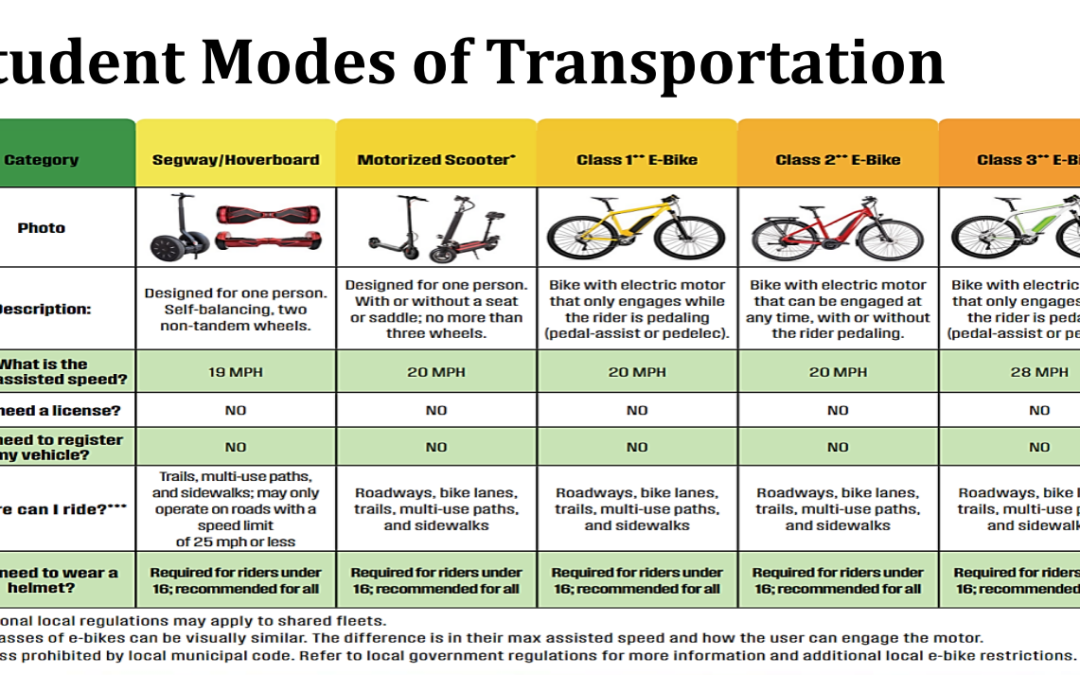
OCPS’ proposed policy would also completely ban modified or Class 3 e-bikes that go faster than 28 miles an hour.
Charging the devices on campus would also not be allowed for safety and fire prevention.
The older students eligible to ride e-bikes and e-scooters would need to register with school administrators.
Superintendent Maria Vazquez warned it would be up to school staff to enforce the rules and oversee the permits.
“I’ve had a few conversations with some principals that see this is going to be a burden because they do not have the staff to follow through and monitor this the way it needs to be,” Vazquez said.
The district will also need to add better signs and more storage and parking for students to park their e-bikes and e-scooters as well as create a safety video.

Alicia Farrant
“From an education standpoint, we are developing a comprehensive informational video for parents and students to improve awareness and micromobility safety, district expectations and responsible use of e-bikes and e-scooters,” said Joe Silvestris, the district’s senior director of the safety and emergency management department.
Some school board members were skeptical the district’s proposed policy could meaningfully solve the problem on campuses.
“Who is regulating it? Who is standing at the door ensuring that the kids riding up have the permit?” Farrant said. “When I’m going out and about, the kids are running through stop signs as if they own the road. … I don’t know that a little video is going to really fix the problem.”
OCPS’ action comes as school districts across the country and state are tackling the issue in different ways, Silvestris said.
Some districts have banned e-bikes and e-scooters completely while others prohibit the class of high-speed electric devices, he said. Schools that allow them require students to dismount on campus entrances and walk them to parking storage areas, he added.
“Schools are experiencing significant increase in student use of e-bikes, e-scooters, and other micromobility devices,” Silvestris said. “This rapid growth has contributed to a rise in injuries and near-miss incidents on and off our school campuses.”
Already the district drafted an incident reporting and data tracking process to better understand the scope of the problem at OCPS and established a working group with principals to share feedback and look at the challenges, Silvestris said.
Orange County and city of Orlando representatives attended Tuesday’s school workshop with Jacobs saying, “Our entire community has a stake in this.”
WinterParkVoiceEditor@gmail.com
To comment or read comments from others, click here →
by Beth Kassab | Jul 3, 2026 | City Commission, News, Police and Public Safety
Safety Rules for Electric Bikes and Scooters Vetoed by Gov. Ron DeSantis
Improving safety regulations, especially near schools, is a priority in cities like Winter Park where officials have already begun drafting their own ordinance
July 3, 2026
By Gabrielle Russon
Some local officials expressed surprise and frustration after Gov. Ron DeSantis recently vetoed a bipartisan bill considered an important step in tackling the epidemic of electric bike and scooter crashes.
DeSantis’ decision came less than two months after a 13-year-old boy was killed in Orlando’s Lake Nona area while riding his e-scooter to buy Mother’s Day flowers.
Without a statewide safety law, rules will fall to local governments like Winter Park, which has already begun drafting an ordinance that city officials say they want in place before the start of the school year in August.
Roads near schools are of particular concern to local officials because so many students use e-bikes and e-scooters on a daily basis.
“We know they’re dangerous. We know they’re killing students. And so I’m not sure why we needed to delay taking any action knowing how dangerous they are. … All of us were hoping that we would get some guidance from the state,” said Orange County School Board Member Stephanie Vanos, who represents Winter Park. “It just doesn’t seem like the governor cares all that much about what’s happening to our kids.”
School Board members are scheduled to discuss what to do next at a Tuesday work session.
Senate Bill 382 won unanimous approval from the Legislature in March, but DeSantis has expressed concerns it could lead to more police surveillance and bring unintended consequences.
“What it will lead to is more surveillance of people by law enforcement and we don’t need that. I think there were problems with it,” DeSantis said when he spoke to journalists late last month during a press conference. “Certainly, I don’t want to do anything that’s going to lead to more surveillance.”
Winter Park City Commissioner Warren Lindsey said he would prefer cities draft the new regulations for their specific needs instead of the state imposing one set of rules for all of its 23 million people.
“My opinion is that it’s better to regulate that by local ordinance rather than state statute,” Lindsey said. “In a time when you’ve got preemption, where the state’s taken away local governments’ ability to regulate anything, this one is good because what works in Winter Park may not work in Maitland. What works in Winter Park may not work in Orlando or Ocoee so I’m in favor of local ordinance.”
Winter Park is developing an e-bike and e-scooter ordinance with the goal of rolling it out before school starts on Aug. 11, said Lindsey, who was the only city commissioner who responded to an interview request for this story.
Some of the potential regulations could include setting a speed limit for e-scooters and e-bikes on sidewalks, increasing the helmet age requirement from 16 to 18 years old and imposing fines for those who break the rules.

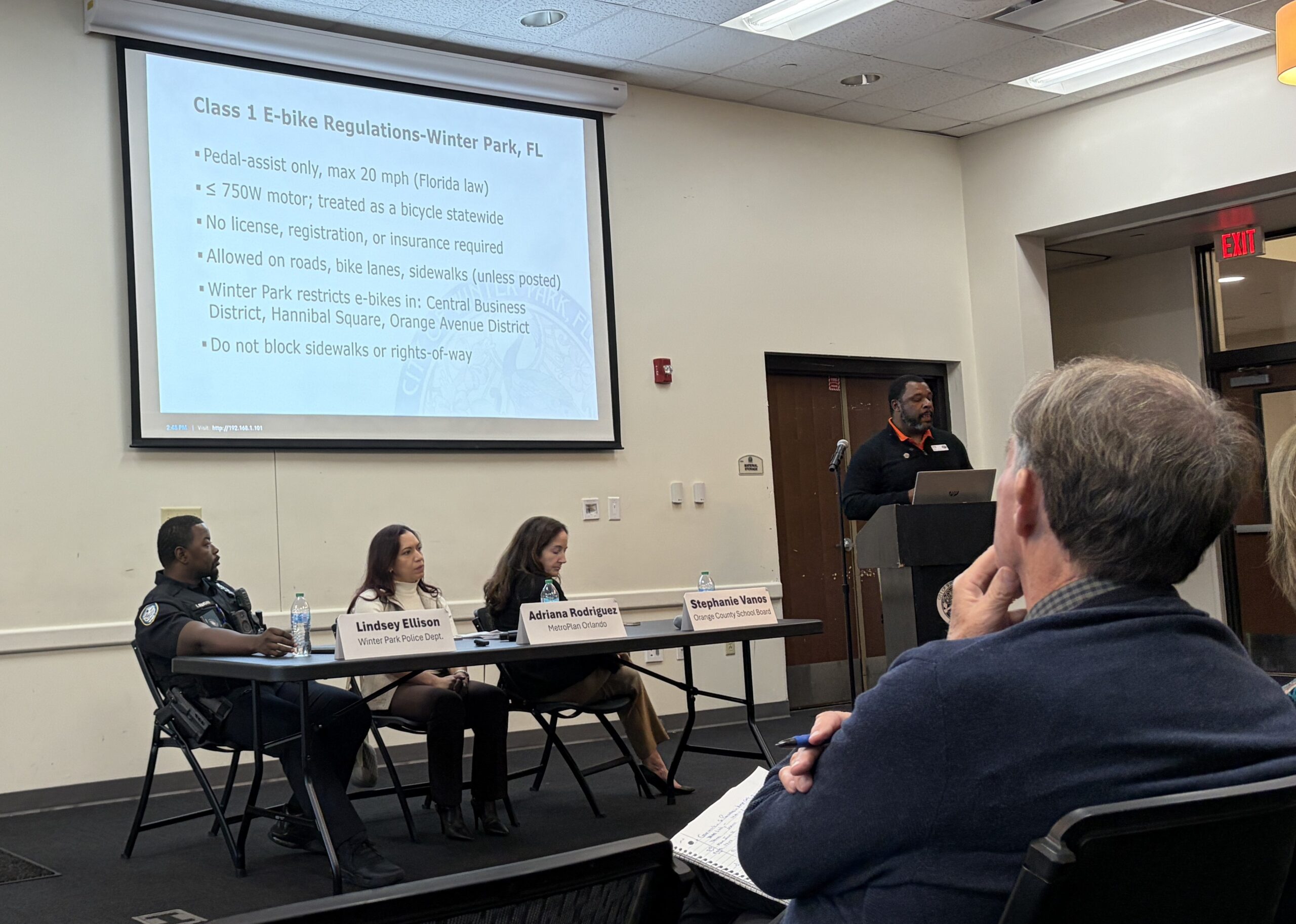
Winter Park Commissioner Craig Russell, who is also a teacher at Winter Park High, held a community meeting about e-bike safety earlier this year and has advocated for a local ordinance. School Board member Stephanie Vanos (third from left) sat on the panel.
Lindsey, whose day job is a criminal defense lawyer, called e-bikes and e-scooters “definitely a public safety issue.” However, he said he is mindful that minors don’t end up with traffic records as the city drafts a policy.
“The purpose of the proposed regulations are not intended in any way to be punitive to children but rather to be educational and to protect them because they’re inexperienced and to educate them on proper and safe operation of e-bikes and scooters,” he said.
In 2025, nearly 500 e-bike and e-scooter crashes were reported in Orange, Osceola and Seminole counties, according to MetroPlan, Central Florida’s regional transportation planning organization.
MetroPlan is focused on working with local governments, like Winter Park, to lower those statistics.
“We were expecting for some action to be taken at the state level, but I would say that the fact that it didn’t pass isn’t significantly changing how we were planning to proceed as an agency for metropolitan Orlando,” said Lara Bouck, MetroPlan project development manager.
The group is considering whether to draft a model ordinance to help local governments. Bouck said she hopes a Winter Park representative joins a working group expected to take on that task.
“The intent there is to give each of our municipalities, including Winter Park, a starting point that they can sort of pivot off of if they’re going to adopt their own ordinances, which I think will be a priority now that nothing passed at the state level,” Bouck said.
MetroPlan also launched a pilot program offering a free rider safety online course for parents at selected schools.
If DeSantis had signed SB 382 into law it would have required all law enforcement agencies across Florida to document micromobility device crashes the same way and record crash date, time and rider’s age or if the rider has a valid Florida learner’s driver license or regular license as well as other information.
The challenge is law enforcement agencies currently don’t report crashes in a uniform way, making it hard to understand the big picture.
Another provision in the bill would have allowed police to write $30 nonmoving traffic violations if an e-bike goes faster than 10 mph within 50 feet of pedestrians.
“I understand law enforcement has a job,” DeSantis said. “Do we really want to have policing of e-bikes? Are you going 10 miles or eight miles? I think it was a little bit of overreach.”
The bill would also have created a statewide task force to propose recommendations by Oct. 1 how to regulate “micromobility devices” like e-scooters and e-bikes.
Vanos acknowledged the bill wasn’t “perfect” but said it was “moving us in the right direction.”
She testified in Tallahassee during the Legislative Session to urge lawmakers to give schools representation on the task force.
Both Vanos and Orange County Commissioner Kelly Martinez Semrad, who represents Winter Park, said improving safety also means addressing bigger infrastructure challenges in communities.
“Devices that can reach higher sustained speeds are increasingly being operated in mixed-use environments—roads, sidewalks, and multi-use trails—without consistent rules, training requirements, or clear expectations for right-of-way behavior,” Martinez Semrad wrote on social media Thursday. “The result is a preventable risk environment: faster vehicles, denser shared spaces, and no modernized regulatory framework to govern how they interact.”
WinterParkVoiceEditor@gmail.com
To comment or read comments from others, click here →
by Beth Kassab | Jul 3, 2026 | City Commission, Environment, News, Police and Public Safety
Gov. Ron DeSantis Vetoes Winter Park Police Request but Allows Mead Garden Project
Sen. Jason Brodeur said the decisions follow the governor’s preference for regional impact over budget items that he may view as favoring one city
July 3, 2026
By Gabrielle Russon
The city of Winter Park scored an environmental victory and took a public safety hit as Gov. Ron DeSantis signed the new $117.6 billion state budget this week.
DeSantis vetoed $62,500 for Winter Park Police to buy more security barriers to protect crowds at outdoor public events. Meanwhile, $500,000 escaped DeSantis’ veto pen to fund a water clean-up project at Mead Garden that will leave an impact on the greater region’s environment.
“We were disappointed to learn the city’s Police Department Vehicle Threat Mitigation project was included as one of the $1.7 billion projects vetoed by the Governor,” Winter Park Mayor Sheila DeCiccio said in a statement. “We are, however, grateful for the approval of the Mead Garden Regional Nutrient Reduction grant that remained funded at $500,000. This grant will meaningfully support the city’s efforts to regionally improve water quality throughout the interconnected lake systems of Winter Park and Maitland, benefiting both Orange and Seminole counties.”
State Sen. Jason Brodeur, R-Sanford, who sponsored both funding requests on the Senate side, elaborated why he thought the Governor vetoed the $62,500.
“I’m disappointed for the community, but I think it speaks to the Governor’s focus on truly regional needs over a request by a single municipality, favoring projects that benefit multiple municipalities, like a watershed project. It’s not always the case but that is what was portrayed to me,” Brodeur said in a statement.
Last year, Winter Park Police previously received $62,500 from the state and bought security barriers — a trailer with eight barriers and a gate — that will protect Watermelon 5K runners and Fourth of July event-goers this weekend.
Winter Park Police Chief Tim Volkerson said he had been hopeful to receive the same amount of money this year to buy more barricades.
“We will continue to seek alternative funding opportunities to acquire equipment to enhance community safety for our public events,” Volkerson said in a statement. “This is a continuous process as technology and the landscape of public safety evolves.
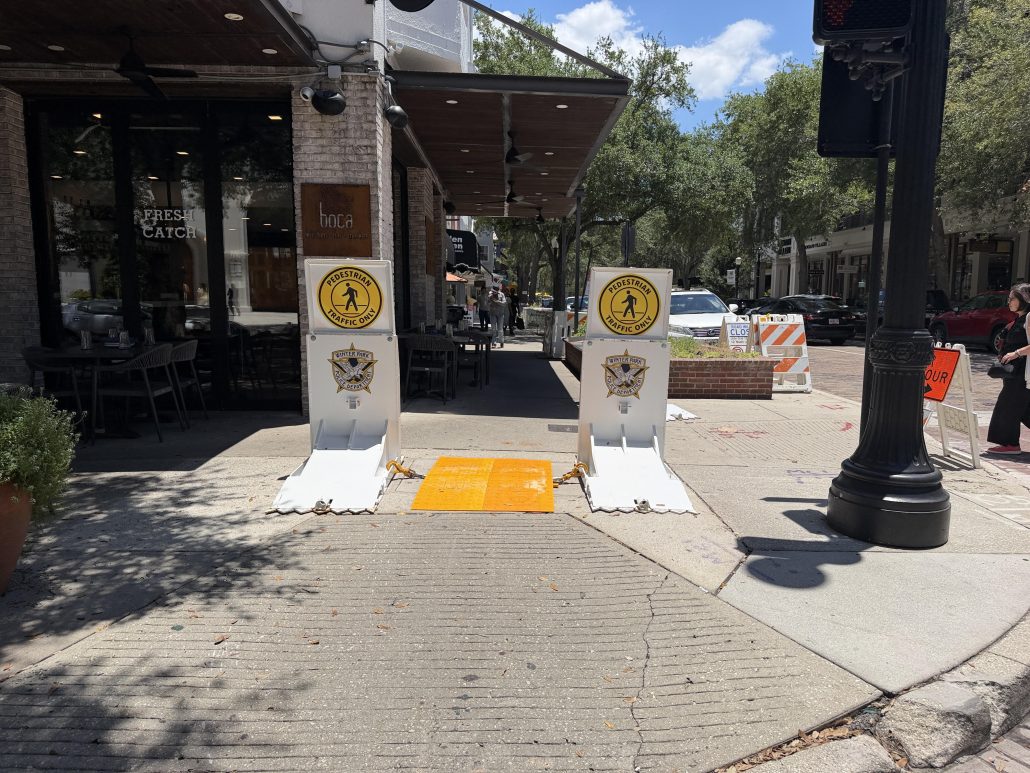
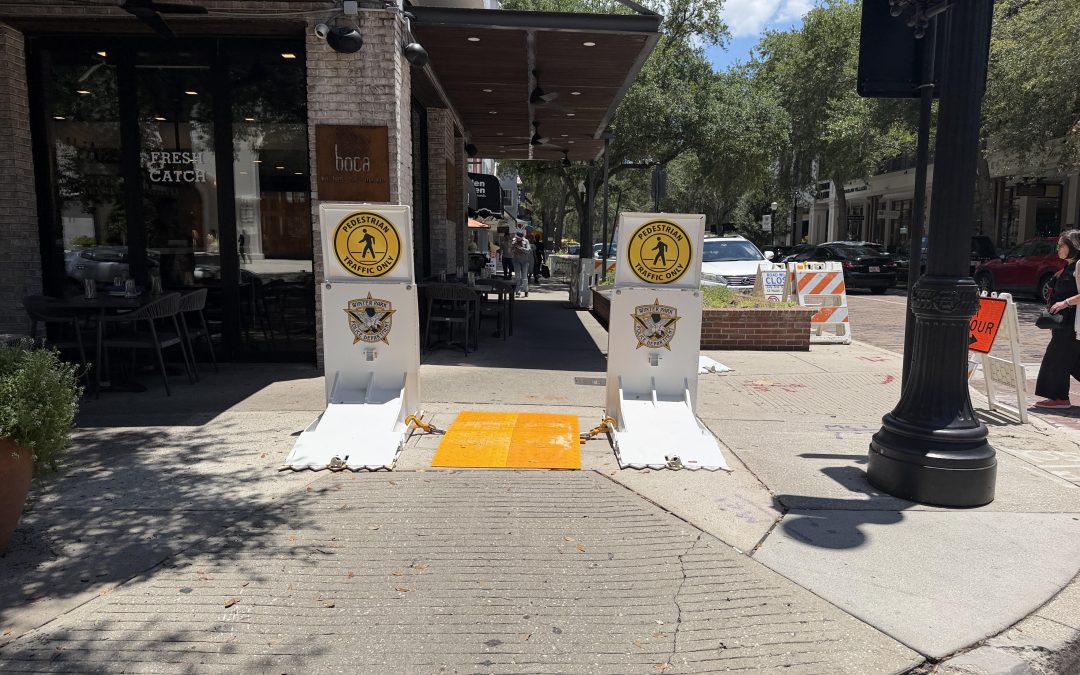
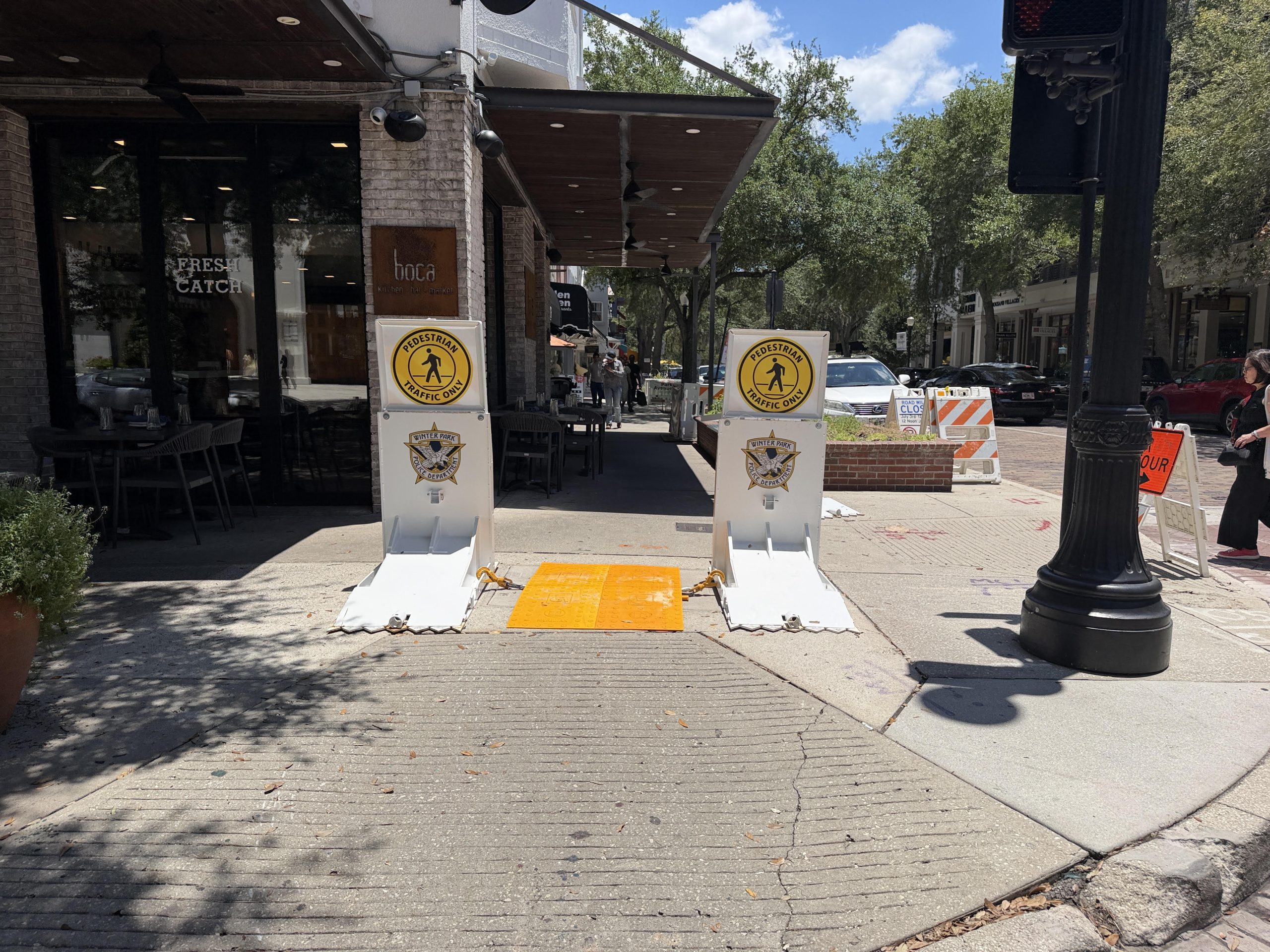
Barriers purchased by Winter Park Police last year help protect pedestrians and businesses along Park Avenue during special events. (Photo courtesy of Winter Park Police)
Winter Park City Commissioner Warren Lindsey shared the same sentiment that he was dismayed about the police funding veto.
“It was a very practical and necessary security protection that would really benefit thousands of citizens, not just Winter Park citizens, but citizens throughout Central Florida that attend different concerts and events around and in Central Park,’ Lindsey said in an interview. “Anything that we can do to enhance their protection is just a win for everybody and it helps provide peace of mind.”
Lindsey also said he was thankful DeSantis did not axe the $500,000 to filter excessive nutrients from Alice’s Pond in Mead Garden.
“It’s really one of our crown jewels of Winter Park,’ Lindsey said of Mead Garden.
He thanked Brodeur and state Rep. Anna Eskamani, D-Orlando, who had sponsored the funding in a bipartisan effort.
DeSantis vetoed about half of Eskamani’s projects, according to Eskamani, who is often a fierce critic of the governor.
Eskamani said she was grateful the Mead Garden funding survived, calling it a crucial non-partisan issue to protect the environment. She had also been optimistic it would advance because DeSantis himself has campaigned on water quality through his term, she said.
“This is going to be a really important investment,” Eskamani said. “All of our bodies of water are interconnected, and when we’re able to create improvements with one of these major parks, it absolutely will impact the entire community.”
Ahead of the DeSantis vetoes, the Florida TaxWatch criticized state lawmakers for sponsoring $380 million worth of water projects in the state budget which the group dubbed as “budget turkeys” in its annual report. The group said its opposition wasn’t targeting the value of the water projects but the budget process itself since the lawmakers-supported projects circumvented a formal, competitive review.
When asked about Florida TaxWatch’s criticism, Eskamani said, “I definitely think there can always be more transparency in the state budget.”
She added, “With that said, water projects tend to be some of the most important projects with a lot of merit” and argued Florida needs more grants for inland communities to clean up their lakes and rivers.
WinterParkVoiceEditor@gmail.com
To comment or read comments from others, click here →

by Beth Kassab | Jun 17, 2026 | City Commission, News, Police and Public Safety, Taxes
Early Retirements at City Hall. Plus Winter Park Nine to Reopen and Micromobility Ordinance in the Works
The cost cutting has already started ahead of budget talks next month. Meanwhile, the city has almost finished work on the new greens at the WP9 and new rules for electric bikes and scooters are in the works
June 17, 2026
By Beth Kassab
As talk of budget cuts swirl around local governments amid intensifying debate over the property tax amendment that will appear on the November ballot, five employees of the city of Winter Park have taken an early retirement package.
The packages, offered, as part of a cost-cutting effort, will reduce the City Hall headcount to 533.

Rene Cranis
The most high-profile, so far, is City Clerk Rene Cranis, who is well-known for her work managing city elections, city records and helping to run and document public meetings among other duties.
She has served Winter Park for three decades and has been active with the Florida Association of City Clerks.
Last month, the City Commission appointed Deputy Clerk Kim Breland, who was hired by Winter Park in 2017, to the lead role once Cranis retires at the end of June.
City spokeswoman Clarissa Howard said a cost savings figure from the five retirements will be evaluated as the city begins its annual budget process next month.
David Zusi, director of the city’s water and wastewater utility, recently retired, but his departure was already planned after 29 years of service. Commissioners recognized his dedication and contributions to maintaining the city’s water system during a May proclamation for “David Zusi Day.” Jason Riegler was appointed to take over the water utility for the city.
Winter Park Nine to Reopen

A photo courtesy of the city of Winter Park shows work underway at the Winter Park Nine.
City Manager Randy Knight said the Winter Park Nine is slated to reopen next month after the wrong chemical damaged seven of nine greens.
The city spent about $100,000 to redo all nine greens plus the putting green near Casa Feliz. Each of the greens were tilled to remove the dead grass, reshaped and then sprigged with Tif-Eagle Bermuda Grass, Howard said.
She said the new grass is of a higher quality than was used during the last renovation of the course.
The city is also trying out a new maintenance company to care for the courses. Knight said the cost of up to $197,000 for four months is about equal to the cost of doing the work in-house. He said the cost — about $50,000 per month — covers salaries for a seven-day maintenance operation, fuel, equipment repairs and maintenance, fertilization and pesticides.
Changes for E-Bikes and Scooters
City Commissioner Craig Russell is urging his colleagues on the City Commission to move forward quickly with new rules for riders of electric bikes and scooters in the wake of the death of a 13-year-old boy in Lake Nona who was hit by a truck on his e-bike on Mother’s Day last month.
Russell has pushed education and safety related to the devices in the past and held a community meeting on the topic earlier this year.
Commissioner Craig Russell leads a community meeting about electric bike and scooter safety earlier this year.
He wants to see new rules on the books for police to enforce.
“My interest is to have something before the start of the school year in August,” Russell said at a recent meeting.
Other commissioners agreed and said they would consider a new ordinance this summer even though Orange County’s ordinance is not yet done.
Howard said the city attorney is still working on the draft ordinance, but some potential changes could include:
- Increasing the age of riders who are required to wear helmets from 16 to 18.
- Establishing a speed limit for electric scooters and bikes on sidewalks, which would be more restrictive than the state law that requires a speed limit of 10 miles per hour only within 50 feet of a pedestrian.
- Keeping the prohibition of the devices from the Central Business District such as Park Avenue, New England Avenue and Orange Avenue.
- Starting a new system of city-based fines (similar to a parking ticket) for violations of the ordinance. This came in response from discussion among city commission members who want to be able to enforce the rules, but protect minors from infractions that could remain on their records.
- The potential to impound scooters and bikes as a result of violations to the ordinance.
A draft of the proposed changes is likely to be considered by the City Commission in the coming weeks.
WinterParkVoiceEditor@gmail.com
To comment or read comments from others, click here →




Recent Comments