by Geri Throne - Guest Columnist | Sep 27, 2017 | Headline, News, Tree Canopy, Zoning and Development
No Park Expansion
A 20,000-square-foot medical office building will occupy a lot once home to bowling lanes on Fairbanks Avenue near U.S. Highway 17/92.
City commissioners accepted an offer to buy the land from ComTech Properties for $3.5 million by a 4-1 vote, Commissioner Carolyn Cooper opposed. The site at 1111 W. Fairbanks Ave. has been coveted by some in Winter Park eager to expand Martin Luther King Park.
The city put the land out for bid in June, less than a year and a half after it bought the 1.63 acres from Rollins College for $2.9 million. The college had bought the bowling lanes site in 2013 for $2.85 million as part of a planned athletic field, but sold it to the city after it found another location.
The city used community redevelopment — or CRA — funds from its special downtown taxing district to pay for about a third of the purchase price to Rollins. The intent was to create turn lanes from Fairbanks Avenue onto Hwy. 17/92. There also was discussion at the CRA and city commission level about using the parcel to expand MLK Park.
Commissioner Cooper argued Monday the city should delay the sale “for now,” so it can study what effect the new city library will have on storm water drainage in the area. Hurricane Irma raised the need for more land to offset storm water, she said. Commissioner Greg Seidel voiced similar concerns, as did two residents who spoke to delay the sale. This area “was the TV stand-up spot” reporters used to show flooding from Irma, resident Charley Williams said.
Mayor Steve Leary said the agenda item was “never about park space and water,” but about needing space for traffic lanes. Arguments about stormwater were just another tactic to delay the sale, he said, and that could scare away prospective tenants in the office building and jeopardize the bid.
To comment or read comments from others, click here →
by Concerned Reader | Sep 20, 2017 | Headline, News, Opinion, Uncategorized, Zoning and Development
Stormy Weather Ahead
Will the Lights Stay On?
Editor's Note: Articles written by citizens reflect their own opinions and not the views of the Winter Park Voice.
Peter K. Gottfried, Guest Columnist
Tropical Storm Maria has now become Hurricane Maria and is battering residents of the Caribbean — even as they are still reeling from the devastation of Hurricane Irma. Too soon to tell if Maria will turn toward Central Florida, but one thing remains certain – the City of Winter Park is still not ready for a major hurricane.
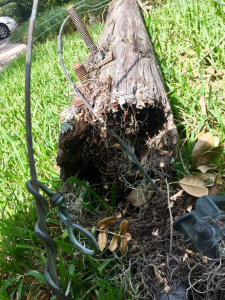
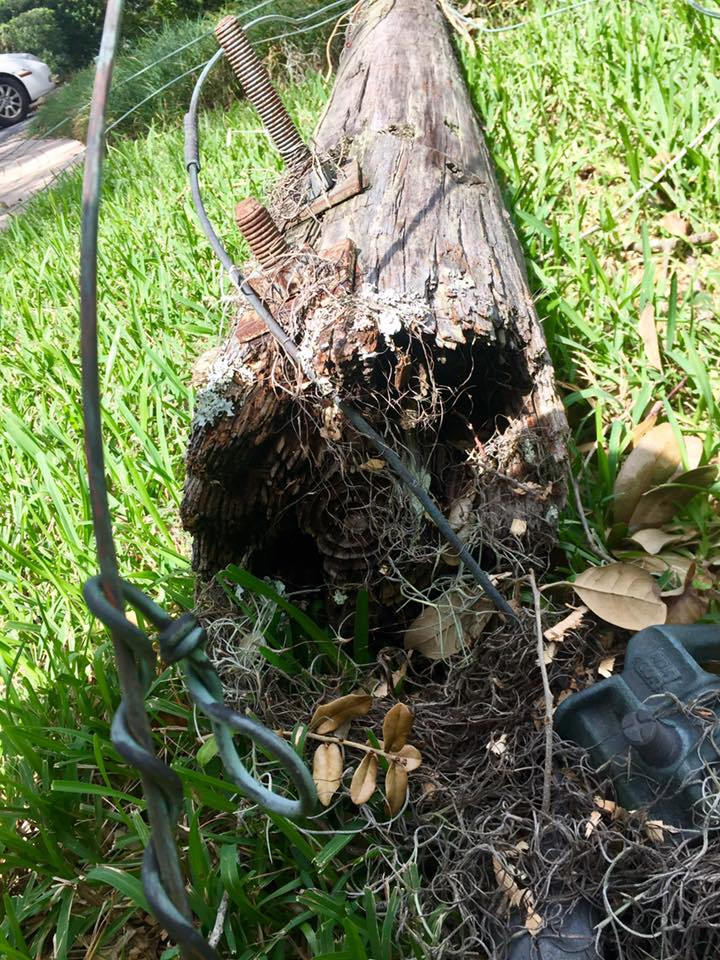
This rotten utility pole at Stovin and Park Avenue fell during Hurricane Irma.
Storm Water Has No Where to Go . . .
Flooding occurs in the same areas of the City it always has – and thanks to continuing development without proper storm water management, it is getting worse. The City knowns about these areas, but continues to take a go-slow approach to addressing them.
. . . Except Into the Roads
Lake Mendsen within Martin Luther King Park – site of the proposed $30 million library-event center — is woefully inadequate to handle existing storm water drainage from the Winter Park Village, the Paseo Apartments and the CNL Heritage Center. Even a heavy afternoon thunder storm will cause flooding on Denning Drive and Harper Street. The construction of the new library, with its associated impervious surfaces, can only make things worse. Other areas of the City that routinely flood include the intersection of Kings Way and Fawsett Road and stretches of Palmer Avenue, where water rises to the curb top after an afternoon downpour.
High Rates Alone Won’t Keep the Lights On
Reliable electric power during major storms is a significant issue. Like many other customers in Winter Park, I was without power for a week following Hurricane Irma.
Let’s Bring Our Infrastructure Into the 21st Century
Winter Park purchased the electric utility from Progress Energy/Florida Power in 2005 with a promise to underground all lines within 10 years. According to the City website, that target completion date has moved out to 2026. Progress is measured in terms of how many miles of line have been undergrounded rather than the number of additional customers served. The current debate is less about how and when to underground and more about how to pay for it. For information about undergrounding in your area, go to https://gispublic.cityofwinterpark.org/ugstatus/
Editor’s Note: The City of Winter Park issued a statement that said undergrounding timeline was 20 years.
Winter Park can do better. There is no reason we should scramble every time there is a major storm. Let’s bring our infrastructure up to date so we can have some peace of mind when the next storm hits.
Peter K. Gottfried is President of Natural Systems Analysts, Inc. which provides technical and scientific support to the U.S. Geological Survey, the U.S. Coast Guard, and the Bureau of Land Management. He served as a City Commissioner and on the Planning and Zoning Board, Lakes and Waterways Board and, currently, on the board of Mead Botanical Garden.
To comment or read comments from others, click here →
by Guest Author | Sep 7, 2017 | Headline, Opinion, Tree Canopy, Zoning and Development
Keep the Park in Winter Park
Guest Columnist – Bob Bendick
Editor's Note: Articles written by citizens reflect their own opinions and not the views of the Winter Park Voice.
 The “Greenspace Connectivity” article published here is a useful continuation of the discussion in our community about the need to update Winter Park’s ten-year-old Parks and Recreation Plan.
While there remains some uncertainty about the exact questions to be answered by a plan update, it has been encouraging to see the support among elected officials and others for continuing investment in parks and open space in Winter Park.
WP Vision Focuses on Parks & Greenspace
A number of the recommendations of the 2008 plan have been implemented. This, in itself, demonstrates the value of park planning, and this progress provides a good base for additional improvement. Careful stewardship of our parks reflects the views of the great majority of Winter Park residents, as expressed through the city’s recent Visioning Process. The Vision plan recommends:
• Investing in a sustainable future that encourages and supports lifelong learning, healthy living and a daily connectivity to the natural world.
• Enhancing walking, biking and recreational activities through a connected and integrated network of open space.
• Fostering sustainable public and private parks and open spaces using state of the art practices and techniques.
Revise Parks Plan to Address Today’s Needs
So why is a revision of the city’s parks and recreation plan a practical and useful step toward achieving the elements of our shared community vision? First, a revised plan would reflect the preferences of today’s Winter Park’s residents. For example, activities such as lacrosse and paddle boarding hardly existed here ten years ago, but now have grown to become popular uses of our parks.
Reduce Cost and Conflict
A carefully wrought plan would provide a much-needed cohesive framework for making decisions about expanding, adding or modifying individual parks. The decision-making process would become more cost-effective and the City would realize a reduction in the lost time and conflict that results from ad-hoc decision-making.
Avoid Duplication
A thoughtfully revised plan would reduce duplication of facilities and activities, thus improving the delivery of recreational services to the people of Winter Park. It might also introduce innovative ways for private citizens to contribute to the natural and scenic character of our city.
Introduce Updated Management & Maintenance Practices
An updated plan would introduce state-of-the art techniques for management and maintenance of park facilities. A specific, achievable menu of desired projects would enable the City to take advantage of strategic opportunities for implementing the plan through public infrastructure programs, private donations and amenities in commercial and residential development projects.
Connect Our Parks
An updated plan would show how our parks can be connected with walkways and bikeways to provide a green framework for the city’s future. Connectivity among our parks would enhance opportunities for outdoor recreation for citizens of all ages while affording opportunities for safe, non-motorized transportation. We can achieve all this through coordination with the City’s bicycle and walkway planning.
No Need to Re-invent the Wheel
The city’s 2008 parks plan is a sound, useful document. There is no need to start over or to undertake a lengthy and complex planning process. We can take a practical, creative approach to discover ways to further enhance and connect our city’s natural assets of parks, lakes, private open space, walkways and bikeways.
Such an effort is well worth the investment of time and money. Having a clear, overarching vision of the city’s specific open space needs and priorities will save us in the long run, and will encourage the partnerships and creative ideas that are central to park planning and management in today’s world.
We owe it to the next generation to keep the park in Winter Park.
To comment or read comments from others, click here →
by Concerned Reader | Sep 4, 2017 | Headline, Tree Canopy, Zoning and Development
Green Space Connectivity
A City In Search of a Unified Parks Plan
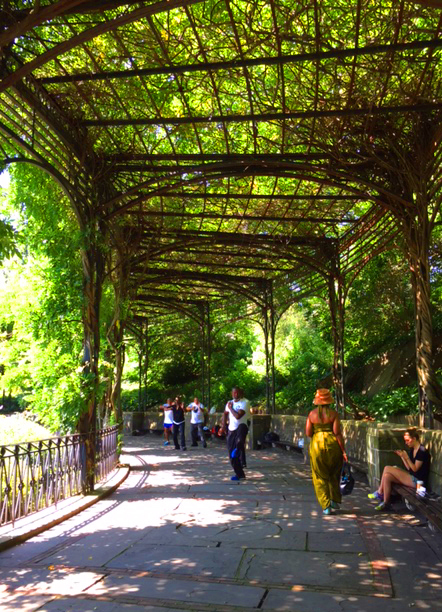
Among the drawers, shelves and stacks of notebooks, leaflets and books storing visions, plans and master plans sits the Winter Park Parks & Recreation Master Plan. As that plan nears the age of 10 – it was last updated in 2008 — Commissioners, staff and citizens have concluded the time has come to give it some much-needed attention.
Outdated Information
Many of the national statistics used to support the 2008 plan date from 1999. In 2008, Geographic Information Systems (GIS), upon which we now base much of our data, did not exist. According to GIS data, since 2008 the City has added 50 acres of parkland – some of it under water, but most of it visible to the naked eye.
In addition, some significant developments have occurred in the past 10 years that do not appear in the 2008 plan – projects in Mead Botanical Garden and plans for the new library-event center in MLK Park, for example.
Parks Plan Needs Life Support
Solid reasons exist to resuscitate the plan. Both the City’s Comprehensive Plan and the Vision Plan require the City have a current Parks & Recreation Master Plan. Actually, Comp Plan Policy 6-2.5.4 states the plan should be updated every five years. Second, the City must have a current Parks & Recreation Master Plan in order to retain accreditation under the Commission for Accreditation of Park and Recreation Agencies (CAPRA).
There’s Talk, but No Action Yet
Toward that end, the Commission took up the question of updating the Parks & Recreation Master Plan at their August 28 meeting, with the stipulation that they intended to take no action at that meeting.
At the outset, it’s important to know three factors which could stand in the way of a speedy conclusion to this effort. First, with the recent retirement of former Parks & Recreation Director John Holland, no Parks & Rec director is in place to guide the update process. According to City Manager Randy Knight, the search for a new director has not yet begun.
As of August 28, there is no money in the FY 2018 budget for a plan update, although that could change. Finally, the scope of work is vague and the proposed schedule, which exceeds 12 months, is not set to commence until March 2018.
What Do We Know About WP Parks?
According to the 2016 Comprehensive Plan, Winter Park boasts 346 acres of publicly owned park, open space and conservation lands. There is no distinction between active park space, for instance the Farmer’s Market and Azalea Lane tennis courts, and passive green space like Central Park or Mead Botanical Garden.
Of the 346 total acres, 27.58 acres comprise 36 ‘mini-parks.’ Some mini-parks provide peaceful sightlines onto small gardens or lakes, while others are little more than a park bench in a roadway median.
Howell Creek Conservation Land to be Added
In addition to the existing inventory, the City is in the process of purchasing 55.57 acres of conservation land along the Howell Creek Basin. The properties were appraised at $166,000. The agreed-upon purchase price plus commissions will come to $304,500. Approximately half this amount will come from a grant from the State of Florida. The remainder will likely come from the Parks Impact Fee Fund, which currently has a balance of more than $1 million.
The package deal includes seven separate parcels. Of these 55+ acres, two parcels totaling 12.23 combined acres are within Maitland City limits, and 7.71 acres are submerged.
Maitland Gets a Piece of the Park
According to minutes of the August 14, 2017 Commission meeting, staff plans “to work with the City of Maitland on a joint planning agreement to transfer the one piece of property that is in their city limits and adjacent to our park into [Winter Park] city limits and to transfer ownership of the other parcel to Maitland.”
Once this wetlands area has been reclaimed, invasive plants will be replaced with native species. The City plans to create a recreation area that will feature boardwalks, nature trails and a kayaking “blue way.”
Questions Remain — How Do We Anticipate Future Costs of Park Ownership?
Parks & Recreation accounts for approximately 15 percent of the City’s budget. To date, more money has been devoted to parks acquisition. As our parks age, however, the lifecycle costs of ownership and maintenance increases. Is the City prepared to create a Parks & Recreation Master Plan that accurately reflects these costs so we can anticipate out-year budget requirements – and budget for them?
How to Develop Connectivity Between the Park Spaces?
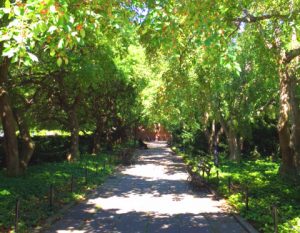 In their August 28 report to the Commission, staff highlighted the need for connectivity between our existing parks and green space. Their recommendation was endorsed by Commissioner Greg Seidel, who cited the need to weave in GIS data points to evaluate feasibility and to accelerate the connectivity portion of the Parks & Recreation Master Plan.
Should We Distinguish Passive Park vs. Active Park?
As urban sprawl presses on our borders, our active parks and passive green space frequently find themselves in the same footprint and in direct competition with one another. The resulting frustration for any visitor is that neither the active nor the passive functions can be adequately realized.
Charley Williams’s ‘Official Quiet Zones’
 Elected officials, City staff and Winter Park residents are embarking on a difficult task – one that will take time to complete. In the meantime, Winter Park resident Charley Williams offered the following thoughts that might form a context and a way to think about these issues. In this spirit, we share his musings with you.
Charley Says . . .
Leash your dog
Take your bike for a walk.
Enjoy the garden.
Leave the flowers on their stalks.
Take a deep breath
. . . .and take one again.
Smell the dirt and
The scent of the air after the rain.
Sit on a bench, relax, listen.
Remove your sunglasses.
Feel the shade.
Close your eyes – smile, feel your thoughts fade.
Watch the clouds.
Enjoy the sunset.
What bird call was that?
Are the owls waking up?
Come tonight for a meteor shower.
Bring your blanket to lie on.
Feel our natural rhythms
In the low light of our park after dark.
Charley Williams has lived in Winter Park and Central Florida for over 25 years. When it comes to sports and rec, he’s proud to say he still has good knees.
To comment or read comments from others, click here →
by Concerned Reader | Aug 7, 2017 | Headline, Zoning and Development
City to Reconsider Memory Care Center
Villa Tuscany Back on the Agenda

In April 2017, Villa Tuscany Holdings (VTH) sued the City of Winter Park, challenging the Commission’s March 27 denial of their application to build a 41,000-square-foot memory care center at 1298 Howell Branch Road.
Under the jurisdiction of a Special Magistrate, the City, represented by City Manager Randy Knight, has drawn up an agreement with Villa Tuscany Holdings to enable VTH to submit plans for a revised project. To read the entire document, click here.
According to the mediated settlement agreement, in early September VTH will submit plans for a re-designed memory care center to the City planning staff. After it goes through the Planning Department, the Commission will review the new application, which will include the mediated settlement agreement. The Commission will consider the agreement and the plans as one item.
What’s Changed?
The proposed agreement calls for a reduction in gross square footage from 41,352 to 30,896.
Although the redesigned building will be two stories instead of three, the maximum height will be reduced by only three feet. The number of on-site parking places will increase from 23 to 25 – which still represents a variance from the required 27 spaces.
The number of patient “units” drops from 51 to 46. Despite a significant reduction in rooms and in square footage, however, the number of patient beds is reduced by only one – for a total of 50.
Commission May Review in October — Date Flexible
The date has not yet been confirmed, but it is tentatively scheduled for the first Commission meeting in October.
To comment or read comments from others, click here →
by Concerned Reader | Jul 11, 2017 | Headline, News, Zoning and Development
News Update: New England Ave. Project Denied
by Anne Mooney
On a 5-0 vote last night, the Commission denied BFC Holdings’ application to build a 52,600 square-foot mixed use complex at 158 E. New England Ave.
Fuzzy Parking Math Still Not Cleared Up
The basis for denial was the applicant’s failure to offer sufficient mitigation for the 80- to 100-space parking deficit (the exact number depends on who’s counting and how). Even though the City was prepared to grant an unprecedented concession of requiring three parking spots per 1,000 square feet of office/retail space – all other Class A office buildings in Winter Park are required to provide four spaces per thousand – BFC Holdings still came up short.
CBD Parking Study Now in Progress
When this project was tabled at the March 27 Commission meeting, Planning Director Dori Stone observed that the City’s parking studies needed updating. The City has since hired a consultant, Kimley-Horn, who is now in the midst of a parking assessment of the Central Business District (CBD). Commissioners suggested that allowing this project to go forward with such a large parking variance before they have the study results would be premature.
If the Parking Code is Wrong, Why Is It Still In Place?
Commissioner Sarah Sprinkel objected to the Commission being asked to grant what amounts to a change in the parking code for a single applicant. “Why is the code still in place, even when you are now telling us it shouldn’t be?” asked Sprinkel.
‘Class A Office in the CBD Is Different’
At the March 27 Commission meeting, Planning Director Dori Stone asserted that Class A office space in the CBD operated differently from Class A office space in any other part of Winter Park and could, therefore, be supported by three spaces per 1,000 square feet.
‘What Is Class A Office, Anyway?’
At the July 10 meeting, Planning Manager Jeff Briggs stated that staff “was having difficulty coming up with an agreed-upon definition of Class A office space.” Parameters for size and other characteristics of everything from hallways to conference rooms, which would set ‘Class A’ apart from Classes B or C, apparently do not exist.
Can Valet Parking Promise Be Enforced?
Referring to the applicant’s assurances that all visitors to the new complex would be required to use valet parking, either in the New England Avenue building garage or in the Bank of America garage across the street, Commissioner Greg Seidel questioned how the requirement to use valet parking would be enforced.
Unless the applicant enforces the valet parking, it probably will not be enforced at all, since Winter Park employs only one parking enforcement officer for the entire City.
Time to Close This Chapter
Commissioners asked the applicant for compromise. “The building is lovely,” they all agreed, “but it’s too big.” Commissioner Peter Weldon said he thought it was time to “close the chapter” on the application in its current form, and he moved to deny. The other four Commissioners agreed.
Duck the Summer Heat & You’ll Miss All the Fun
BFC Holdings is Back with New England Ave. Project
July 8, 2017 / by Anne Mooney
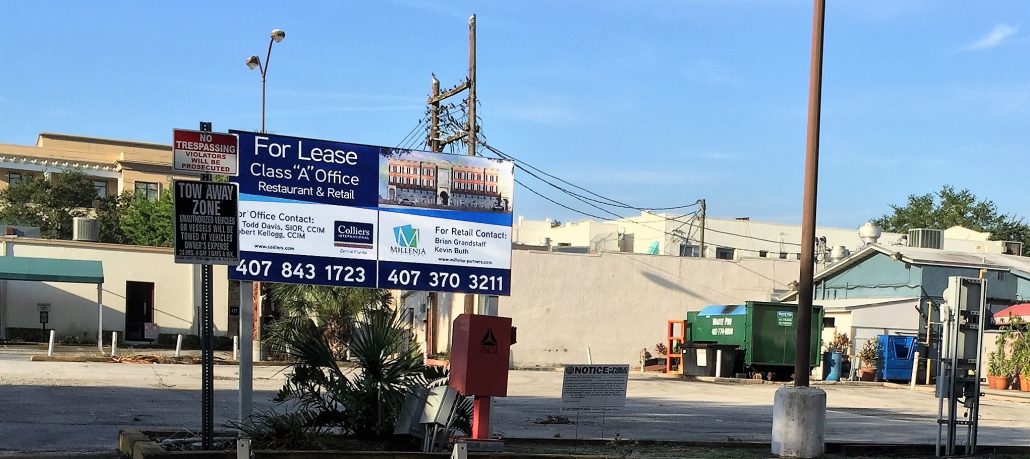
BFC Holdings will return to the Commission on Monday, July 10, with their proposal to build a 52,600 square-foot mixed use building at 158 East New England Avenue.
BFC Wants Big Variances
The proposal came before Planning & Zoning and then the Commission in March of this year. Neither body was able to reach a decision regarding the project, which requests variances for building height, third-floor setbacks and a significant parking deficit.
P&Z Can’t Decide
After hearing the application on March 7, P&Z was evenly divided, with a 3-3 vote. Rather than tabling again – as they had at the November 7, 2016 meeting — or denying the application, P&Z kicked it forward to the Commission.
Commission Can’t Decide
On March 27, the Commission couldn’t decide either. They were okay with the variance for 45 feet of building height, rather than the 40 feet permitted in C-2 zoning. They were also willing to go along with a vertical façade along Knowles Avenue with no setback or terracing on the third floor to break up the vertical mass of the 45-foot-high wall. But they just couldn’t solve the applicant’s fuzzy parking math. See Winter Park Sings the Parking Blues.
‘Back to the Drawing Board’
Concluding a meeting that lasted well beyond 10:00 p.m., the Commission unanimously voted to table the application, advising the applicant their project “was not ready for prime time,” and to “work things out” regarding the parking variances.
What’s Changed Since March 27th Meeting?
According to the July 10 Agenda Packet, City staff has “discussed parking issues and suggested changes with the applicant based on comments made by individual commissioners at the public hearing. However, the application is unchanged since the March 27th meeting.”
Only the Weather Has Changed
Apparently, the only things that have changed are the weather and the requirement for public notice. According to City Code, after a tabling the only people required to receive notice in the mail of a public hearing are property owners within 1,500 feet of the subject property. The hearing is, however, publicly advertised, as are all public meetings.
Form, Not Content
The application contains a draft Developer’s Agreement that was not included in the March 27th application. According to the Agenda Packet, the agreement incorporates approvals needed and commitments from the applicant made at the March 27th meeting. The draft, however, contains changes recommended by the City Attorney only “as to form but not content.”
Two Hearings Required for Approval
Since no decision was reached at three previous hearings, BFC still has to clear the hurdles. As a request for Conditional Use for a three-story building within the Central Business District, BFC’s application requires two more hearings. A July 10 Commission decision to approve the project would result in a second hearing July 24.
To comment or read comments from others, click here →
Recent Comments