
Commission Delays Merrywood Vote as Preservation Talks Continue
Matt Morgan is still trying to buy the property as Commissioner Kris Cruzada pushes for compromise for ‘conscience’ of city
Oct. 15, 2026
By Beth Kassab
The fate of Merrywood remained uncertain the morning after a more than four-hour meeting devoted to determining how much, if any, of the historic property must be preserved for its new owner to get permission from the City Commission to split the lakefront lot he purchased in August for $15 million into two.
As these debates often do in Winter Park, the discussion touched on more than the fate of one house. For many, it reflected a collective angst over losing the architectural diversity and history that, along with its walkability and lush tree canopy, have long earned the city acclaim as a destination for visitors and people seeking a Florida lifestyle in a New England-style village.
Natalie Brethauer, one of at least 10 people who signed up to speak at the meeting, illustrated that tension between old and new. She told commissioners she grew up in Winter Park, moved away for college and lived in other vibrant cities, including Denver, Houston and the Old Town neighborhood of Alexandria, Va., before returning home and marrying at the Capen House, which had been slated for demolition before it was floated across Lake Osceola to be preserved.
“The whole reason I came back to Winter Park is because it is such a unique and beautiful place to raise a family and live,” she told commissioners. “And something that I’ve noticed since moving back, and it’s really ramped up post-COVID … It looks as though it’s like a dystopian-type vibe happening here. You go down Palmer [Avenue], and to me, I describe it as like an evil villain lair in ‘The Incredibles’ movie or something. Like, what are these homes that are being built? I thought the whole point of Winter Park was its beautiful historical charm, and that was the lure and the draw, and so it’s just really sad to see a lot of that going away.”
She was referring to the proliferation of what have become known as “white box” houses. Though they aren’t always white, the homes feature sharp edges and an ultra-modern aesthetic more common in, say, Miami Beach than along the local brick streets fronting the Chain of Lakes.
After the meeting, Commissioner Kris Cruzada, who voted in June along with Mayor Sheila DeCiccio and Craig Russell to approve a lot split without any preservation conditions, said he considered Brethauer’s comments representative of part of the “conscience” of Winter Park. He said that sentiment was one reason he pushed so hard Wednesday night for a compromise that would preserve some portion of Merrywood in exchange for allowing the lot split.
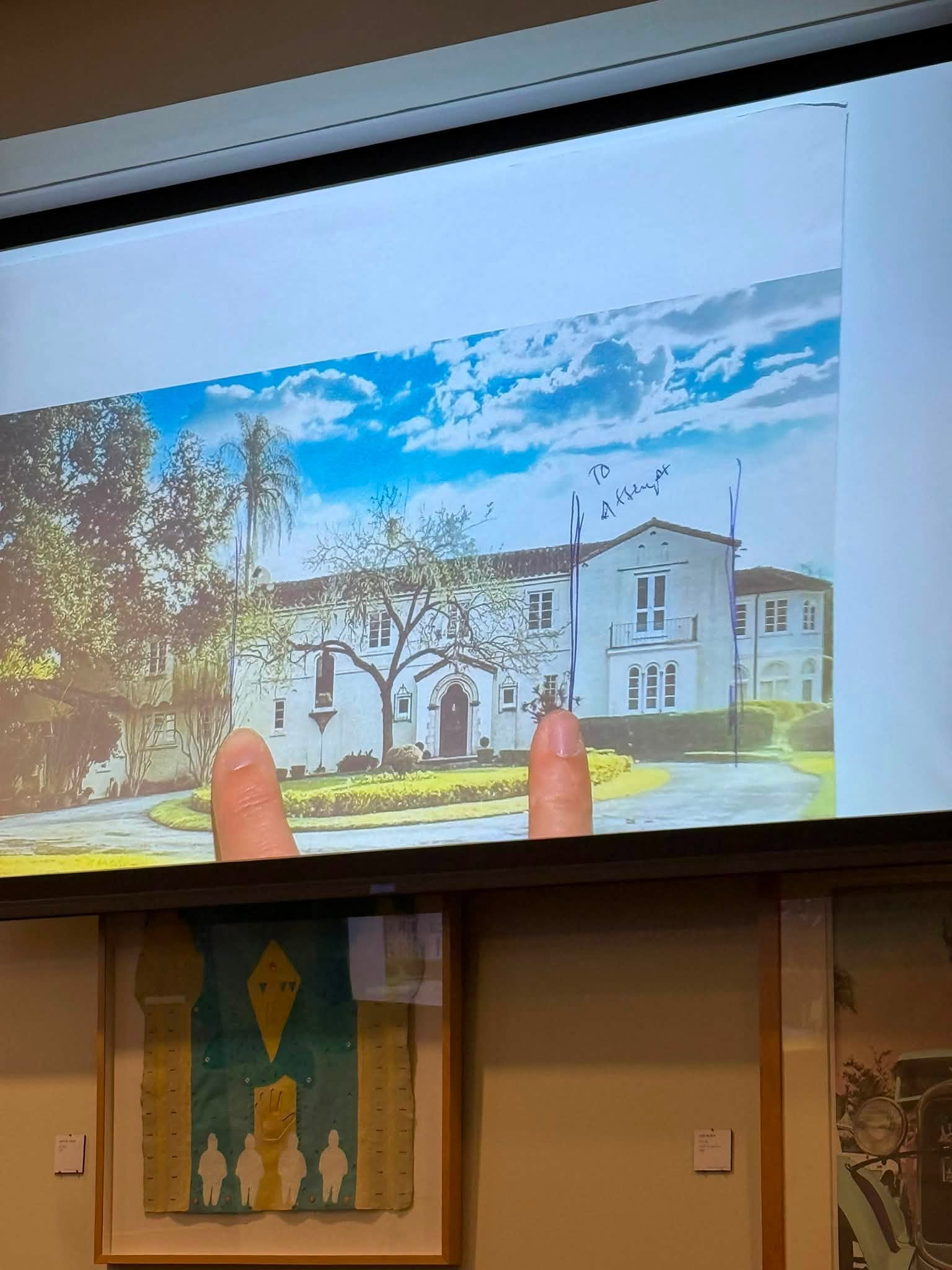
Attorney Jason Searl, who represents Steve Lockwood, points to areas on the Merrywood facade that could potentially be saved.
The property at 1020 Palmer Ave. has already set a record for the highest sale price in Winter Park at $15 million. It would become even more valuable if it were subdivided so that a portion could be sold separately.
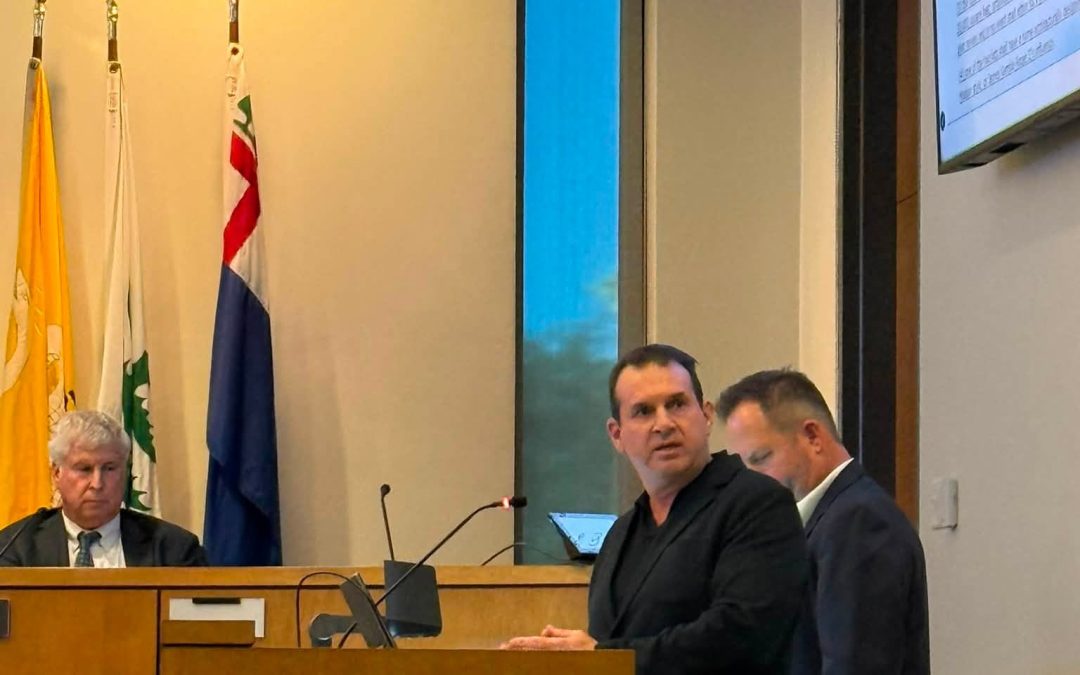
Lockwood said during the meeting that a close family friend wanted to purchase the new lot and build a house there. Lockwood, who sat through the hours-long meeting with his wife and daughter, said he plans to build a new house for his family behind Merrywood. The existing house would be at least partially demolished and converted into what he called a “guest house.”
After the meeting, Lockwood told the Voice he would hire an architect and try to determine what would be feasible under a condition proposed by Cruzada that would require preserving a portion of the nearly 90-year-old estate. The house was designed by James Gamble Rogers II and is listed in Florida’s database of historic and cultural assets.
Cruzada’s shift in position was key to the commission’s unanimous 5-0 vote to delay a decision until Nov. 11, giving new owner Steve Lockwood time to outline what portion of the house he believes could be preserved.
Commissioners discussed retaining only a portion of the facade, or front wall, while gutting everything else.
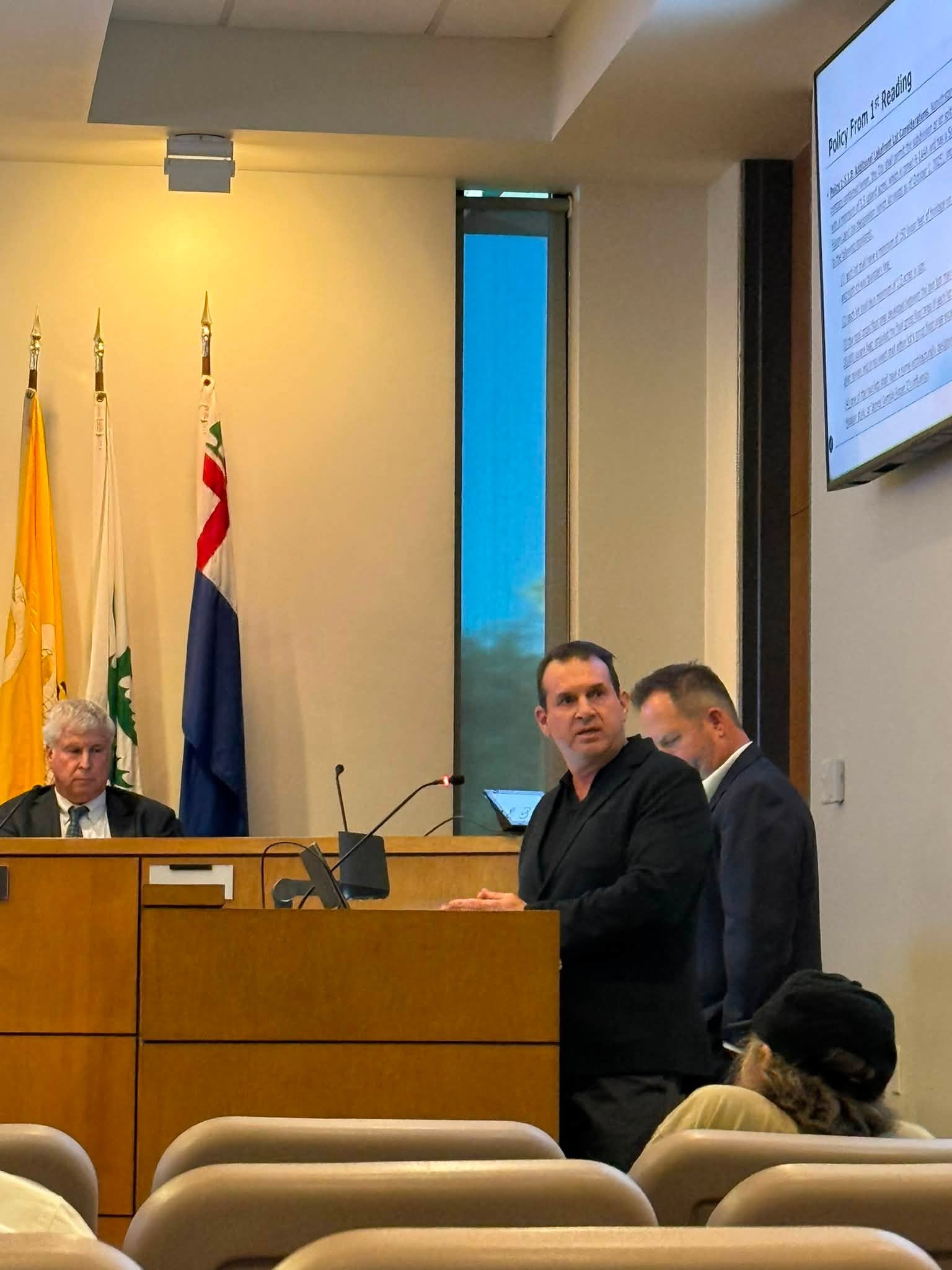
“Just like a billboard?” asked Commissioner Craig Russell, conjuring the image of an old Hollywood set piece.
Even after the meeting was recessed to give the owner and his lawyer time to try to work out some terms, it remained unclear how much of the house would need to be preserved to secure at least three votes on the commission, or how much Lockwood considered feasible and affordable.
Throughout the meeting, Lockwood and his attorney, Jason Searl of Maynard Nexsen, pointed to inspection and engineering reports that appeared to have been prepared earlier this year, when Tara Tedrow was still under contract to buy the property. The reports indicated that the house was in a state of disrepair beyond saving.
Searl showed commissioners an overhead projection of the house and pointed to a section of the facade, perhaps 30 feet long, that he said could potentially be restored.
That led to an exchange among commissioners that got to the heart of the discussion.
Commissioner Elizabeth Ingram said 30 feet was inadequate.
“That’s not the architecture,” she said. ” That’s not the beauty of the home. It’s not the house anymore. To me, if you were willing to keep that entire facade, that front whole section where you have the extra height on this side, and then you have the little rounded space around the side. That is the coolness. That is the charm and the beauty and the style of James Gamble Rogers.”
Ingram also said preserving so little would “erode” the city’s comprehensive plan, which must be amended to allow the lakefront lot to be split. The plan generally prohibits lakefront lot splits.
“That doesn’t encourage one bit of historic preservation, which we all claim to love and respect and want to promote, but then we’re going to be OK with just keeping 30 feet of this ginormous, beautiful home? Like, what are we doing?”
Cruzada argued that preserving some of the house was better than preserving none of it.
“I guess what I’m trying to do is find a path to some level of preservation or we lose it all together,” Cruzada said. “You know, we’re in an unfortunate set of circumstances. He’s here before us trying to compromise.”
“No, he’s here trying to have us compromise our comp plan,” Ingram replied.
“You’re right,” Cruzada said. “But the other side is if we don’t allow the lot split, then he’s still going to go forward with the demolition permit. Then we don’t have anything.”
Lockwood, who owns federal government medical staffing contractor Loyal Source and last year purchased the Orlando-based drinkware brand Corkcicle, and his attorney opened the meeting by saying they were unwilling to put any preservation conditions in writing beyond a commitment that Lockwood would make a “good faith” effort to preserve a portion of the house.
Searl proposed allowing any square footage Lockwood preserved to count toward the potential additional square footage of the new homes on the divided lot. The commission has sought to limit the combined size of the homes to 30,000 square feet.
Searl said that if commissioners did not approve the lot split Wednesday, Lockwood would move forward with demolishing the house and potentially seek approval for the lot split in the future. He quoted former owner Cathy Gilmer, who spoke during the June meeting and called the house “basically a waste” that falls further into disrepair every day it remains standing.
Searl said Lockwood was discouraged and offended by an open letter to the City Commission, organized by the Friends of Casa Feliz and signed by nearly 300 people, that called on the city to deny the lot split unless Lockwood agreed to designate the house as historic.
The letter came as a disappointment and a surprise, Searl said, after Lockwood spent two hours meeting with the leaders of Casa Feliz, another Gamble Rogers-designed house that was saved 25 years ago when it was moved across Interlachen Avenue to its current location on the Winter Park Nine. It now serves as a museum and popular event venue.
“When that happened, it feels like to us you’re then fighting a losing battle, and anything you say will not achieve a cooperative spirit from that group,” Searl said.
When it was Betsy Owens’ turn to speak, she explained that Lockwood knew about the letter and called for at least 80% of the house to be preserved, including the entire front elevation.
“When Mr. Lockwood and I met last week, I mentioned this letter,” said Owens, executive director of Friends of Casa Feliz. “It’s been in circulation for about two months, so this was not at all a reaction to that meeting. We were very upfront about that. We recognize an uncomfortable reality: Merrywood is not historically designated and could be legally demolished tomorrow, but today the city has something it ordinarily lacks, and that is leverage. The owner is asking you to change the comprehensive plan. That gives you an opportunity to secure preservation protections in return … We understand that saving some portion is better than losing all of it. We don’t want the perfect to be the enemy of the good.”
Lockwood later apologized for misunderstanding the open letter, saying he thought it was a new letter rather than the one Owens had already told him about.
After initially insisting he would not agree to delay the vote and would rather face a rejection than push the hearing to another meeting, Lockwood ultimately agreed to wait until November.
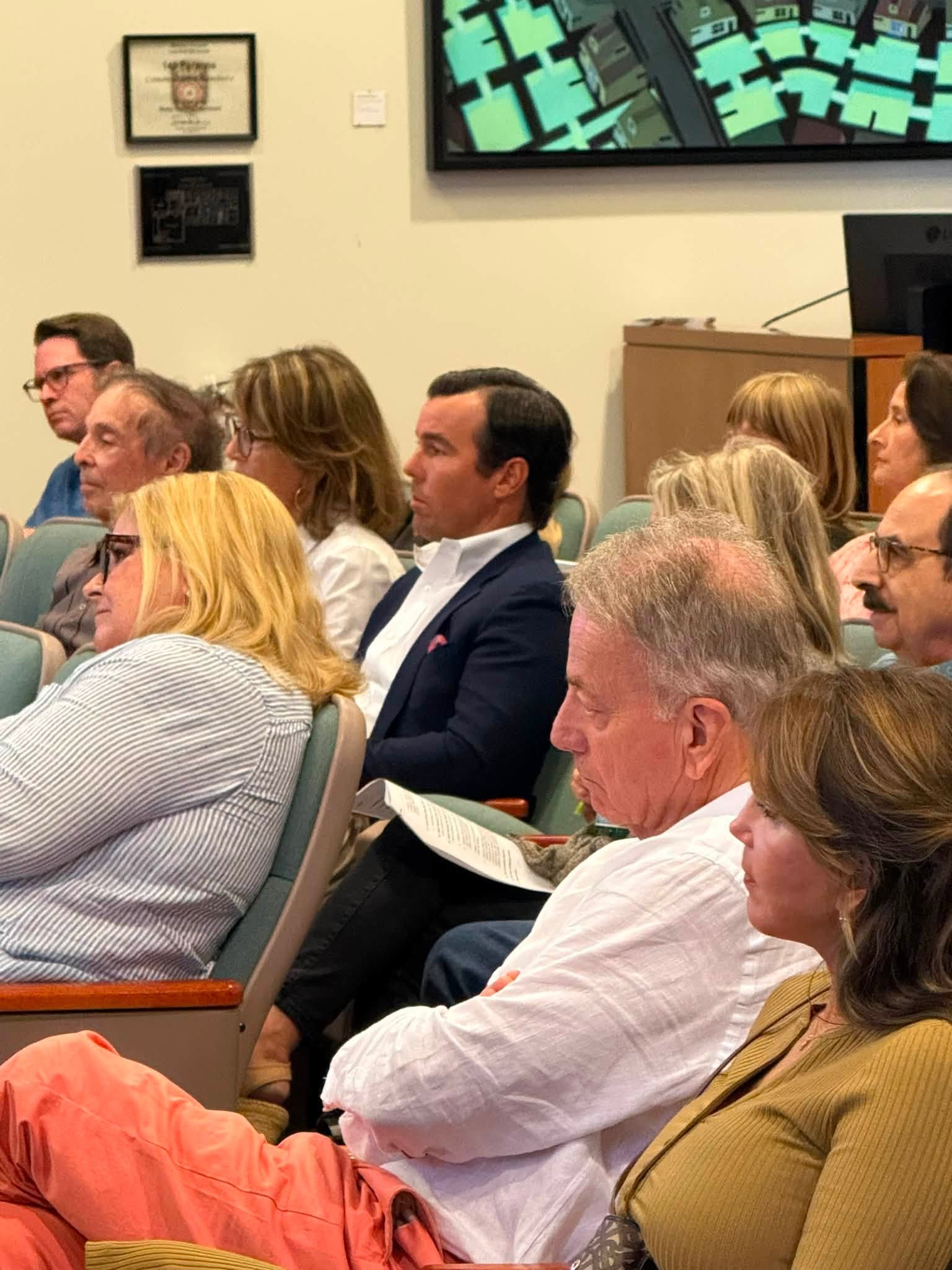
Matt Morgan, center, listens to the debate over Merrywood during the Winter Park City Commission meeting.
That leaves four weeks for a potential compromise to take shape or another twist to emerge in the saga of Merrywood.
Matt Morgan, one of the faces of the Morgan & Morgan law firm who lives in a historic home in Winter Park not far from Merrywood, sat in the commission chambers for nearly the entire meeting but did not speak.
On Thursday morning, he sent a letter to commissioners reiterating his desire to purchase the property. Morgan emerged publicly as a potential buyer over the summer after commissioners were told during the first vote that Merrywood had to be demolished because no one was willing to invest the money needed to restore it.
“I want to make certain the commission understands that I am willing to assume the financial responsibility and substantial undertaking necessary to preserve and restore the home,” Morgan wrote on Thursday morning. “I recently offered to purchase Merrywood for its pro rata share of the $12 million contract price. I also indicated that, upon reviewing the operating agreement for Lake Osceola Holdings, I would be willing to increase that offer.”
Tedrow reportedly had the property under contract for $12 million contingent on the lot split going through. Lockwood purchased the property under Lake Osceola Holdings LLC for $15 million, though his identity wasn’t known until last week and it’s unclear why the price went up by $3 million.
Morgan said Searl has told him the property is not for sale.
But Morgan said he remained hopeful the house would be preserved and expressed relief that the second and final vote on the lot split was delayed.
“Thank God they took a breath,” he said. “Because they were getting ready to entirely change the code on a hope and a prayer.”
WinterParkVoiceEditor@gmail.com
The First United Methodist Church, for one of their buildings, preserved the facade of what used to be the Lincoln Apartments on Morse Boulevard. How much nicer it is to see that facade rather than a plain square building. The fact that the new owner would preserve even a portion of the house is preferable to having it totally demolished.
Personally, I would absolutely love to see a totally restored Merrywood, but it’s not my home or my property. Still, I hope the commissioners will continue to keep in mind what makes this city charming (and it’s not the proliferation of big box houses).
I love the fact there are residents passionate about preserving a historical home. Matt Morgan, included. I moved here from Pasadena, California where there are many historical homes that have been extensively re-stored and are shining glories to the current owners and The City. The Blacker House is a great example of what can happen when there are no historical preservation laws in place…and because of what did happen, the need for historical preservation laws. But, it did take owners who had the money and interest to restore the Blacker House into a beautiful home. The current owners, the Knell family, are beloved for having the courage and vision to undertake that project. They host many public and private events at their home….that benefit all, including themselves. May the new owners take note.
I have a number of comments to share here.
1. I like ‘white box houses’!
– We cannot live in the Victorian past. WP can only thrive if it evolves to embrace a wider vision of what it is. Not be held in the past.
2. I find it intriguing that a Commission that was willing to embrace a ‘lot split’ without conditions when Ms Tedrow was asking, has now started to impose conditions – we will only give a split if a collapsing old house is retained and subjected to ‘Historic Registration’.
– That seems arbitrary and capricious interference of a new owner’s rights when such conditions had not been applied previously.
To my mind, the Commission already agreed in principle to the lot-split without conditions. Nothing has changed, except the deterioration is getting worse.
Allow the spilt and move on.
There are more important things in life such as a vote on Homesteading relief which will do far more damage to the ‘quaintness’ of WP.
But the façade of the home is not visible from the street.
In my opinion, I don’t care about seeing it from the street. It would be nice, of course, but that argument is moot to me. I just want it to be restored and enjoyed by this family, and then the next, and then the next.
It’s not for me. It’s for the inhabitants, yes, but it’s for the house itself, the craftsmanship, its history, and the example it sets. An example of what makes Winter Park different, of what our values are.
It’s about knowing that a piece of original Winter Park architecture still exists somewhere, whether it’s open for me to see or not.
“They don’t make them like they used to” isn’t just a cliché. So if it still exists, that’s enough for me.
And I’m fully aware that not everyone shares that vision. I just want to explain why the argument that it can’t be seen from the street isn’t the mic-drop statement you might think it is.
While it’s certainly set back from the road, the home can be seen from the street. Especially if on foot or bike. Of course, the property is also visible from the lake. You know, there are many people who own private art collections and you might only get a glimpse of those pieces if you are invited into their home. And, while it would be within their right to destroy a privately owned Andy Warhol or Mark Rothko, it might make you a little squeamish to learn that it happened. And if that private collector told you their plans in advance, you might even try to talk them out of it. That’s the best way that I can think of to describe how I think some folks feel about certain architecture and history as I’ve talked to a lot of them while reporting these stories. I’m not suggesting Gamble Rogers is equal to Warhol or anyone else. Time will tell. But as the editor here, I aim to help people understand each other’s positions and so I’m just offering that as one way to think about it. Yes, it’s a private asset, but it’s existence and meaning can still touch others. To be clear, I also understand that any sense of stepping on one’s property rights makes others just as squeamish. But local governments impose do’s and don’ts on private property everyday.
Beth, Baloney. Local governments do not tell people they can’t tear down their own home.
Really? Then why is there a permit process? Some local governments (not Winter Park) go far beyond that and don’t give owners authority over whether a home is designated as historic.
Thank You for the quick recap of last night’s hearing. The WP City Commission is trying to save something that is probably unsavable, but at least the current owner is attempting to look at a solution. James Gamble Rogers gave us eternal and classic exterior architecture, but the interior floor plan is not workable for today’s buyers . The allocation of square footage is miles apart from the day the house was built to today’s demands. The conversion cost is astronomical. As was pointed out during the hearing, the Fosgate house on Park Avenue (and then Charles and Joan Clayton’s) was a prime example.
In my opinion the best solution would be for the owner to build a new house in a similar style, but this would need to be a voluntary agreement. It would probably be more visible from the street than the current Merrywood. This is a prime example of the clash between public desire and private property rights. Thanks,again, for your great coverage.
In many cases, nondescript
large homes have replaced smaller older homes in WP. The owners simply want a big house regardless of how it looks or fits into the neighborhood, which is sad, but that practice is common in many areas of the country.
Trying to impose restrictions when the Merrywood house is not visible from the street, restoration costs high, it is not listed in the historical register, and the new owner is even willing to keep a portion of the front facade- approve the split and move on.
Regarding the casa feliz letter- I do think it is unusual to have elected officials sign the letter ahead of the hearing. Perhaps they should consider maintaining at least an appearance of being open to considering all options presented to them at the meeting.
I hope that a decision will be made soon as I am not sure the delays and tables have really resolved any of the issues. It’s hard to compromise on an issue such as this because the house either stays or doesn’t.
But regardless of the house situation l, I support a lot split in order to prevent a 40k sf home.
Here’s a solution: The City of Winter Park has a Communication Dept. with a $1,000,000 budget. The department should take an picture of Merrywood back in her heyday and make 258 copies for the very few in town who are obsessed with this issue. Give each of the 258 a copy and when they drive by they can hold it up on the driver/passenger side window. Sort of a yin/yang moment of reflection.
At what point does leadership give way to an endless effort to appease the same vocal minority?
The Merrywood debate is becoming another example of a City Commission seemingly incapable of making a decision without first seeking the approval of those who oppose virtually any meaningful change in Winter Park.
Merrywood is a historically significant home. Nobody disputes that. But the engineering reports describe a structure in serious disrepair, and sentiment alone cannot restore a building. Historic preservation is a worthy objective, but it cannot become an absolute principle that overrides private property rights, financial reality, and common sense.
Equally troubling is the increasingly dismissive attitude toward modern architecture. You may dislike contemporary homes. Others appreciate them. Architectural taste is subjective, and Winter Park is not a museum or a quaint historic village frozen in time. It is a living, evolving city.
And the contradictions are remarkable.
Some of the loudest voices celebrating the charm of Alexandria, Boston, and Charleston are the same voices opposing the density, mixed-use development, and walkability that make those communities so appealing.
Consider the Orange Avenue Overlay. We had an opportunity to encourage thoughtful mixed-use development, connectivity, and a more pedestrian-oriented environment, potentially incorporating rail transit. Instead, we ended up with a park that represents an extraordinary failure of imagination and urban planning.
We demand architectural conformity while tolerating asphalt parking lots required by outdated minimum parking standards. We resist thoughtful density while accepting land-use policies that encourage more banks and less vibrant street life.
We scrutinize homeowners who remove declining trees, yet where is the comparable outrage over the condition and management of our publicly controlled tree canopy? And while residents argue endlessly about architectural aesthetics, the city’s budget has grown from approximately $54 million to $94 million in seven years. Where is the same intensity of public scrutiny over spending, priorities, and measurable results?
The Commission already approved the Merrywood lot split on first reading. Now, after a change in ownership, commissioners are considering preservation conditions that were not previously imposed. The property is not locally designated historic, and the owner has a legal pathway to demolition. The Commission should explain clearly what has changed and why additional conditions are justified.
Contrary to the predictions of impending disaster, two homes on this property will not fundamentally alter Winter Park’s character.
What threatens Winter Park’s future is not modern architecture. It is the unwillingness to distinguish between legitimate preservation, personal aesthetic preferences, and the rights of property owners.
And let’s stop pretending that the most organized or vocal residents necessarily represent the broader community. Thirty-five people speaking at a meeting, or hundreds signing a preservation petition, deserve to be heard. They do not automatically deserve a veto over someone else’s property.
Commissioners, you were elected to lead, not to referee an endless contest over whose nostalgia should dictate the future.
Leadership requires making principled decisions, applying standards consistently, respecting property rights, and occasionally telling the loudest people in the room that they cannot have everything they want.
Winter Park deserves a government with a vision for its future, not one perpetually negotiating with its past.
1. Can the Teardown Permit be revoked?
2. Changing the Comprehensive Plan for one property (and others that would no doubt follow) is NOT A GOOD IDEA…
The City should not give Something (lot split) and get Nothing!
3. I like the charm of Winter Park like it is – not ‘white boxes’ !
4. The Commission Video needs to be improved:
a. the speaker microphones are too narrowly focused – hard to hear most of the time.
b. there is no split view of what is up on the 2 screens – hard to follow the procedure (WP can do better).
5. The Charm of WP is what attracts people here and maintains the property values – throwing that away is imprudent and leaves Nothing for Future Generations.