Rollins Halts Expansion Plans
Rollins Halts Expansion Plans
Public Hearings on Alfond and Lawrence Center Projects Postponed
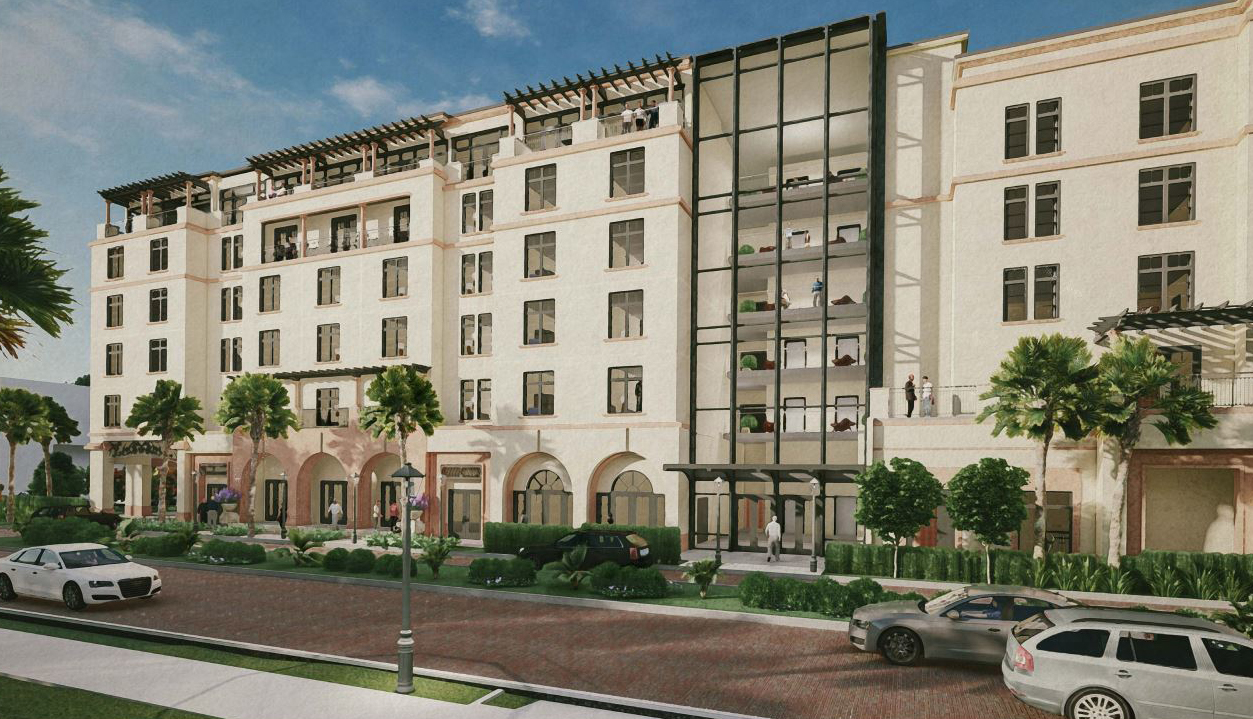 On August 29, Rollins College announced the cancellation of public hearings in September and October on the expansion of the Alfond Inn and the proposed construction on the Lawrence Center site at 200 E. New England Ave.
Phase II of the Alfond
The Alfond Inn expansion has been long in the works as Phase II of the original plan. It includes the addition of 70 hotel rooms, bringing the total to 182, and the addition of a spa and health club, 4,000 square feet of meeting space and just over 300 square feet of retail space. The expansion also called for an additional 153 parking spaces.
Relocation of Crummer Business School and Cornell Fine Arts Museum
Redevelopment of the Lawrence Center site, at New England and Lyman, was a three-phase project consisting of a new parking structure, a new facility for the Crummer Graduate School of Business and new space for the Cornell Fine Arts Museum.
In order to complete all three phases, the college was requesting a zoning change from Office (O-1) to Institutional (PQP or Public-Quasi-Public).
Public-Private Parking Arrangement with City
As part of Phase I of the project, Rollins was seeking a Conditional Use Permit to build a three-level parking garage to serve the business school and museum properties. The City of Winter Park was contemplating a public-private partnership to expand the garage to four or five stories. This would provide an additional 120-180 public parking spaces in the Central Business District (CBD) and would require a change in the height map from three to four or five stories.
‘Innovation Triangle’
In a letter from Rollins Vice-president of Business and Finance & Treasurer Ed Kania to City Manager Randy Knight, which was provided to the Voice by the City Communications Director Clarissa Howard, Kania described the three-part expansion – the Alfond, the Crummer Graduate School of Business and the Cornell Fine Arts Museum – as the “Innovation Triangle.”
Kania formally withdrew Rollins’ request for public hearings regarding the Innovation Triangle that had been scheduled in September and October. “We would like to withdraw these requests,” he wrote, “in order that we may investigate other potential parking locations to better meet the needs of the College and the residents of Winter Park.”
Projects on Temporary Hold
“With so many exciting and mission-critical projects taking shape at Rollins,” wrote Chief Marketing & Community Relations Officer Sam Stark, “we are putting a temporary hold on our Lawrence Center and Alfond Inn expansions in order to explore and evaluate some cost-saving and project-sharing opportunities that will benefit the College and the community.”
Winter Parking
Winter Parking
Will the City Kick the Old Rules to the Curb?
 For the past year or so, the Kimley-Horn parking gurus have been lurking about Park Avenue, Hannibal Square and the Orange Avenue corridor scoping out parking lots and counting cars. They are scrutinizing parking codes that have remained essentially unchanged since the 1970s.
1970s — Merchants vs. Restaurateurs
The codes weren’t entirely static, however. There was some back-and-forth caused by competition between retail merchants and restaurateurs for parking on Park Avenue. In the early 1970s, there were four restaurants on Park Avenue. By 1982, that number had increased to 18, and the retailers were feeling the pinch.
1980s – Too Many Restaurants!
In response to an outcry from Park Avenue merchants, the city formed a Downtown Parking Advisory Commission to study the problem. In 1983, the Commission adopted their recommendation and passed an ordinance that new restaurants could be approved only when they provided sufficient parking. Bakeries, coffee shops, ice cream and dessert shops were exempted from the new rule.
2000s — Enter Winter Park Village
Move forward 20 years to 2003. Winter Park Village opened with four fancy new restaurants and a movie theater with stadium seating. It quickly became the place to be. Once again, Park Avenue merchants felt the pinch, but this time it was because there weren’t enough restaurants. La Belle Verrierre, East India Ice Cream Company and Two Flights Up had all closed, reducing by 400 the number of restaurant seats. All three locations converted to retail.
2003 – Not Enough Restaurants!
So, in 2003, the Commission saw the wisdom of attracting restaurants and the associated foot traffic to Park Avenue to improve the retail climate. They passed an ordinance that allowed new ‘fine dining’ restaurants (with wait staff and table service) on Park Avenue to open without providing the incremental increase in parking. This zoning change quickly produced the desired effect. Since 2003, 17 new restaurants have opened along Park Avenue – adding a whopping 1,471 new restaurant seats.
2018 – Too Many Restaurants!
Based on the current Central Business District (CBD) parking code of one parking place per four restaurant seats, those 1,471 seats equate to 372 parking spaces. Those 17 new restaurants replaced former retail locations. Compare the retail parking requirement with that for restaurants, and under the present code you end up with a parking deficit of 207 spaces. Basically, this puts the city right back where it was 36 years ago.
2018 – The Pendulum Swings Back
That brings us to the August 7, 2018 meeting of the Planning & Zoning (P&Z) Board. City Planner Jeff Briggs presented a draft parking ordinance affecting the CBD, Hannibal Square and the Orange Avenue corridor.
The draft ordinance, which has six components, was not an action item – it was up for discussion only. A summary of the proposed ordinance follows.
1.Retail to Restaurant Conversions
The ordinance removes the ability to convert retail or office space to restaurant without providing the required parking spaces. This change is supported by Comprehensive Plan Policy 1-G-3: “Preserve Park Avenue as a retail shopping district with complementary restaurant destinations, maintaining existing Future Land Use Map designations and zoning and prohibiting bars and nightclubs.”
2.New Retail & Office Requirements
The proposed ordinance changes parking requirements for new retail and office from one space per 250 square feet to one space per 350 square feet.
3.Large Office Buildings
Requirements for new large office buildings would provide one space per 250 square feet for the first 20,000 square feet. For floor area exceeding 20,000 square feet, the requirement would be one space per 350 square feet.
4.Shared Parking
The ordinance provides for the use of the Urban Land Institute’s (ULI) shared parking analysis as a reference. Limited types of shared use make sense in Winter Park, such as retail or office buildings with upstairs residential. In a few circumstances, a restaurant might share parking with a nearby institution such as a school or church.
5.Distance for Offsite Parking
The ordinance would change the distance permitted for offsite parking from 300 feet to 450 feet. As Briggs pointed out, that would be going from the length of one football field to one and a half football fields. P&Z Chair Ross Johnston suggested that if employees were required to use offsite parking, that would free up on-street parking for customers who want closer proximity to their destinations.
Johnston also pointed out the difficulty of regulating shared parking. How would the City determine if the people using the shared parking were actually entitled to it, or if they were opportunistic “parking poachers.”
6.Fee in Lieu of Parking
According to the Staff Report, instead of providing actual parking spaces, a developer could write a check to purchase or fund the required parking within a City-owned parking facility.
The City Staff Report stated: “Note that no such fee-in-lieu program can be established without a specific City Commission approved parking facility for which the funds collected are to [be] implemented for either surface or structured parking as to both location and cost and the ability to provide the same number of or more parking spaces otherwise needed to be provided on-site by the property owners electing to pay a fee-in-lieu.”
The Lawrence Center Quandary
So, if the parking must be City-owned, as stated above by the Planning Department, this raises the question: why would the City invest in additional parking decks above the proposed two-story, three-deck Rollins parking facility at the Lawrence Center – if the City is to have no ownership in or control over that facility?
On the other hand, does the City really want to get into the parking business?
“Parking is No Silver Bullet Number”
Although the draft ordinance was discussion-only, P&Z board members appeared squeamish at the prospect of recommending passage in the absence of a more comprehensive plan to deal with parking and transportation within the City. Owen Beitsch stated, “I don’t want to suggest that we don’t act, but I do want to suggest that we think about a package of solutions that constitutes a plan, not just an ordinance that says these are the ad hoc things we want to change.”
Ordinance is One Piece of a Much Larger Puzzle
Briggs responded that there are many aspects to the downtown parking puzzle – such as employee parking, valet parking, parking enforcement, how to create new parking – and the ordinance addresses only the Zoning Code. And that is the purview of P&Z – the zoning code.
Johnston responded to Briggs, “What you’re hearing is that we’re trying to get an ordinance in isolation that has other contingencies attached to it, and we’re not comfortable isolating that part of it. . . . We need to see what the net result of our actions is.”
In other words, will the ordinance alleviate a real or perceived parking deficit? If so, how can we tell?
Where Will the Ordinance Go Next?
Briggs explained that the next step was a similar non-action discussion of the ordinance with the Commission on August 27. The P&Z Board will meet the following day, August 28, for their regular work session, and Briggs will update them about the discussion at the Commission meeting. If the ordinance is still moving forward, there will be a public hearing before P&Z on September 11. P&Z will be asked to vote at that meeting.
If the ordinance passes, it will go back to the Commission September 24 – the same meeting at which the Commission will take up the Lawrence Center expansion. While it is appropriate for discussion of the two matters to coincide, citizens are advised to pack a lunch, as this could be a lengthy discussion.
Who ever said parking was boring?
The Time for Public Input is ALWAYS!
The Time for Public Input is ALWAYS!
Editor's Note: Articles written by citizens reflect their own opinions and not the views of the Winter Park Voice.Randy Knight, City Manager of Winter Park
 The city always asks for public input and considers this input vital to our city governance. Winter Park operates under a representative form of government. This means we, as citizens, elect representatives to run the city, pass laws and regulations, address development requests, and plan for the future of our city. As part of that process the city ALWAYS asks for community input and often times it provides opportunities for that input multiple times before final decisions are made.
When the question arises, “has anyone asked you…” about items such as the Lawrence Center Garage, parking or mixed use, the answer is, “Yes, the city has asked or will ask as part of the process.”
For the proposed Lawrence Center Parking Garage, a citywide notice was mailed to all city households at the beginning of August asking interested residents and stakeholders to attend and share their input at upcoming meetings. The notice was also posted on cityofwinterpark.org/citywide. The dates for public input are Tuesday, September 11, for the Planning & Zoning Board and Monday, September 24, for the City Commission meeting. Both meetings are held in Commission Chambers located on the second floor of City Hall.
For the proposed parking code changes, a community input meeting was held in July, multiple summits were held in 2017, and the City Commission was provided an update at their March 2018 meeting. These meetings were noticed by various means. Subscribers to citEnews were emailed a notice. The meetings were posted online with related reports posted on cityofwinterpark.org/parking, postcards were mailed to 274 property owners in the corridors directly impacted, and advertisements were placed in the newspaper. If an ordinance modifying the parking code moves forward for City Commission consideration, those meetings will be advertised and public input taken in public hearings at the Planning & Zoning Board and at two separate City Commission meetings.
The Orange Avenue pilot project for mixed use was just suggested at the July 10 Commission work session. This will be a multi-month study/process and public input will be solicited throughout that process. This project was considered by your elected representatives over Aloma Avenue, West Fairbanks Avenue and Lee Road because there are three major properties along that corridor that have expressed interest in redevelopment over the next 24 months. That is not the case for the other corridors.
We understand what a challenge it can be in our busy lives to keep up with the various issues being addressed by the city and that is why we use multiple methods to get the word out. The best ways to stay informed for these types of projects are to subscribe to the citEnews emails at cityofwinterpark.org/citEnews or periodically visit the city’s official website for upcoming board & public meetings at cityofwinterpark.org/bpm.
Recent Comments