What is a “Third Place?”
What is a “Third Place?”
Why Is It So Important?
 All of us know those special “cool” places we seek out when we want to experience personal fulfillment beyond our First Place (home) and our Second Place (work).
These places have certain characteristics we enjoy. They present socially diverse, culturally engaging environments. These “social condensers” or “civic cafes” encourage open conversation and create places for all levels of a community to come together. They allow the suspension of social and political distinctions that have made us increasingly divided and isolated.
Ray Oldenburg, in The Great Good Place (1989), calls these locations Third Places. Third Places are critical to a community, according to Oldenburg. Dom Nozzi, AICP, summarizes Oldenburg’s notion of Third Places:
[av_promobox button=’no’ color=’theme-color’ custom_bg=’#444444′ custom_font=’#ffffff’ size=’large’ icon_select=’no’ icon=’ue800′ font=’entypo-fontello’ box_color=” box_custom_font=’#ffffff’ box_custom_bg=’#444444′ box_custom_border=’#333333′]
They are distinctive informal gathering places, they make the citizen feel at home, they nourish relationships and a diversity of human contact, they help create a sense of place and community, they invoke a sense of civic pride, they provide numerous opportunities for serendipity, they promote companionship, they allow people to relax and unwind after a long day at work, they are socially binding, they encourage sociability instead of isolation, they make life more colorful, and they enrich public life and democracy. Their disappearance in our culture is unhealthy for our cities because . . . they are the bedrock of community life and all the benefits that come from such interaction.
[/av_promobox]
Other experts like William H. Whyte (City) and Fred Kent, Founder of Project for Public Spaces www.pps.org, have described the distinctive characteristics of a successful Third Place. It must be readily available to all groups – either free or for a nominal charge — to enter and purchase food, drink, entertainment, be educated or partake of other activities that are present within. It must be easily accessible to neighborhoods, community stakeholders and visitors. It should be a place where people feel welcome and comfortable, and where they are encouraged to enter into conversation with one another. People who go there should anticipate meeting old friends and making new ones, and they should expect to take away something they cannot normally find in other places.
Examples of important Third Places include cafes, parks, museums, libraries, playing fields, churches and bars. A good new Third Place builds its own constituency. It gets people to form routines — for example, alfresco lunches, morning lattes or the children’s storytelling time. This encourages people to use new paths. In other words, supply will create demand.
Oldenburg points out that desirable experiences will occur when there are places that are conducive to them — or they will not occur at all. When certain kinds of places are not active, certain positive experiences disappear. A Third Place is not something to look at, it is something to live within.
Today, the City of Winter Park is, itself, a Third Place. It is envied and studied by cities and planners locally, regionally and internationally. Citizens and visitors alike know and enjoy the long-ago developed Third Places within our Third Place, like Central Park, Park Avenue, Mead Gardens, museums, sidewalk dining, the golf course — the list goes on. Over time, some of these places have even changed location, like our library, hotels and post office.
As a 30-year citizen I’ve been blessed to live and raise our two daughters in Winter Park. I would encourage not only the preservation of our past and present world-class Third Places, but also ask that we all support our city’s process of envisioning our future. Continuing to create new Third Places that help further express our rich diversity and ability to socially and intellectually connect with one another may make us one of the very few cities that can continue to do what others cannot.
Worth Protecting
The Winter Park Voice and the Casa Feliz Parlor Series will present a panel discussion entitled "WORTH PROTECTING: Historic Preservation – What Does It Mean for Winter Park?”...
Board Slogs Through Draft HP Ordinance
Board Slogs Through Draft HP Ordinance
Segal Becomes Chairman
 Using some pretty intense persuasive tactics, Mayor Steve Leary prevailed and his candidates for the Historic Preservation Board (HPB), former County Commissioner Bill Segal, Winter Park resident Laura Armstrong and architect Phil Kean, finally won approval from the City Commission in a 3 – 2 vote, with Commissioners Carolyn Cooper and Greg Seidel dissenting.
Segal to Head HPB
At his first HPB meeting on August 12, Bill Segal was elected Chairman by the four members present – which included Segal himself — replacing Interim Chair Rebecca Talbert. Phil Wood was named Vice-Chair. The fourth member present was Genean McKinnon, who nominated both Segal and Wood. Talbert expressed her willingness to remain as either Chair or Vice Chair, but her motion failed for lack of a second.
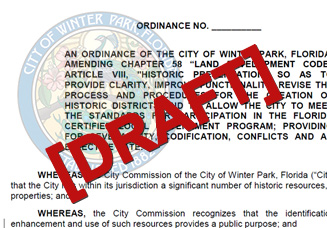
Once the question of board leadership was settled, the first order of business was a review of the revisions to the draft Historic Preservation Ordinance that will come before the Commission at the November 9 meeting.
Stone and Hamner Champion Historic Preservation
Frank Hamner of the Citizens’ Group that has been working on the draft ordinance presented the latest version to the HPB. During the arduous page-by-page review, Hamner and City Planning Director Dori Stone found themselves in the curious position of defending historic preservation to the very board that is meant to champion the cause.
HPB Is Not So Sure
Discussion among the board members was more about the disadvantages the proposed ordinance would create for individual homeowners than about possible benefits to the City of preserving historic buildings and districts. “Everything we’re doing here creates an added burden,” said Segal.
Hamner pointed out that, unlike other cities, Winter Park has no means, other than the ordinance, to protect a truly historic home.
Segal Balks at CLG Status
Segal expressed concern about the City’s application to the State of Florida to become a Certified Local Government (CLG). He worried about “extra levels of government” and additional reporting requirements. Despite Stone’s assurances that the City already complies with most of the CLG requirements, and that CLG status would not put any appreciable extra burden on city staff, Segal could not be persuaded that it is a good idea for the City to apply for CLG status. “We just don’t know what we’re buying into,” said Segal.
What Is a CLG?
According to Florida Department of State, “Certified Local Governments are municipal and county governments which have made historic preservation a public policy through the passage of a historic preservation ordinance. Participation in the CLG program allows local governments to partner with other CLGs to share preservation ideas and experiences, as well as the opportunity to compete for CLG grants.”
Stone pointed out that the intention to achieve CLG status has been in the City’s Comprehensive Plan for the past 14 years, though the City has never made formal application to become a CLG.
The CLG grants tend to be small — $50,000 or less – but they have their merits. For instance, the last inventory of potential Winter Park historic assets was done in 2001. Since that time, much has changed. We are told there is no money in the budget to update the inventory, but if Winter Park had CLG status, it would qualify for a grant to complete the inventory. The inventory would cost in the neighborhood of $10,000 and is the type of project for which the grants are intended.
August 19: The Slog Resumes
The August 12 meeting ground to a halt shortly before noon, as Genean McKinnon had to leave. With only three members seated, the board no longer had a quorum and could take no action. They resumed the long slog through the revisions on the afternoon of August 19. At that meeting, Dori Stone informed the board that they would receive a completed draft reflecting all proposed revisions, and that they would vote at their September meeting on whether to approve the ordinance.
Once the final draft has been approved by the HPB, it will go for public hearings in October and then for a final vote by the City Commission at the November 9 Commission meeting.
Winter Park: Unique for Not Being a CLG
So far, language stating that Winter Park will seek CLG status remains part of the existing Historic Preservation Ordinance. Sixty-eight Florida cities and 12 counties are Certified Local Governments. Most Florida cities that are known to have historic resources are CLGs – among them Tampa, St. Pete, Miami, Coral Gables, Sarasota, Orlando, and the list goes on until you get to the Ws, where you’ll find West Palm Beach, Windermere, and Welaka . . . but not Winter Park.
Why not?
There appears to be firm conviction on the part of Mayor Leary, some members of the Historic Preservation Board and certain denizens of the blogosphere that CLG status will introduce yet another layer of government and bureaucracy, which will be onerously burdensome to city staff – though city staff doesn’t seem to see it that way. Planning Director Dori Stone, who would be the local official responsible for administering the CLG program, informed the HPB that the City of Winter Park already fulfills nearly all the requirements for being a CLG, and that any additional staff work would perhaps entail an extra 8 to10 hours per year.
What do the Real CLGs Tell Us?
The folks at Preservation Winter Park were also curious about the amount of work required of CLGs and whether the burden outweighed the benefits. They contacted people with firsthand knowledge, among them local officials who administer the CLG program in West Palm Beach, Lakeland, Miami-Dade and the City of Orlando.
This is what they were told.
West Palm Beach: “In no way has it been a burden. One hour a year of completing a report and emailing minutes.”
Lakeland: “To my knowledge, Lakeland has not been burdened by our CLG status whatsoever.”
Miami-Dade: “It’s never been a burden to be a CLG.”
Orlando: Small amount of staff time for reporting to state and National Park Service.”
Is This How You Would Describe Winter Park?
In her email to Preservation Winter Park, Kathleen Slesnick Kauffman, Historic Preservation Chief of Miami-Dade County, wrote: “It is not a difficult or lengthy process to become a CLG, but the whole point of the program is to provide a benefit to cities or counties that have an expressed interest in saving their heritage, and have made it a priority to do so by having a strong preservation ordinance.”
She continued, “Is this how you would describe Winter Park?”
Recent Comments