Ladybird, Ladybird, Fly Away Home . . . .
Ladybird, Ladybird, Fly Away Home . . . .
Traffic, Congestion and Noise = Project Denial
On June 27, the Ladybird Academy came before the Commission to request a reversal of the Planning & Zoning Board’s denial of their application to build a 13,000-square-foot preschool and child care facility on the west side of the K-Mart Plaza fronting Gay Road and Trovillion Avenue.
Residents: Pre-School Not Compatible with Neighborhood
Near some of Winter Park’s most congested intersections — Lee Rd. at 17-92 and Lee Rd. at Webster – the neighborhood between the K-Mart Plaza and Lake Killarney has quiet, two-lane streets and is home to the Killarney Bay and Chateau du Lac condominium complexes, as well as several smaller single family homes. The population is predominantly, though not exclusively, seniors. Residents from this peaceful neighborhood showed up in force, with signed petitions, to oppose the proposed child care facility.
Peak Hour Operation for 144 Kids
Ladybird Academy, a franchise operation with several locations in Central Florida, wanted to build a preschool and child care facility that would accommodate 144 children. They planned to operate between the hours of 7:00 a.m. and 6:30 p.m. The company, incorporated in 2011, is headquartered in Lake Mary. Ladybird offers not only day care and preschool for children ages 6 weeks through 5 years, it also offers before- and after-school and summer camp programs, according to their website. www.ladybirdacademy.com
Neighbors Fear Noise, Traffic
On June 7, the Planning & Zoning Board heard extensive public comment about increased traffic when parents dropped off and picked up their children during morning and evening peak traffic hours – those times when drivers trying to avoid congestion on Lee Road and 17-92 cut through the residential streets. Residents also were concerned about the level of noise that might be generated by 144 children during lunch and recess.
Major Retail Coming to the Area
Residents pointed out that much of K-Mart Plaza is presently unoccupied because it is undergoing renovation. The Whole Foods center, which also will have other major retailers, is also due to open soon. City Planning Director Jeff Briggs noted that traffic generated by these additional large retail developments will be spread out over the day, reducing the impact at any one time. To add an additional 140 or so cars at peak traffic hours, however, could tip an already stressed road system into total gridlock.
Ladybird Experts Weigh In
Ladybird Academy produced a sizeable group of experts that included a traffic engineer and a real estate appraiser, each bearing the proper list of credentials. The traffic engineer cited statistics indicating that both 17-92 and the interior neighborhood streets were currently operating well below capacity, a condition that is not immediately apparent to the anecdotal observer.
The real estate appraiser, Mark Carpenter, was tasked with reassuring current residents that the proposed daycare facility would not diminish the value of their property. He contended that the project would have the opposite effect, to enhance property values. “Basically, right now,” he said, referring to the proposed site, “it’s an eyesore.”
Gladys Renqifo-Ellis who, like many of her neighbors, enjoys the quiet expanse of green space that is the proposed site, disagreed with Mr. Carpenter’s characterization.
Ladybird Seeks Conditional Use Approval
While the Ladybird Academy project did not require zoning changes, because of the nature of its business, the project had to meet 12 criteria for Conditional Use set forth in city code. These criteria were enumerated by City Attorney Kurt Ardaman.
Basically, the code requires the proposed project be consistent with the Comprehensive Plan and comply with land use code. The building, landscaping, and irrigation must be compatible with the scale and character of the surrounding neighborhood. There needs to be adequate parking, lighting, storm water retention and noise mitigation.
Academy Fails Compatibility Test
Where the Ladybird Academy project fell short was in the area of compatibility. Criterion #3 reads: “Operating hours, noise, parking and traffic impact will be compatible with existing and anticipated land use activities in the immediate neighborhood and compatible with the character of the surrounding area.”
Criterion #7 reads: “That traffic generated from the property use should not on a daily or peak hour basis degrade the level of service on adjacent roads or intersections. . . . That access directs traffic away from residential roads and toward more heavily traveled roads.”
According to Ardaman, if the project fails to meet any of the criteria for Conditional Use, it is the obligation of the Commission to uphold the decision of P&Z and deny the application.
Ladybird Academy failed the test.
H-Words: ‘Heritage’ and ‘Historic’
H-Words: ‘Heritage’ and ‘Historic’
Are They History?
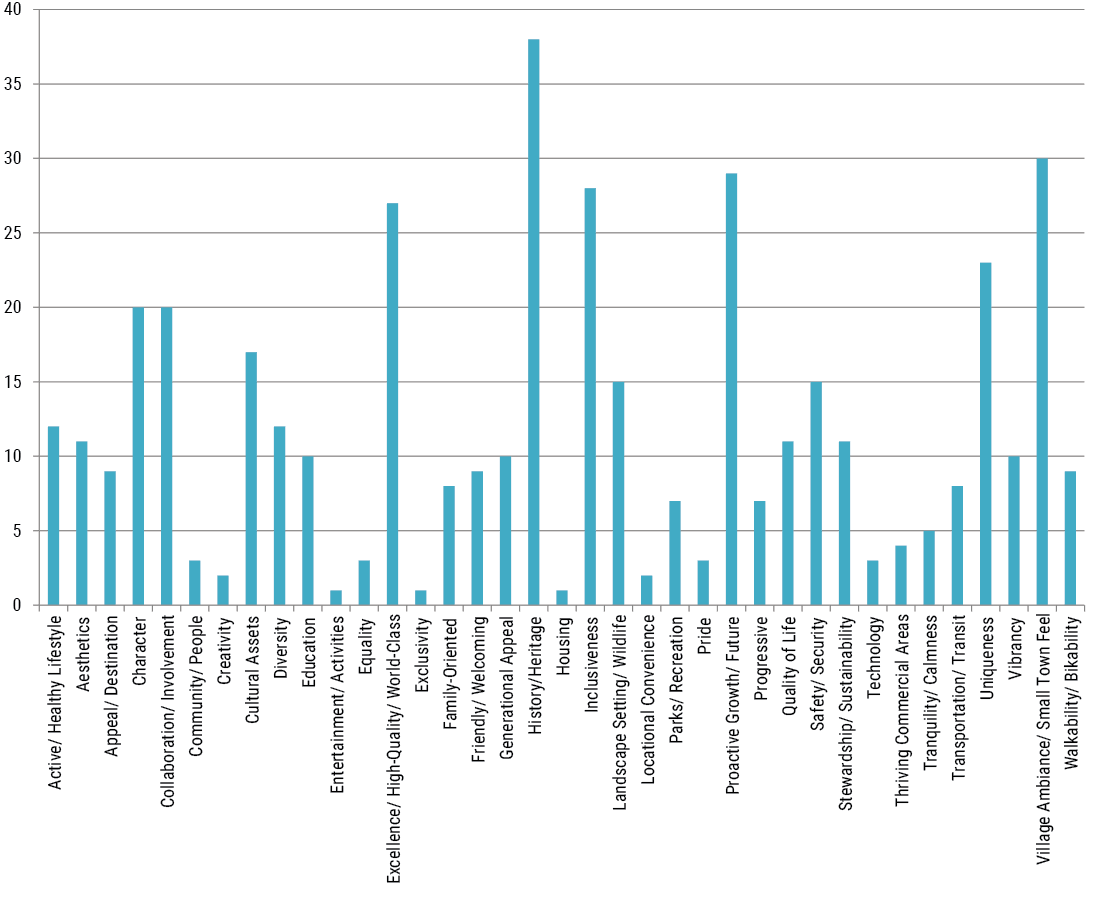
Winter Park’s Visioning Task force has spent more than a year coming up with a vision of how the City will grow and develop. Among the exercises the Task Force conducted was a survey in which citizens were asked what, about Winter Park, was most important to them. The results are illustrated in the graph below. “History/Heritage” beat every other descriptor hands down.
Draft Vision Statement: No Heritage There
Yet, in the final draft of their report to the Commission, the Visioning Task Force removed the word Heritage from the city’s vision statement. Winter Park went from being “The City of Culture and Heritage” to being “The City of Arts and Culture. . . .”
Historic Districts: Ever More Difficult
Meanwhile, on March 15, after running on a one-plank platform of property rights, Peter Weldon was elected to the City Commission. Throughout his campaign, Weldon promised to undo the combined work of the Citizens Committee on Historic Preservation and the Historic Preservation Board, whose members had worked for more than a year to craft a revised Historic Preservation Ordinance. The Commission had approved the revised ordinance in November 2015.
That ordinance lasted a little more than six months. On May 23, the voting threshold for formation of an historic district was restored. The votes required went from 50 percent plus one to two-thirds. The revised ordinance makes designation of historic districts in Winter Park more difficult than in any other Florida city.
Voluntary Historic Designation ‘Encouraged’ . . .
The amended ordinance calls for the City to publish a list of properties which either carry historic designation or are located in an historic district, so that prospective buyers will have prior knowledge of what they are getting into if they purchase a house that has been designated or is located in an historic district. It also contains language about “encouraging voluntary participation.”
Toward that end, Commissioner Weldon drew up a list of six suggested encouragements, which the Historic Preservation Board (HPB) met to discuss in a June 22 work session. Proposed incentives include reducing or waiving building permit fees, waiving the fee to underground utility service, small need-based rehabilitation grants, ornamental streetlights for districts, a complicated ‘transfer of development rights’ and staff assistance with National Register applications.
But Under-funded
City Planning Director Dori Stone told the HPB there is a total of $50,000 in the City budget for historic preservation incentives. Stone stated that historic preservation, especially updating the Florida Master Site File (an inventory of properties that have been or could be designated historic) will “definitely take a back seat” to the upcoming Comprehensive Plan review.
“Words Do Matter,”
. . . one Voice reader posted on this website. And these words – history and heritage – are still important to those who call Winter Park home. At the June 27 Commission meeting, Commissioner Sarah Sprinkel called on the City to celebrate her heritage. Sprinkel was talking about citizens and their contributions to the City. “Heritage is more than a building,” she said. And to Sprinkel, Winter Park’s heritage is important and worthy of a celebration.
Another way Winter Park could celebrate her heritage is to restore the word heritage to the Winter Park Vision Statement. The final draft of Vision Winter Park will come before the Commission at its next meeting on July 11.
City staff and members of the Visioning Task Force have spent a great deal of time meeting with and listening to the citizens.
Did they hear?
The restoration of this small word, which has no fiscal impact, would carry a great deal of weight with the citizens of Winter Park.

Every Possible Library Site Got Close Scrutiny
Every Possible Library Site Got Close Scrutiny
Guest Columnist – Tom McMacken
Editor's Note: Articles written by citizens reflect their own opinions and not the views of the Winter Park Voice. On March 15th, a record number of Winter Park voters went to the polls. As a candidate for re-election, I had spent months outlining a vision for our City. I participated in candidate forums, sent mailers, visited residents’ homes and had countless one-on-one encounters.
That Is How Democracy Works
When it became apparent on the evening of the 15th that a majority of residents did not share this vision, I phoned the new Commissioner-elect and congratulated him. Was that difficult to do? Yes. Was I disappointed in the outcome? Yes . . .but that is how democracy works.
New Library: Elected Fair & Square
The proposed new library and events center at the civic center location in Martin Luther King, Jr. Park went through the same process I did. Those in favor and those opposed had equal opportunity to present their views. After reviewing all the points for and against, a majority of residents voted to approve moving forward to secure the bonds necessary to make the vision of a library and events center of the future a reality in our community.
Petition Could Stop the Library
As with any vote, some people were disappointed with the outcome. Unfortunately this disappointment has manifested itself into a petition drive that could prevent the new library and events center from being built.
The City has declared the petition drive invalid, but in order to assure potential bondholders that the bonds and the location of the new library and events center are valid, the City of Winter Park has been forced to initiate a “bond validation” process. As with any legal action, the expenditure of time and money will result in additional cost to the tax payers.
Commissioners Did Not Mislead Voters
What is far more upsetting to me than the petition drive is the claim by the organizers that somehow the residents of Winter Park were misled by the Library Task Force and, ultimately, by the City Commission. As a Commissioner, I was involved in this process from the beginning, and I find this line of thought insulting and totally without merit.
15 Sites Examined
During my six years on the Commission I can think of no other issue that was more thoroughly vetted than the library. A Library Task Force appointed by the Commission and comprised of residents from a broad political cross-section of the City worked for 17 months to ascertain the validity of a new building and to identify the best possible location. During this time, dozens of public meetings were held seeking input on more than 15 different sites.
MLK Park Won Out
Once the civic center site in MLK, Jr. Park showed promise, a two-day Community Charrette was held at the park to again obtain input from residents. This charrette was attended by scores of residents in person and hundreds more who participated online. After weighing all the options, the Library Task Force was unanimous in their recommendation of a new library and events center to be located at the civic center site in MLK, Jr. Park.
As I watched the selection process narrow down to the park, I remembered back to a design studio in college where our professor encouraged us to think of parks not only as places of recreation but also re-creation; that parks, art, and education enjoyed a unique relationship. The ability of this new facility to relate to and enhance the experience of both library and park users is exceptional.
The fact that this can be accomplished within essentially the same impervious footprint of the existing Civic Center speaks volumes about our community’s respect for our open spaces.
But the process did not stop with the Task Force. Their recommendation was just that, a recommendation. It still had to withstand the scrutiny of the Commission and additional public input. Repeatedly during this phase, citizens approached the Commission wanting verification of where a new library would be located, and repeatedly they were assured that MLK, Jr. Park would be the home for the new building should the bond referendum pass.
The process took another step forward when a majority of the Commission voted to accept the recommendations of the Task Force and place the issue on the ballot for the residents of Winter Park to make the ultimate decision. As I look back at the process, I struggle to find opportunities that were missed. Each site had pros and cons, but as each round of eliminations took place the civic center site remained.
Gateway to Park Avenue
The civic center site abuts Morse Boulevard along the traditional gateway to Park Avenue. The thought of extending the character of the avenue as opposed to hoarding it should be applauded, not condemned. The issue was subject to the same scrutiny that any candidate endures — months of exposure in the political arena. It was a question at every Forum, and information was provided on websites, in mailers, via phone calls and at meet-and-greets.
Advocates on each side of this issue took advantage of every means possible to get their message out. If anyone feels they were not adequately informed, I believe it is not from any form of misinformation but rather from not having taken advantage of the wealth of information that was available during the campaign.
Become Involved
I end this with a call out to all the residents of Winter Park to join in embracing the new library and events center. No congratulatory phone calls are required. All that is needed is a willingness to become involved. I was privileged to attend a recent presentation by the Aspen Institute, a world-renowned organization that has chosen our community to explore and develop programing for the library of the future.
This Is Your Library, Your City
The possibilities are endless. This programing process will continue through additional community conversations, commission meetings and design reviews. All will be open to the public. Please take the time to get involved in your community, for it is that personal involvement that makes Winter Park the special place we all call home.
Editor’s Note: Tom McMacken served two terms as Winter Park City Commissioner, from 2009 to 2015.
Recent Comments