Controversy surrounding the city’s new library project dominated the January 28 City Commission discussions, even though it wasn’t on the agenda. This time around, criticism came from state officials, who aren’t happy with the City’s plans to build its new library and civic center at Martin Luther King Park. The state has even warned that the city could lose future grant money for parks if it doesn’t comply with the rules.
None of that is stopping the City from going full speed ahead with the project. Plans are underway to tear down the Rachel Murrah Civic Center this week and take the chainsaw to 60 trees at the park between now and April.
City Out of Compliance with State Grant Rules
The Florida Department of Environmental Protection notified the City Manager in a letter dated March 6, 2018 that the city had failed to follow the rules governing a grant it received in 1994 for improvements to Martin Luther King Park. Commissioner Carolyn Cooper and several citizens pleaded unsuccessfully with commissioners to hit the pause button to resolve the issue.
Seen in this context, and taking into account the City’s failure, so far, to come up with a clear plan to bring the Canopy project back in line with the $30 Million budget approved by the voters in 2016, the decision to proceed with such haste gives one pause.
Playing the Blame Game
“There is a small group that continues to protest this project and has gone to the State and has asked the State to overturn previous State grants, once again costing the citizens of Winter Park money,” said Leary. “If we have to pay back the State . . . uh, this is a small group who are shooting people in the foot. It’s an absurd request.”
FL Department of Environmental Protection
The notification of non-compliance came from the Florida Department of Environmental Protection (FDEP) and concerned the 1994 grant for improvements to MLK Park under the Florida Recreation Development Assistance Program (FRDAP). The grant required the City to dedicate the park, in perpetuity, “as an outdoor recreation site for the benefit of the general public.” [emphasis added]
City Version of Deed Restriction Unacceptable to FDEP
A March 6, 2018, letter from FDEP General Counsel’s office warned that the Public Dedication recorded by the City in January 2018, “does not meet the requirements of the rule and is not acceptable to the department.” The letter went on to state, “Failure to comply with the department’s rules can result in the City being declared out of compliance and therefore ineligible for further grants from the department.”
This could affect the City’s application for a FRDAP grant for improvements to the wetlands around Howell Branch.
But Wait – There’s More
A January 16, 2019 letter from FDEP stated, “It has also come to our attention that some or all of the City’s previous land and recreation grants do not have restrictive covenants recorded for the parks funded by our grants.” In addition to MLK Park, the letter contains a list of other FRDAP grants for locations such as Lake Baldwin Park, Mead Garden, Phelps Park and the Howell Branch Preserve, requesting the City to provide copies of the declarations of restrictive covenants for each within 60 days.
A FRDAP grant to the City carries with it the requirement to publicly record with Orange County a covenant restricting the park to outdoor recreation, in perpetuity.
If the City converts this dedicated land to another use, according to the January 16 FDEP letter, the City must “. . .replace the removed property with property of similar size and value and replace any facilities (such as the walking trails around the current civic center that were part of the FRDAP grant) that will be removed by the new construction.”
Citizens Urge Caution
During public comment, several citizens urged the Commissioners to move cautiously with their demolition plans until the way forward is clearer.
“I see a tendency by the City to insulate itself from opposing views and from citizen input,” began Beth Hall. She pointed out that the original Library Task Force had considered multiple sites for the new library, MLK Park among them. “But I don’t see where the FRDAP grant was pointed out or considered by the Task Force,” she said. “Thus a major restriction on the viability of the site was ignored.” Hall pointed out that the City had made no attempt to inform voters of this issue at the time of the bond referendum.
Who Knew about the Grant?
In a January 30 email responding to a public records request from Beth Hall, City Clerk Cindy Bonham confirmed the City has no records of communications or materials about the MLK Park FRDAP grant being provided to the Library Task Force, to the Commission, to the Planning & Zoning Board, the Library Board, the Library Staff or to the trial court that heard the bond validation suit.
Road Not Taken
Referring to the FDEP requirement to replace all converted lands with land of similar value, Hall asked the Commission to remember the bowling alley property. “That it is gone is a failure of long-term vision and strategic thinking,” she said. “Maybe hearing other voices would have taken us another way, but we will never know, for that was the road not taken.”
When is a Canopy Not a Canopy?
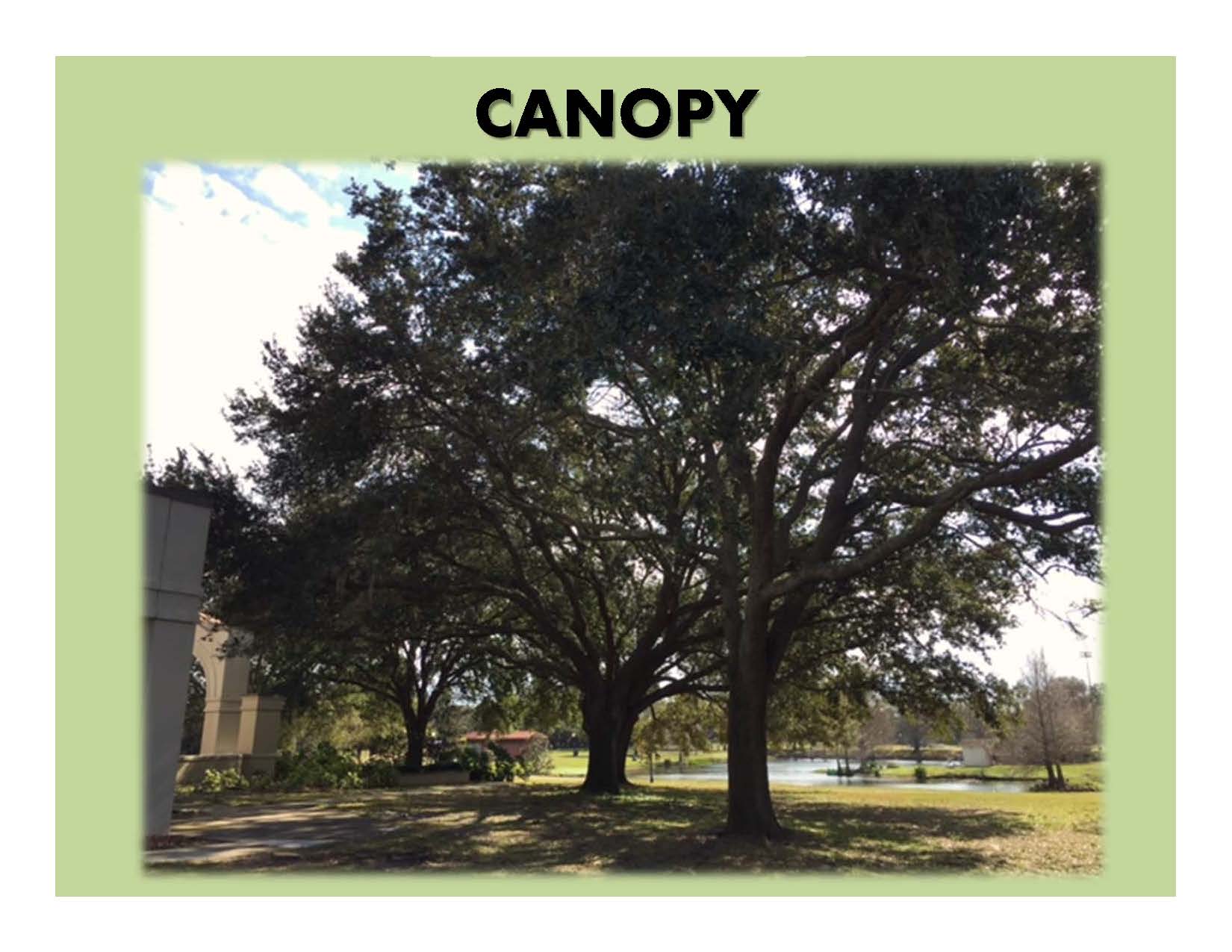
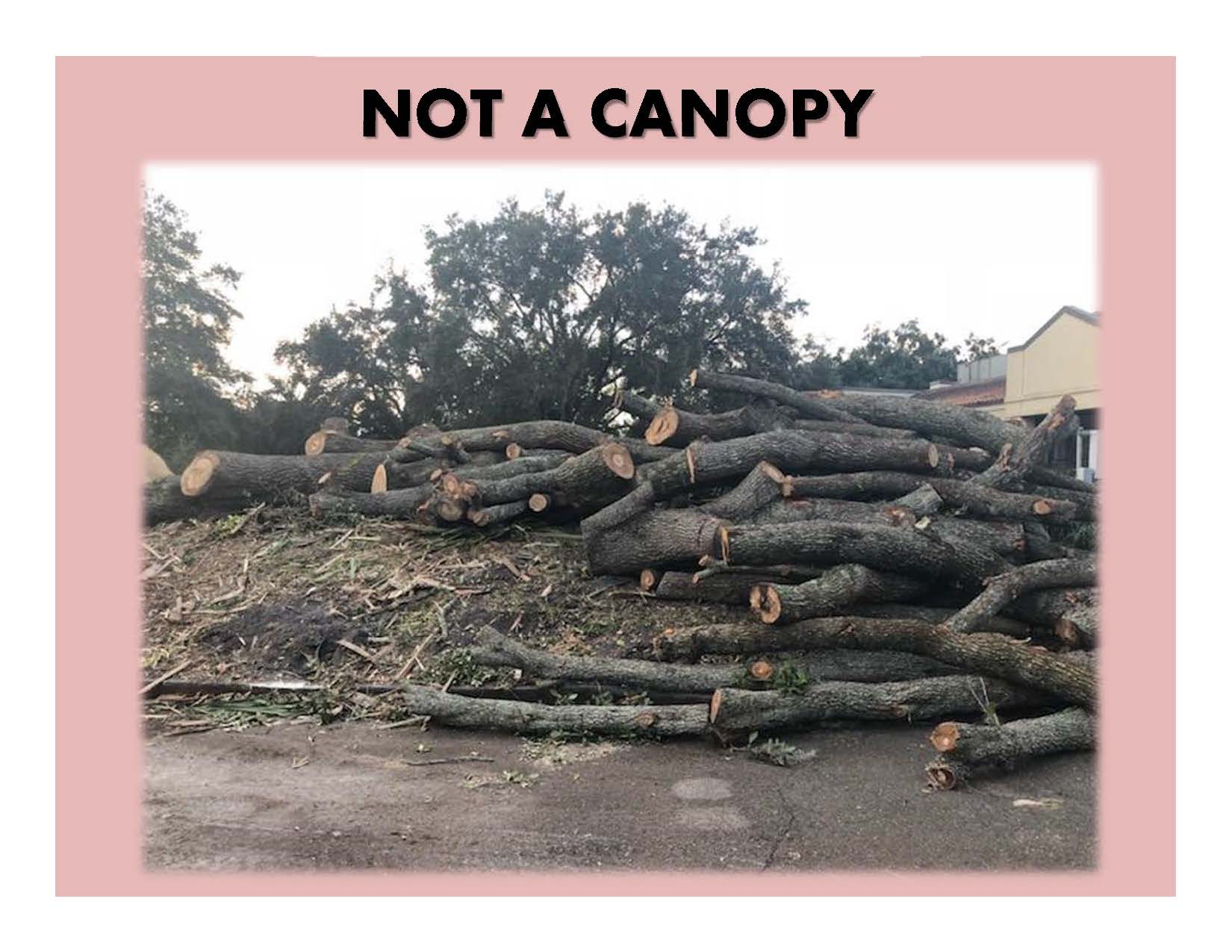
Charley Williams displayed the City’s tree demolition legend, which identifies more than 60 trees that will fall victim to the chainsaw this spring. He suggested the City Communications Department might keep citizens abreast of what will transpire in MLK Park. He showed before and after pictures of mature live oaks that were removed January 26 to make way for the Civic Center demolition.
Williams urged Winter Park to “show some leadership” by heeding the advice of the Winter Park Forestry department to save mature specimen trees by root pruning and moving them to safety within the park. He pointed out that other cities have done this and that there are Winter Park residents ready and willing to privately fund the project. “We’ve already named it the Canopy,” said Williams. “Now I think we ought to walk the walk.”
‘We Keep Whittling Away Amenities While the Price Goes Up’
Kim Allen enumerated ways in which the Canopy project has changed since it started in 2016. The square footage of the library is significantly reduced. Elements of the buildings, like the porte cochere at the entrance, have either been eliminated or declared ‘alternatives,’ which the City can build only if it raises additional money. The $30 Million budget cannot accommodate many elements that would seem integral to the success of the project.
Sarah Sprinkel: “It Makes Me Mad”
In her closing comments, Commissioner Sarah Sprinkel decried having what she called “an issue that some people in this community have created for us.”
Cooper reiterated her suggestion to put the matter of the grants on the City Manager’s report so that people could see periodic updates of how the City is working through the issue. Cooper’s desire for this kind of transparency was not supported by her fellow Commissioners.
Leary: “It Just Seems to be One Thing After Another”
In his concluding remarks, Mayor Leary said, “Whether it’s trees outside, or whether it’s water . . . I mean, it’s one thing after another.”
Commissioner Carolyn Cooper will serve a fourth and final term as Commissioner in Seat #3. “I am gratified to have the support of so many Winter Park residents,” said Cooper, “and I look forward to serving those residents for the next three years.”
Incumbent Peter Weldon Seeks Second Term
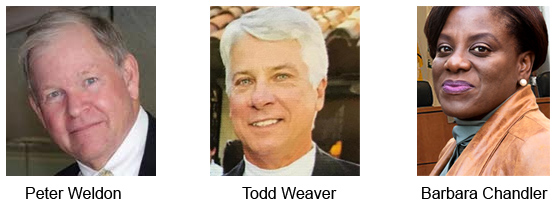
Running on the slogan “Getting Results that Matter,” Commissioner Peter Weldon is seeking a second term on the City Commission. First elected in 2016, Weldon ran on a property rights oriented platform that promised to repeal the then-newly-passed Historic Preservation Ordinance. Immediately following his election, Weldon successfully accomplished that goal. His 2019 campaign points to the many positive things that have transpired in the City since 2016.
Candidate Todd Weaver
Weaver, a semi-retired aerospace engineer and engineering consultant, has lived in Winter Park for 22 years. He served on both Winter Park and Orange County Lakes and Waterways Boards and is founder of Friends of Lake Bell. He is running as a “common sense environmentalist” and says he believes “the city needs to seriously consider the choices it makes about infrastructure and what Winter Park will look like in ten or twenty years.”
Candidate Barbara Chandler
The race for Seat #4 recently heated up as a third candidate, Barbara Chandler, threw her hat into the ring to challenge incumbent Commissioner Peter Weldon and candidate Todd Weaver.
Chandler is Manager of the Hannibal Square Heritage Center. According to her website, Chandler is running on a “Families First” platform, vowing to keep Winter Park Family-Friendly. Chandler has not responded to WP Voice requests for information as of this writing, but any information she chooses to provide will be included in an updated version of this article.
May Trigger an April 9 Runoff
If none of the candidates for Commission Seat #4 receives a majority of the vote in the March 12 general election — that means 50 percent plus one vote – that will trigger a runoff election between the two candidates who received the most votes. A runoff election, if necessary, will be held April 9.
Readers have called and messaged, saying they were told by the Orange County Supervisor of Elections office that they would be unable to vote in the March 12 election.
That was due to an error in the Orange County system which has been corrected.
Winter Park voters vote ‘at large,’ not by precinct or district. All Winter Park Voters May Vote in the March 12 election.
A small item on the City Manager’s Report at the January 14 Commission meeting stated, “Library Design: Project pricing came back on design development drawings and the project is over budget.”
Getting the Project Back to the Level It Should Be
Commissioner Greg Seidel asked City Manager Randy Knight to elaborate. “Staff continues to work with the design team,” said Knight, “trying to bring the project in on the budget the Commission’s adopted. . . . Once we get the project to the level it should be,” Knight said, “I’ll be bringing [the design] back to the City Commission . . . along with some add-alt opportunities” so the Commission can decide if they will try to fund those and, if so, how.
Should We Wait to Demolish the Murrah Civic Center?
Commissioner Carolyn Cooper attempted to make a motion to delay demolition of the Rachel Murrah Civic Center and removal of surrounding trees until the Commission has a clearer idea of how they are moving forward with the Canopy project. Cooper was, however, ruled out of order by Mayor Steve Leary because, he said, the item was not on the agenda as an action item and had not been publicly noticed.
‘Small Group of Citizens Increased Costs’
Leary went on to state, “The only increased cost to taxpayers so far has been the lawsuit brought against the taxpayers and the voters in the city by a small group. That has cost us in legal bills; that has cost us in delays. So, additional monies that must be spent to move this forward, as of today, have not been due to overages because we’re still working through the budget.”
Citizens Sought to Prevent Library Location in MLK Park
Leary was referring to the Save Our Library WP PAC’s 2016 petition drive to prevent the new library from being located in Martin Luther King, Jr. (MLK) Park. The PAC gathered 2,300 voters’ signatures in what was supposed to be a Citizens’ Initiative, which has no deadline. The City Clerk declared the petitions “insufficient,” insisting they constituted “reconsideration of a referendum,” for which the deadline had passed. The court upheld the City, and the library location was never put to a vote. According to the City Manager, the lawsuit cost the City $32,878 – slightly less than it would have cost to put the matter of location to a vote of the people.
Bond Validation Suit – ‘A Wise Investment’
The City also spent $168,881 on a Bond Validation Suit to protect the City from future legal challenge regarding the bond issue. The successful Bond Validation Suit had the added advantage of allowing the bonds to be sold at a more favorable rate. According to an attorney who was close to the situation, who asked not to be identified, “Any expenditures associated with the bond validation will be recovered over the life of the bonds and represents a wise investment on the part of the City.”
So, What Do We Know Now about Projected Costs for the Canopy?
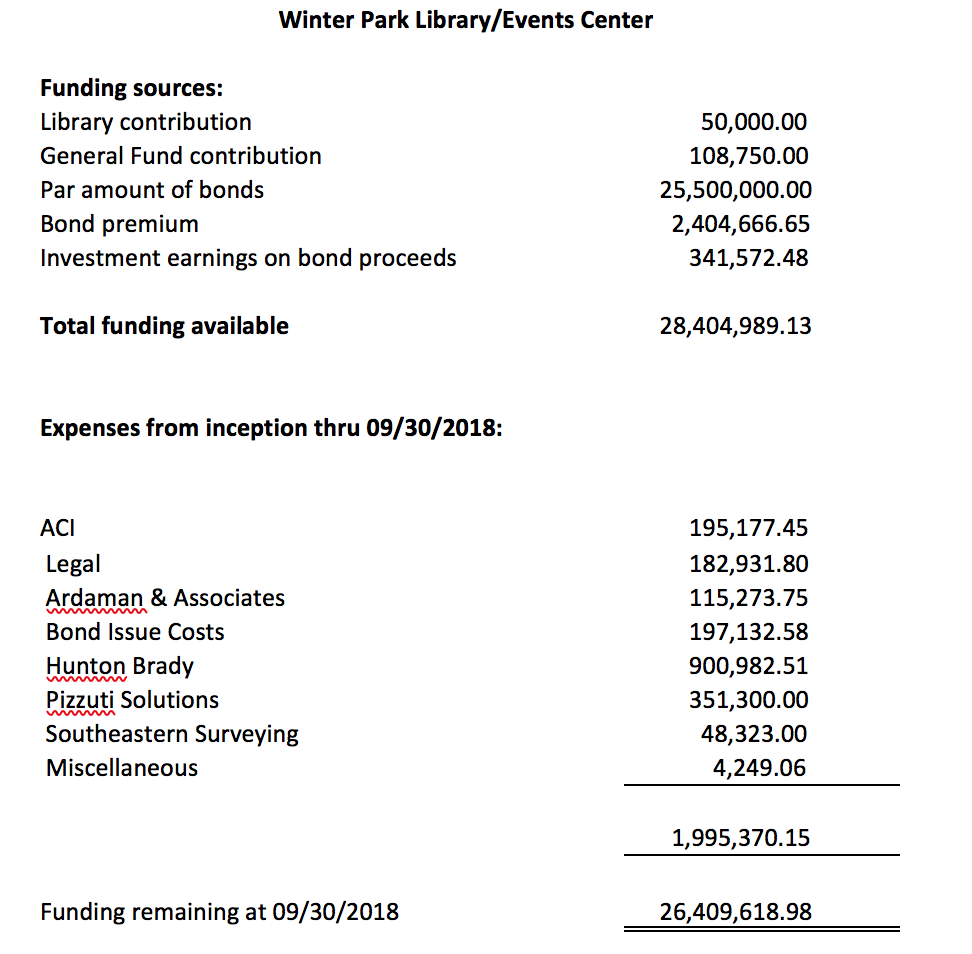
A November 2018 email from City Clerk Cindy Bonham summarizes spending and funding sources on the Library-Event Center as of September 30, 2018.
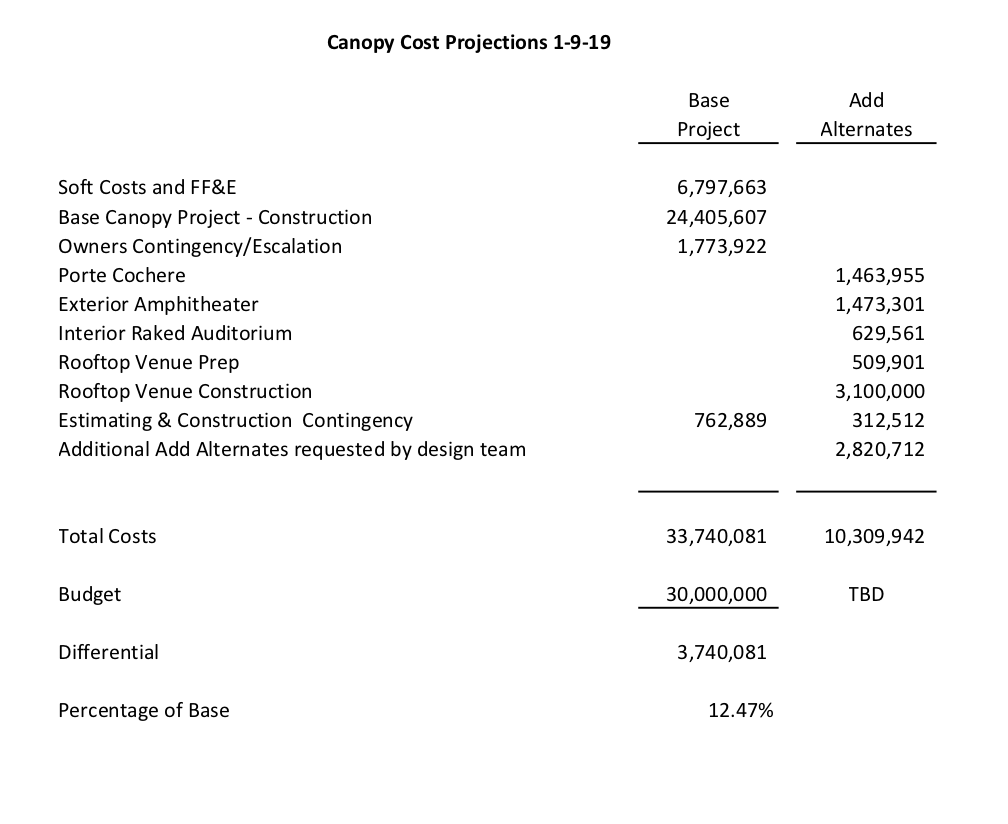
In a January 16 email to the Voice, City Manager Knight sent the most current figures available at that date which, he cautioned, are nowhere near final. “At the stage this spreadsheet was developed the base project would be 12.5 percent above budget,” he wrote. The “base project” he refers to is the library-event center without a single one of the add alternates – including the porte cochere at the entrance.
“Once the design team has managed to bring the cost of the base project to within budget,” wrote Knight, “we will present the Commission a list of add alternates that we think they may wish to consider along with potential ways to fund those alternates.”
Project Status – Only the Numbers Will Change
While Knight’s numbers will definitely change, the information he provided presents a good picture of the shape of the project and where each element now stands.
Is $30 Million Enough?
From these numbers, it would appear the original $30M budget, which was supposed to include a comfortable cushion, barely covers two of the three items on the March 15, 2016 ballot, which called for a library, events center and associated parking structure.
The associated parking structure has morphed into expanded surface parking on and around MLK Park. The library has gone from 50,000 square feet to a little over 34,000 square feet. The event center will be slightly larger than the current Civic Center, estimated at 12,600 square feet.
The enhancements envisioned for the project, such as the porte cochere at the entrance, the exterior amphitheater, the interior raked auditorium and the rooftop venue stand to shoot the budget into the stratosphere, adding between $10 and $14 Million to the cost of a $30 Million project.
The Real Work Begins
To bring this Canopy dream to fruition will take some serious compromise and fundraising of mythic proportion.
Brilliant Color, Dark Humor and an Examination of ‘Place’
Rollins College Cornell Fine Arts Museum (CFAM) launches its Winter 2019 season today with a thought-provoking exhibit featuring favorites from the permanent collection and the debut of several new acquisitions. The show builds conversations around notions of ‘place’ – the city, places of devotion, landscape, the politics of place and the experience of place beyond the immediate.
What is place?
What is home?
Where do you fit – and how?
This is the essence of “The Place as Metaphor.”
Rococolab – Brilliant Color, Dark Humor
Of particular note is the gallery devoted to “The De la Torre Brothers: Rococolab.” Collaborating artist-brothers Einar and Jamex De la Torre live and work in Ensenada, Mexico and San Diego, California. Their dynamic, baroque-inspired glass work is the product of their bicultural life, which floats freely between Mexico and the U.S.
Though they are widely known in international art circles, this is the De la Torre brothers’ first solo museum exhibition in Florida. Organized by CFAM Curator Gisela Carbonell, the presentation of their work invites consideration of some of the most pressing issues in contemporary culture. Using bright light, vivid color and some very dark humor, the De la Torre brothers’ work speaks a visual language to which contemporary viewers can easily relate.
Bicultural, Bilingual English and Spanish
As you walk into the gallery, the grouping of intricate images waits, like gifts in a box, for you to unpack each one. Open them up and discover inside the beauty, joy, dark humor and scary truths they contain. The exhibit is accompanied by an illustrated booklet, available in the museum store, which is written both in English and in Spanish.
CFAM is located at 1000 Holt Avenue on the Rollins campus. It is open Tuesday through Saturday. Admission is free in 2019, courtesy of PNC Financial Services Group. To check hours and special programs, visit the website at Rollins.edu/cfam
The show will be on view from January 17 to May 12, 2019.
We Depend on your support, make a tax-deductible donation here.
Mission
The Winter Park Voice is a trusted nonprofit journalism site that covers our City Hall and beyond. We endeavor to engage, inform and connect citizens on all sides of issues affecting the quality of life in Winter Park.



 As you walk into the gallery, the grouping of intricate images waits, like gifts in a box, for you to unpack each one. Open them up and discover inside the beauty, joy, dark humor and scary truths they contain. The exhibit is accompanied by an illustrated booklet, available in the museum store, which is written both in English and in Spanish.
Recent Comments