by Beth Kassab | Mar 12, 2026 | Arts and Culture, Historic Preservation, News
Demolition clock starts on Merrywood as preservation push builds
One Historic Preservation Board member called it a “defining moment” for Winter Park
March 12, 2026
By Beth Kassab
The clock is ticking on the fate of Merrywood.
The sprawling Winter Park estate — among the largest and most ornate homes designed by architect James Gamble Rogers II — could be demolished in as soon as 90 days unless preservationists can find a buyer willing to save it.
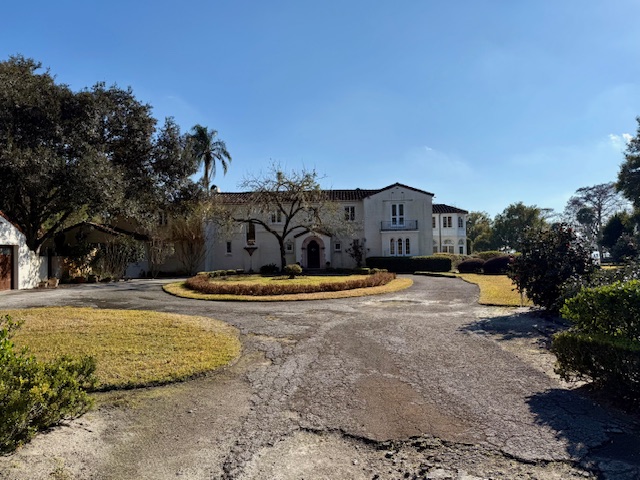
A demolition application has been filed for the property at 1020 Palmer Ave. by owners Cathleen and Raymond Gilmer, siblings who inherited the estate from their parents, who bought the 1939 lakefront home in 1977. The 3.67-acre property overlooks Lake Osceola.
City officials have limited power to stop the demolition because the home is not listed on Winter Park’s Historic Register. But because it appears in the Florida Master Site File, city rules automatically trigger a 90-day delay before a demolition permit can be issued, giving preservationists time to seek alternatives.
That countdown prompted a packed discussion before the city’s Historic Preservation Board this week that drew a who’s who of Winter Park names.
Everyone seemed to have an opinion — from Marc Hagle, known for traveling to space with his wife aboard a Blue Origin suborbital flight and for constructing what is currently the city’s largest home, a 31,000-square-foot residence just a few doors down from Merrywood, to local preservation advocates and the granddaughter of the home’s architect.
“I think, as a community, this is one of those defining moments,” said Margie Bridges, a former city commissioner who now serves on the Historic Preservation Board. “… this is one of those special homes … We have a short time to rally and step up and take care of this in any way that it’s most efficient for the buyer and preserves something special in our community.”
Tara Tedrow, the prospective buyer who has the property under contract, facilitated the demolition permit and is also asking the city to amend its comprehensive plan to allow the lakefront property to be split into two lots.
Under that scenario, she said, she would attempt to find a buyer interested in restoring Merrywood while her family could build a new home on the other portion of the property.
A Planning & Zoning Board hearing on the request was delayed at Tedrow’s request until June.
In the meantime, she said filing the demolition application was intended to start a conversation about saving the home.
“The purpose was to get folks here and to have folks talk about this so that we could at least open a 90-day window to get some creative solutions to see if there is something that can be done to preserve the house,” Tedrow told the board.
Toward the end of the meeting she added: “I want to be clear: we’re not tearing the house down on Day 91. My husband and I have no intention of actually demo-ing the house ourselves.”
Betsy Owens, executive director of preservation advocacy group Friends of Casa Feliz, said she is working to help Tedrow tap a network of preservationists and reach potential buyers for Merrywood in Florida and across the country.
Owens, the granddaughter of the home’s architect who recently walked through the property, said the structure is significant for its “remarkable level of craftsmanship” in masonry, plaster, wood and tile that would be “nearly impossible to replicate.”
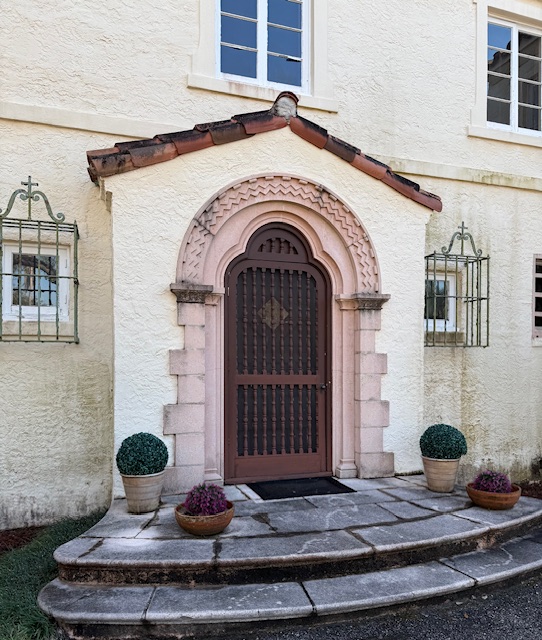
The front door of the home at 1020 Palmer Avenue.
“Merrywood contributes to the historic character of our community, helping to tell the architectural story of what makes Winter Park such a distinctive and economically prosperous place,” she said. “Together with our cherished tree canopy and chain of lakes, our beautifully designed historic homes are the goose that laid the golden egg in Winter Park … Once a building is gone, it’s gone forever. Preservation is not about nostalgia. It’s about stewardship of the cultural resources that define a community.”
She noted past examples of the community rallying to save homes threatened with demolition such as Casa Feliz, which was moved to sit on the Winter Park Nine, and the Capen House, which was floated across the lake to find a permanent home as an event space next to the Polasek Museum.
Christy Knobloch, executive director of the Winter Park History Museum, said preserving real pieces of the past is just as important as preserving archives.
“It’s hard to tell the stories of what it was in a photograph,” she said.
Other speakers noted the potentially high costs of restoring such a home and questioned whether such a buyer exists.
“I think we all love the house,” said John Skolfield, chairman of the Historic Preservation Board. “Most of us find the house very attractive and we want to find a way to preserve it. But these are big dollars, and these are not my decisions. These are the people with the big dollars who can purchase a property like this.”
Hagle, the one-time astronaut who recently completed years of construction at 926 Palmer Ave. after tearing down an older home there, said he has mixed feelings about saving the house but opposes the idea of splitting the lot.
“We just had a party at our house this last weekend — I apologize for the noise if y’all heard that,” he said. “But we had people from all over the world for a fundraiser at the house, and they all commented how gorgeous the city of Winter park is. And that’s who we are … Unfortunately, we’re in a difficult situation because it’s not fair to the homeowner to be burdened with having to save a house that was built in the 1920s that is difficult to repair.”
Aimee Spencer, a former member of the Historic Preservation Board, said she is weary of the narrative that maintaining an old home is too costly.
“I implore this board to begin to help dismantle the myth that preservation of our historic resources is cost prohibitive,” Spencer said. “It is disingenuous to continue the comparison of high quality restoration and rehabilitation to the type of new construction that generally plagues this city. Certainly there are high quality new builds, but on a whole, the comparison is that of apples to steak. True masterpieces are few and far between in Central Florida, and certainly we have already lost many. This remains an attempt at an end run around to produce two empty parcels. Lot splits are not a right in the city of Winter Park, but rather at the discretion if value is added to the city.”
The 90-day demolition delay is expected to expire around the end of May. The Planning & Zoning Board is scheduled to consider the comprehensive plan amendment that could allow the lot split in June.
WinterParkVoiceEditor@gmail.com
To comment or read comments from others, click here →
by Beth Kassab | Feb 7, 2026 | Arts and Culture, City Commission, Historic Preservation, News
Lot Split Request Puts Future of Gamble Rogers Estate in Question
Lakefront lot splits are against Winter Park policy. But the prospective owner of the largest lot on the city’s esteemed chain of lakes says the alternative could be worse — a residence so large it dwarfs the Library & Events Center
Feb. 7, 2026
By Beth Kassab
The fate of 1020 Palmer Avenue — a once-grand home and among the largest and most ornate ever designed by James Gamble Rogers II (think velvet-covered handrails) and known in recent years as “Merrywood” — appears to hinge on whether a unicorn buyer emerges to save the property.
Such a feat would take not only millions of dollars, but also approval from city officials to break one of Winter Park’s cardinal development rules: No lakefront lot splits allowed.
Tara Tedrow, the prospective buyer who has the property under contract, is asking for an exception to that rule to allow the 3.67-acre lot — the largest property on the picturesque Winter Park Chain of Lakes — to be divided into two lots on Lake Osceola. Each lot, she said, would be at least 150 feet wide and 1.5 acres or larger.
Zillow estimates the property at $12.1 million while other estimates, such as Redfin, list it at $6.4 million.
Tedrow, a land-use attorney at Lowndes who also used to practice cannabis law there, could then potentially sell the lot with the existing home and build a new home for her family on the newly created lakefront lot. The exception would be written in such a way that it would apply only to her lot and no others, according to city staff, because the lot Tedrow wants to purchase is the only one large enough.
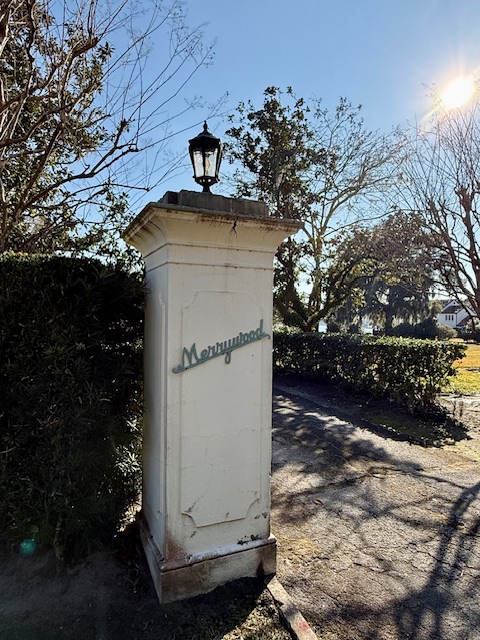
The name “Merrywood” at the start of the driveway at 1020 Palmer Avenue.
While she told the Planning & Zoning Board earlier this week that she believes the currently vacant home is beyond repair, she said she is open to talking with buyers interested in restoring the 7,000-square-foot structure, which dates back to 1940.
She also met with Betsy Owens, granddaughter of Gamble Rogers and leader of the Casa Feliz Historic Home Museum — a Gamble Rogers home and now a popular event space that was famously moved from Interlachen Avenue to just off the ninth fairway of the Winter Park Nine 25 years ago after it was threatened with demolition.
“I’m certain if I’m not in the picture, that the house will get torn down,” Tedrow told the P&Z board earlier this week of the Palmer Avenue home.
The house at 1020 Palmer Avenue is not on the city’s historic register because the longtime owners chose to keep it off. It could be destroyed with a simple demolition permit. However, the property is listed on the Florida Master Site File, a state database of historical and cultural resources, which means the city’s Historic Preservation Board could delay a demolition request for 90 days to allow time to consider alternatives or ways to preserve pieces of the home.
The P&Z board voted 4–2 on Tuesday to grant Tedrow’s request to delay the hearing on the lot split until June — so far, there is no demolition request — to give her time to see whether anyone comes forward who may be interested in restoring the property.
“We appreciate the opportunity to present this case to the city and to hear from our neighbors and members of the historic preservation community,” Tedrow told the Voice. “Having grown up in Winter Park, I appreciate just how unique and beautiful the city is. As I am expecting my third baby in three years, I want more than ever to move back to Winter Park.”
Alex Stringfellow, Bill Segal, David Bornstein, and Charles Steinberg voted in favor of granting the continuance.
Jason Johnson, chairman of the P&Z board, and board member Michael Dick voted against continuing the hearing on the lot split. Both expressed skepticism that a lot split — which would require a change to the comprehensive plan that governs how the city will develop in coming years — should be granted.
The rule states that a property owner cannot divide a lakefront parcel into two and build a house on each one. Such splits would increase density and development along the shorelines of the city’s lakes and decrease the diversity of lot sizes central to the city’s unique character.
The only exception in the plan — which does not apply in this case — is when there is a lakefront lot with a house that is historically designated and older than 1950, and the lot split does not create a new lakefront lot, said Planning & Zoning Director Allison McGillis. In such a case, which occurred last year with another Gamble Rogers house on North Park Avenue, one lot remained on the lakefront while the newly created lot was not on the water.
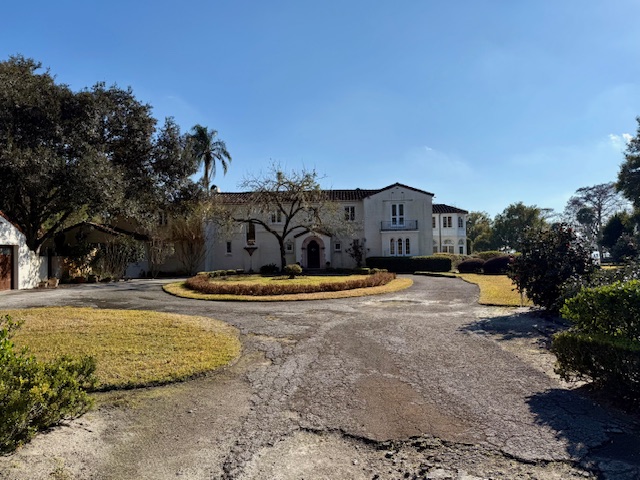
A view of the home from Palmer Avenue.
McGillis told the board she has heard from residents in the area who have concerns about a potential lot split.
“I’ve gotten questions about the fate of the house,” she said. “Most people I’ve talked with want to preserve the Gamble Rogers house because there are not many of them left.”
While splitting the lot does not guarantee that the home would be preserved, Tedrow said a potentially worse outcome could be on the horizon if a lot split is not granted.
Because of the size of the lot, a buyer could demolish the old home and would be entitled to build a new house as large as 56,000 square feet.
“The largest home in the city has a gross floor area of over 36,000 square feet — this 3.67-acre property is legally entitled to have a home 55% larger,” Tedrow told the Voice in an email. “To further put this into perspective, the city’s new library and event space total around 50,000 square feet. The home that could be built at 1020 Palmer Avenue under today’s Comprehensive Plan would be larger than both buildings combined on the city’s library campus and would dwarf every home in Winter Park.”
Such a house would also dwarf the home of Marc and Sharon Hagle, who spent years constructing the largest residence in Winter Park — the one Tedrow mentioned that is 36,000 square feet — just a few doors down Palmer Avenue.
“I think there are some buyers out there who might do that,” she told P&Z members. “I’m not that buyer. So maybe we flip this to somebody else …”
Owens, who also attended the meeting, said she appreciates that Tedrow came to Casa Feliz and is considering ways to find a buyer who might be willing to restore the home.
“We appreciate her willingness to work with us,” Owens said.
The property was most recently the home of Dr. Raymond Gilmer, an orthopedic surgeon who died in 2020 at age 90, and his wife, Sarah, who purchased it in 1977.
The home is now vacant and owned by the couple’s children. Tedrow said the family decided to keep the property off the historic register in case the land would be worth more with the potential for demolition.
A close-up of the front entrance to the property.
There is no publicly available list price because Tedrow offered a contract on the property before it hit the MLS.
She said the price of the existing house would depend on the exact configuration of a potential lot split, if approved, and other factors.
The house was featured as one of about a dozen properties in a 2004 book celebrating the architecture of Gamble Rogers in Winter Park by Patrick and Debra McClane.
“The initial series of interior spaces is unusual for a residence and more closely resembles a hotel or theater entry in that a lobby is provided, which is flanked by a coat room and a powder room,” reads the section on the property, referred to as the Plant House for its original owner. “Stepping up from the lobby, one then enters a large entrance hall nearly 45 feet in length. Triple arched openings on the south wall of the hall — with a fixed window in the center and double-leaf, multiplane doors on the sides — lead to the loggia and then the sunken patio, with Lake Osceola beyond.”
The house boasted features such as “floor buttons” in the dining areas that rang to wait staff in the kitchen, as well as “ornate wrought-iron railings and balusters [that] lined the staircase, and a velvet-covered handrail … provided on the interior wall.”
Jack Rogers, architect and son of Gamble Rogers, told the Voice last year that there are fewer than 10 true examples of his father’s work left in Winter Park as more are torn down every year.
“There’s probably 15 or 20 left, and eight or 10 are absolutely precious, and we seem to be losing them at the rate of one or two a year,” Rogers said. “We still have several wonderful examples.”
WinterParkVoiceEditor@gmail.com
Update: The original version of this story noted cannabis law as a part of Tedrow’s law practice. She no longer practices in that area.
To comment or read comments from others, click here →
by Beth Kassab | Jan 15, 2026 | Arts and Culture, City Commission, News, Police and Public Safety, Schools
Have Complaints about Electric Scooters and Bikes? Meeting Scheduled for Next Month
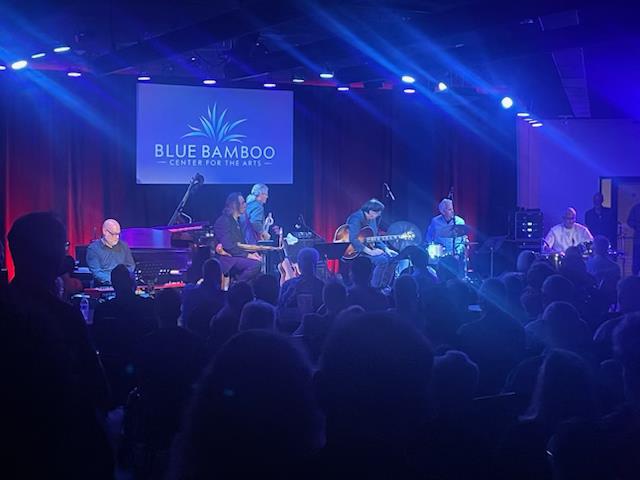
Plus Blue Bamboo’s leader offered a short update on the group’s financial status in the wake of multiple changes at the organization operating at the city’s old library
Jan. 15, 2026
By Beth Kassab
Residents who have questions or concerns about safety related to electric bikes and scooters, which have soared in popularity in recent years, are invited to attend a community meeting at Winter Park Community Center on Feb. 17 at 5:30 p.m.
The meeting comes in the wake of a rising number of accidents and concerns surrounding the motorized devices that are increasingly common in and around school campuses.
Commissioner Craig Russell, who is also a teacher and coach at Winter Park High School, has taken the lead on the topic with a series of safety videos aimed at students and parents and, now, plans for a larger community discussion.
Russell said at Wednesday’s City Commission session that the meeting in February will be about sharing the facts and providing any available updates on the Legislative session, where a proposal (HB 243 and SB 382) is being debated that would put more regulations on e-bikes and scooters and their often young drivers.
“I just want to continue with our public safety effort,” Russell said. “It’s not going to be me telling parents what to do. It’s an informational session.”
The Voice reported last month that Orange County School Board members tossed around potential new regulations such as requiring licenses, training and speed limits at a meeting in November.
Since 2017, electric scooter injuries in the U.S. have surged by 400%, with Florida being a top state in emergency room visits for such injuries, staff told board members, citing data from the Consumer Product Safety Commission. These accidents have more than doubled since 2023 for children under 15.
Update on Blue Bamboo
Commissioners heard an update on Wednesday from Jeff Flowers, who is leading the Blue Bamboo Center for the Arts project that is leasing the city’s old library building.
The group’s founder Chris Cortez died last month after a short illness with glioblastoma, the most aggressive form of brain cancer.
Flowers, a chemist and arts philanthropist who served two stints on the Maitland City Council, noted the challenges the group has faced with the loss of Cortez and difficulty finding tenants for the second and third floors of the building. He said there have been three “very serious” sublease prospects, but no deals yet.
“We are in serious discussions now with another,” he said. “It’s not there yet, but it looks good.”
He said the Blue Bamboo tallied 8,300 people attending shows over the past six months and $180,000 in ticket sales. He said revenue totaled about $340,000 including concession sales and donations.
The Blue Bamboo is required to pay the city $132,000 a year in rent for the building, an amount scheduled to rise to $276,000 next year, according to the lease agreement.
The group has access to a $900,000 grant from Orange County for additional work on the building, but is required to raise matching funds and was counting on help in the form of fundraising and rent from Central Florida Vocal Arts before that group walked away from the deal in August when it was not satisfied by the terms of the sublease offered by Blue Bamboo.
Flowers has loaned Blue Bamboo more than $1 million so far to retrofit the first floor of the building into a performance space and other work.
“The message is look, the Blue Bamboo is here to stay,” Flowers told the commission. “We’ve surmounted every barrier thrown at us.”
Mayor Sheila DeCiccio thanked Flowers for appearing at the meeting and quickly moved on to the next topic after no other commissioners offered any comments or asked any questions.
WinterParkVoiceEditor@gmail.com
CORRECTION: The original version of this story included the wrong location and time for the meeting on e-bikes and scooters. The meeting will be held at Winter Park Community Center at 5:30 p.m.
To comment or read comments from others, click here →
by Beth Kassab | Jan 6, 2026 | Arts and Culture, City Commission, News
Construction on Park Avenue Will Begin this Month Starting on the North End
The estimated $8.5 million project will upgrade technology and aesthetics along the busy shopping and dining district
Jan. 6, 2026
By Beth Kassab
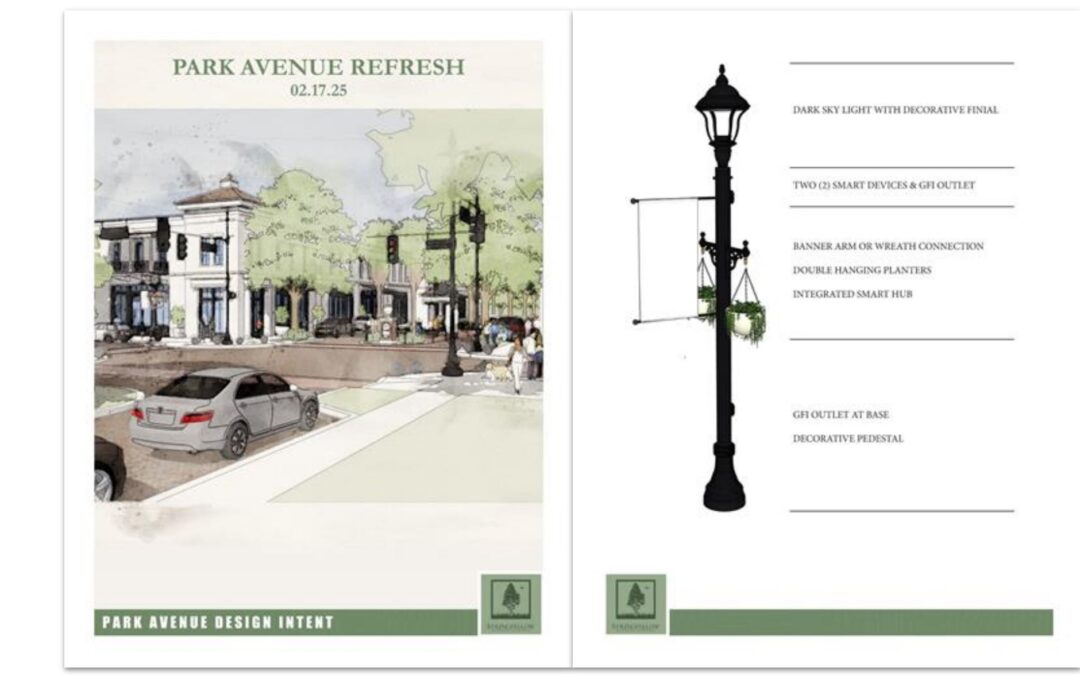
Construction will begin later this month on the first major overhaul in 25 years of Park Avenue’s aesthetics and technology — a project known as the Park Avenue Refresh that will include nearly $1 million worth of new streetlights and a total price tag estimated at $8.5 million over the next three years.
Workers began some tasks last year as the city prepared to launch Phase 1 construction this month. (Photo courtesy of the city of Winter Park)
The work on the first of the three project phases is slated to start Jan. 20 on the north end of the avenue and run from Webster Avenue, near the University Club of Winter Park and the city’s nine-hole golf course to Garfield Avenue along the northern border of Central Park.
The stretch includes the Morse Museum, which houses a large collection of glass windows, lamps, jewelry and other delicate work by Louis Comfort Tiffany, and museum leadership has expressed concerns about potential vibrations from construction, Clarissa Howard, the Refresh’s project manager, told the City Commission last month.
Howard said city staff is working with the museum and others along the stretch such as St. Margaret Mary Catholic Church, which also runs a school with busy drop-off and pick-up times, to minimize disruptions from the construction.
“Fortunately, our project will not be using jack hammers or equipment that would create that type of severe vibrations that could cause damage to the fragile glass,” Howard said in an email. “We are very sensitive to the fragility of the museum’s pieces so we are working closely with them on our construction schedule and activity. We were asked by the museum team to do our work around the museum during the day so they could have staff on standby to keep an eye out for their pieces during construction.”
The new streetlights, which the commission voted in April to purchase for nearly $1 million, include “dark sky” lamp fixtures that cast LED lights downward, wi-fi receivers, electric hook-ups for cameras and speakers and internal sprinklers for potted plants that will hang from the fixtures. The new cameras on the north end of Park Avenue are for security and will allow law enforcement to obtain footage of incidents for a period of time if needed.
In addition to the new light poles, the avenue will get some noticeable upgrades in the form of new oak trees, new sidewalks, repairs to raised planter beds, new potted plants, new trash and recycling bins and bollards or short posts designed to prevent cars from encroaching on the sidewalks. Other work will be done underground to wire the new lights and irrigation system, help contain tree roots and address stormwater runoff concerns.
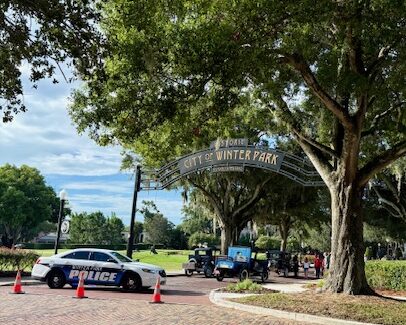
A new sign arches above the north end of Park Avenue near where the Refresh project is slated to begin later this month.
Some work will be done overnight to minimize disruptions to shops and businesses, which rely on foot traffic along one of the region’s busiest shopping and dining hubs.
Last year downtown Winter Park logged more than 1.3 million visitors, according to a city count.
Construction on Phase 2 of the project will start in 2027 and run from Garfield to New England Avenue.
Alex Stringfellow, who serves as the urban planner for the project, said the next phase will be mindful of coordinatization around the considerable space occupied by cafe tables along the sidewalks as well as maintaining the health of the oak tree in front of Briarpatch, the largest along the avenue.
Phase 3 will begin in 2028 and run from New England to Fairbanks Avenue.
WinterParkVoiceEditor@gmail.com
To comment or read comments from others, click here →
by Beth Kassab | Dec 18, 2025 | Arts and Culture, City Commission, Taxes, Uncategorized
Arts Board Backs Off Seven Oaks Sculptures Because of Spending Optics
The decision came this week just days before state CFO Blaise Ingoglia held a press conference in Winter Park on Thursday to call city governments “wasteful”
Dec. 18, 2025
By Beth Kassab
Winter Park’s Public Art Advisory Board this week hit the pause button on spending as much as $175,000 on permanent sculptures for Seven Oaks Park after City Manager Randy Knight appeared at the meeting to warn of bad optics and even a potential budget shortfall if Gov. Ron DeSantis is successful in his drive to reduce property taxes.
“Is that something we’d be criticized for?” Knight asked of the potential expenditure. “Should we wait and see what’s coming before we decide to spend that kind of money on public art?”
The decision by the board, which includes new Commissioner-elect Elizabeth Ingram, is evidence of a chilling effect on local governments brought by the DeSantis administration’s attacks on local spending and threat to significantly decrease local tax revenue.
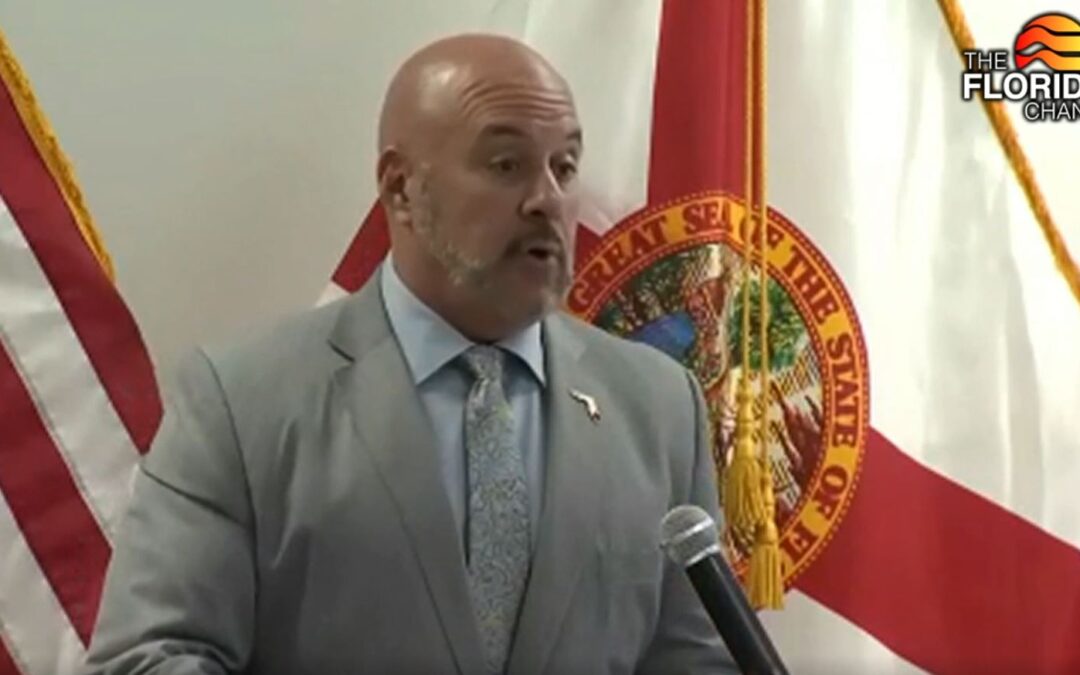
Without mentioning Winter Park a single time, state Chief Financial Officer Blaise Ingoglia, who is running for re-election, held a press conference in the city on Thursday morning.
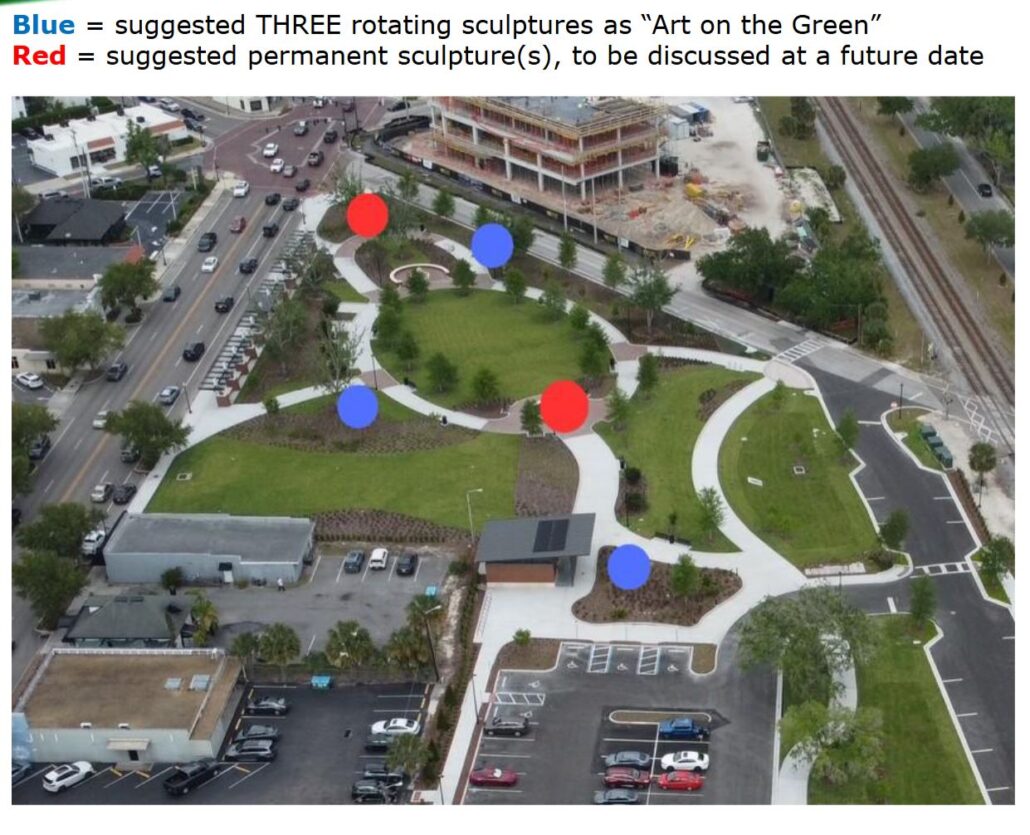
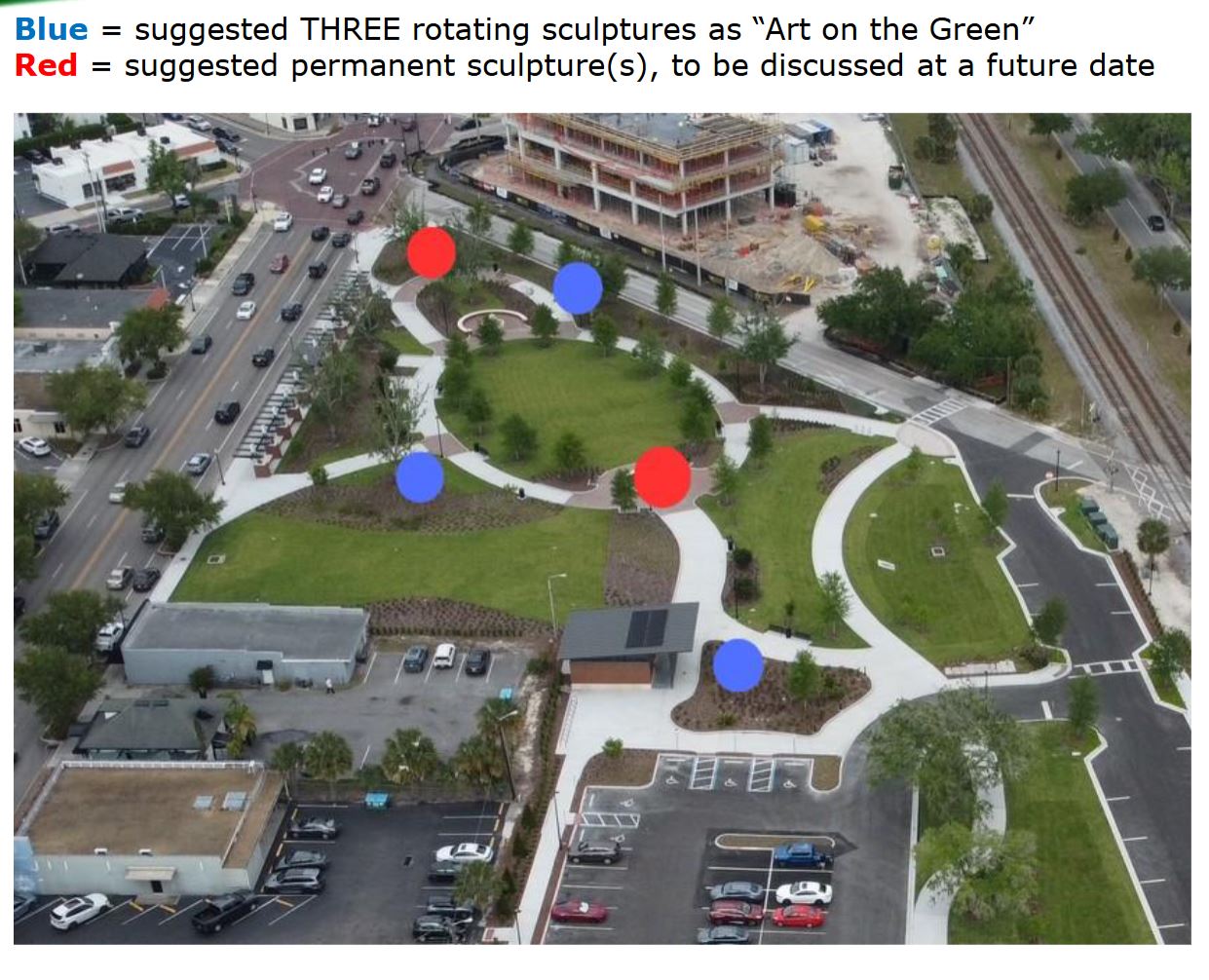
A city graphic shows the proposed location of artwork in Seven Oaks Park.
He repeatedly called cities and counties “wasteful” of public dollars, particularly money collected through property taxes.
But he didn’t cite any examples of cities with bloated budgets that he attributed, in large part, to hiring more staff that far exceeded a city’s need based on its population.
Ingoglia announced a proposal for a new law that would require cities and counties to post their budgets online (which is already required by state law) and to post proposed budget amendments seven days in advance of the hearing. His proposal also would require local governments to identify at least 10% worth of cuts as part of the budget process, though fire and police could not be part of those reductions.
He said the law change would prohibit cities from considering if a business is minority or women-owned when handing out contracts.
Ingoglia called for the end of “the practice of DEI in contracts,” which he said stands for “division, exclusion and indoctrination.”
“Stop with this crap,” he said.
Ingoglia’s office did not immediately respond to a question from the Voice about why the event was held in Winter Park.
The plan for the Seven Oaks Park sculptures came about as part of the city’s public art initiative to promote culture and visitation in Winter Park’s newest public space, which opened earlier this year.
Winter Park is known as one of the top tourism draws in the region and logged 1.4 million visitors to the downtown in 2024.
A plan to bring rotating loaned artwork from Orange County to the park in January is still underway. But the board hit the brakes on purchasing new art to remain in the park permanently.
Arts Board Chairwoman Carolyn Fennell thanked Knight for the information and guidance and noted that the city should “maintain its arts and cultural branding.”
“We all know the importance of arts in our city but others looking in may not have the same value of art as you do or certainly as we do as a community,” Knight said during the meeting.
WinterParkVoiceEditor@gmail.com
To comment or read comments from others, click here →
by Beth Kassab | Nov 21, 2025 | Arts and Culture, Historic Preservation, News
A Century-Old Lifeline: Welbourne Preschool Endures Amid Loss of Black Landmarks
As change continues on Winter Park’s west side, a preschool that opened in 1927 continues to provide a heartbeat for the neighborhood
Nov. 24, 2025
By Beth Kassab
On Sundays, you can find the Rev. Ronald Critton preaching at Bethel Baptist Church, one of Winter Park’s oldest historically Black sanctuaries.
But more than 65 years ago, Critton started out just steps across Welbourne Avenue from his pulpit as one of the tiny voices on the playground of the Welbourne Nursery and Preschool, once known as the Winter Park Day Nursery Association for Colored Children.
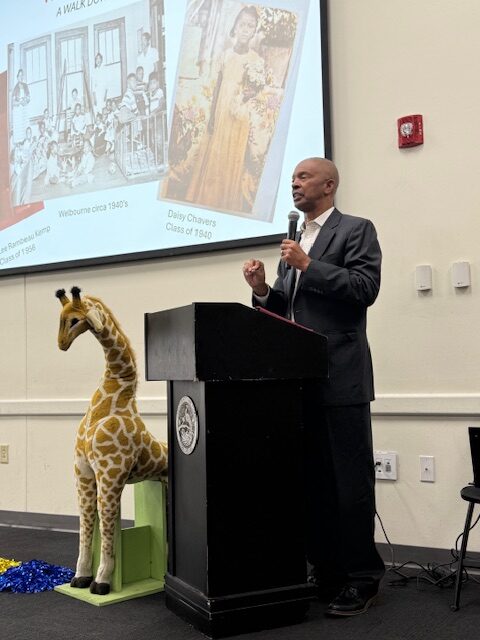
“I do recall the merry-go-round,” Critton told a group gathered recently at a celebration of Welbourne’s history and a fundraiser for its future. “Back then, being a young Black kid, we weren’t allowed to be in certain environments, and that was the only school for us … I felt that I was loved and cared for.”
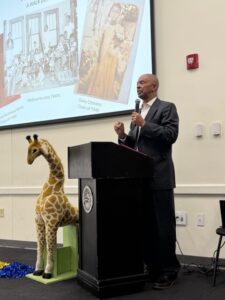
The Rev. Ronald Critton speaks at an event for the Welbourne Preschool.
On Winter Park’s west side — where old homes and buildings disappear almost as quickly as parking spots along Park Avenue at Christmastime — the Welbourne has remained a beating heart of the historically Black neighborhood for nearly 100 years.
This year, Hannibal Square, founded in 1881 by free Black families who worked for the city’s wealthy white winter residents, lost the Gardens at DePugh Nursing Center.
The first licensed facility for Black seniors, dating back to 1956, announced in September that it would close — the latest in a wave of redevelopment over the last two decades as land values have soared.
But the Welbourne, which opened in 1927, continues to buck the odds.
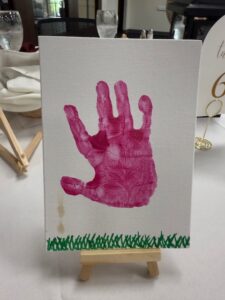
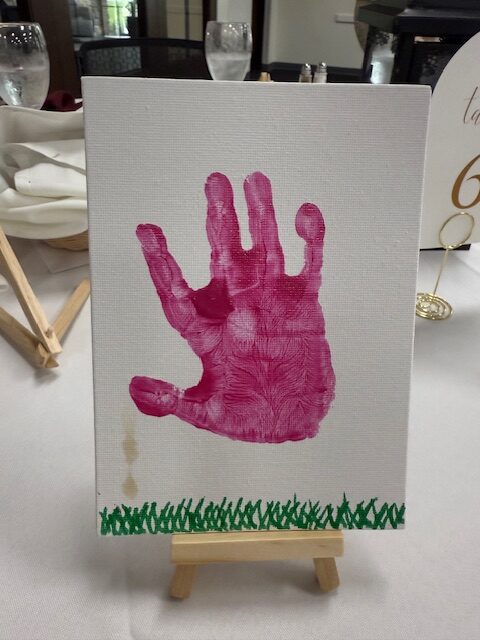
Artwork from Welbourne students was displayed at the event.
Executive Director Latonya Pelt said the school’s mission is too important to let go. She is grateful for a group of loyal supporters, including alumni like Critton, who have helped raise about $70,000 toward the school’s $100,000 goal. Local business leaders such as Gary Lambert of Gary Lambert Salon on Park Avenue and Rick Baldwin, founder of Baldwin-Fairchild Funeral Homes and Cemeteries and now operator of Baldwin Brothers Funeral & Cremation Society, were recognized among key supporters at the recent event.
“I tell our teachers all the time — we care beyond the classroom,” Pelt said. “We care if the children are hungry, if they need anything. We are all a village.”
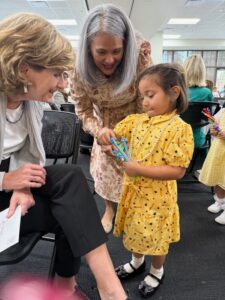
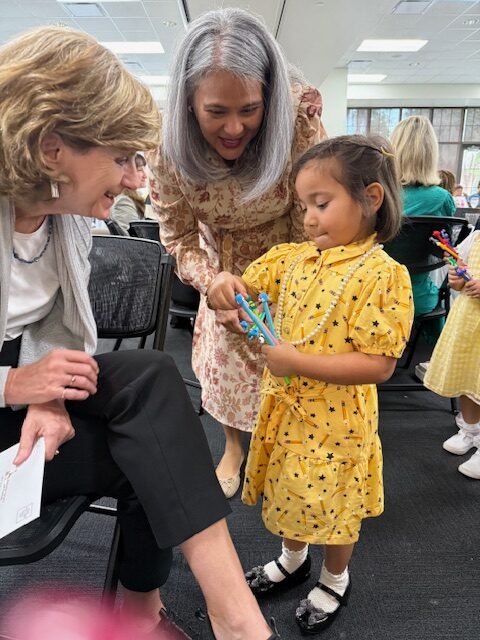
A Welbourne student hands out pens to guests.
The Welbourne provides child care and preschool for free or on a sliding scale based on a family’s income. Full tuition for an infant is $315 per week and decreases to $170 per week for a 4-year-old.
The school currently serves 53 children, from infants to age 4 and is open Monday through Friday from 7 a.m. to 6 p.m.
The fundraising campaign helps provide reduced tuition for qualifying families and increase teacher salaries to reduce turnover. Payroll is the school’s biggest expense but also its greatest asset.
“It’s not a high-paying industry,” Pelt said. “We want to make sure we keep qualified teachers.”
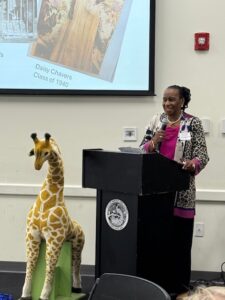
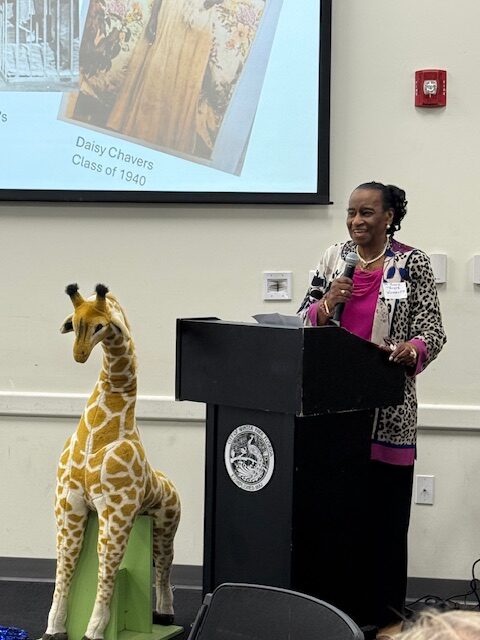
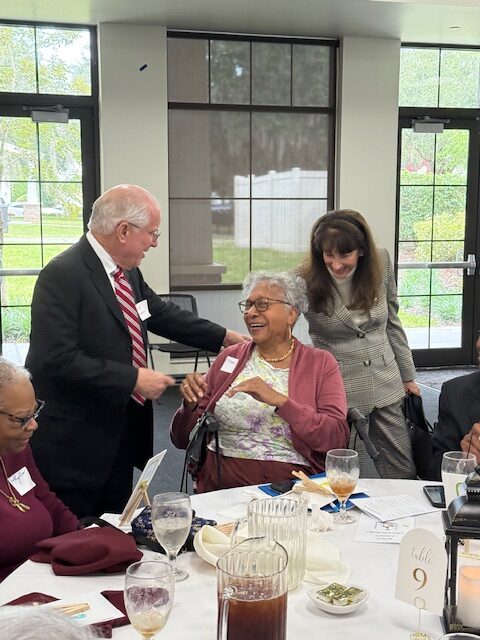
Minnie Woodruff recounts her family’s story and her experience at the school.
Minnie Woodruff remembers one such teacher from when she attended Welbourne before graduating at age 4 in 1943.
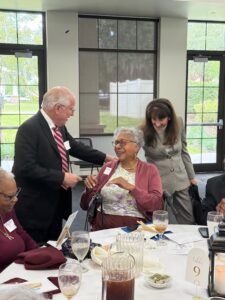
Rick Baldwin talks with Mary Daniels, who once worked as a teacher at the school and later served as president of its board, and Mayor Sheila DeCiccio.
At the recent gathering, she recalled Mrs. Richardson, whom she described as “the teacher, the cook, and if you got sick she would blow your nose.”
Woodruff went on to attend Spelman College and graduate school and enjoyed a long career as an educator. She credits the preschool with helping lay a solid foundation for herself and her seven siblings in a segregated world.
That work continues today, though the school now draws families from a broader area than just Winter Park. Many parents choose Welbourne because they work in Winter Park or face long waiting lists for subsidized child care elsewhere.
“The average two-parent working family in the U.S. cannot afford high-quality childcare,” said Sharon Carnahan, who serves on Welbourne’s board of directors and recently retired from Rollins College as a psychology professor and executive director of the Hume House Child Development and Student Research Center.
Critton, the pastor at New Bethel, said he hopes more Welbourne graduates find their way back to supporting the school and the neighborhood, where he recently became a resident once again.
“It’s been full circle for me,” he said.
WinterParkVoiceEditor@gmail.com
To comment or read comments from others, click here →


Recent Comments