by Beth Kassab | Sep 15, 2026 | Arts and Culture, City Commission, County News, Election, News, Taxes
Will Orange Mayors Join Push to Rethink how Tourist Taxes are Spent?
Winter Park’s resolution is the latest sign of growing pressure to use the county’s nearly $400 million in annual Tourist Development Tax revenue for transportation, affordable housing and other needs
Sept. 15, 2026
By Beth Kassab
Mayor Sheila DeCiccio sent an email this week to her counterparts in other Orange County cities urging them to adopt resolutions in support of using the Tourist Development Tax to help pay for local needs such as transportation improvements and more affordable housing.
Winter Park adopted such a resolution last week that calls for Orange County to “explore every avenue to expand alternative uses of the tax, including but not limited to transportation and affordable housing, adding additional pennies, and lowering the 40% threshold for tourism promotion, and to make this a legislative priority.”
“This is the direction we need to go considering potentially November and the regional areas wanting to get access to public transportation,” said Commissioner Kris Cruzada during a brief discussion.
“November” referred to Amendment 3 on the Nov. 3 ballot, which could significantly reduce property tax collections by increasing the homestead exemption for homeowners and capping property tax growth on commercial and other properties. Property taxes pay for local police and fire departments, road and infrastructure work, parks and recreation and other services provided by local governments.
But the outcry over how Orange County spends its enormous haul of tax dollars collected on hotel rooms — a record $385 million last year — started long before the push this year to threaten property tax revenues.
A disparate chorus of local voices, from County Commissioner Kelly Semrad — who represents Winter Park and was elected on a platform that included reforming TDT in 2024 — to a few local lawmakers and Orlando Sentinel columnist Scott Maxwell, who was one of the earliest advocates for change, has reached a crescendo in recent years, urging that the largesse be used to help solve problems that stem from hosting 75 million visitors a year and housing the low-wage workers who power the tourism industry.
DeCiccio’s effort appears to be the first to attempt to organize mayors to come together on the topic and push for change at the county level.
Commissioner Warren Lindsey applauded her leadership shortly after the unanimous vote on Winter Park’s resolution.
“Hopefully it’ll make a difference to not only people in Winter Park but everyone in the Orlando area,” he said.
The wording of the resolution mirrors a recommendation made last month by Mayor Jerry Demings’ most recent Citizen Advisory Task Force, which, in a stunning rebuke of the long-held status quo, also voted down spending the tax on yet another expansion of the Convention Center, a parking garage at Camping World Stadium and more projects at the University of Central Florida.
Instead, the 34-member group, made up of appointees of county commissioners and city mayors, recommended spending more of the dollars collected from levies on hotel rooms on grants to support local arts and culture, as well as ecotourism projects.
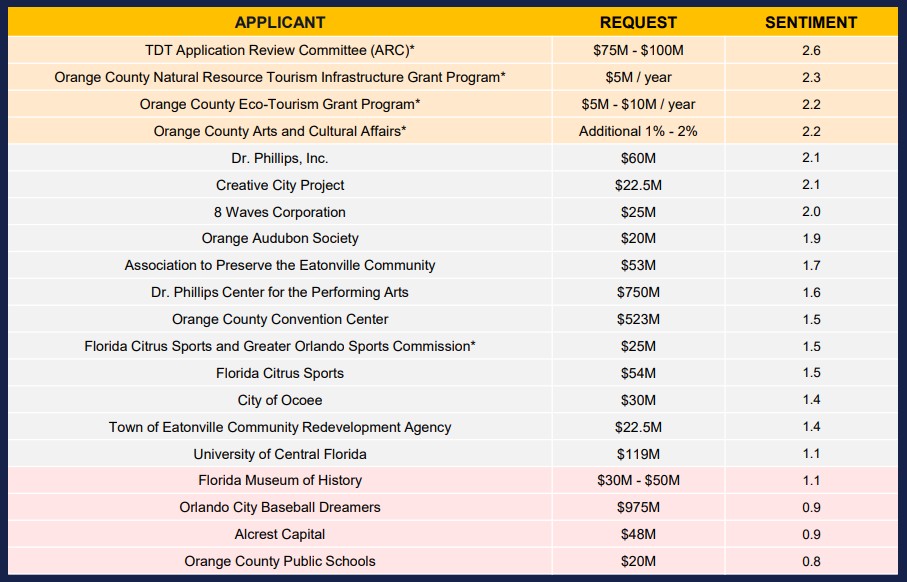
The projects related to the Orange County Convention Center, Florida Citrus Sports, the University of Central Florida as well as the bottom four projects on the above list were NOT recommended by the citizen task force.
The Orange County mayor and Board of County Commissioners arguably have the most power to change the way TDT money is spent.
They have the ultimate say over which projects get the dollars each year within the current confines of the spending rules. And, if other counties across Florida provide any guide, they could succeed in getting state permission to use the dollars for local needs if they made a deliberate lobbying push in Tallahassee.
But Demings, who has served as Orange County mayor since 2018, has not made a major effort to that end — or at least not a public one. Such a campaign would likely involve not only making a case to state lawmakers but also attempting to coalesce the major hotels, as well as Walt Disney World, Universal Orlando and other attractions, behind the idea.
November will also bring a new mayor for Orange County for the first time in eight years and, in another sign that the tide could be turning, both candidates recently rejected the idea of another convention center expansion and said they would support broadening how TDT dollars can be spent.
Linda Chapin moderated a forum last week between Tiffany Moore Russell and Chris Messina for the Orange County League of Women Voters and tried to pin both candidates down on the topic.
Chapin, who served as Orange County’s elected leader in the 1990s and just co-chaired the citizen task force, asked if they would support a convention center expansion.
Moore Russell, a former county commissioner and clerk of court and a Democrat in a very blue-leaning county who lives in Horizon West, hedged her response somewhat on the idea that “data” could one day show a need for more investment in the center.
“I would not have supported the expansion of the convention center unless I saw data that showed me where are we trying to go, what is it trying to achieve, and what’s the return on that investment,” she said. “And so, out of all the projects that I’ve seen so far, I’m a fan of the cultural and arts projects because I think they enhance our quality of life in this community. I am not a fan right now of building any major facilities until we know how do we support those who work in tourism? … We know we have a transportation challenge when it comes to those who visit here and those who work in the industry, as well as affordable housing and workforce housing. So for me, I’m not a fan of big projects right now because I think we need to support those who make our industry thrive in this community.”
Messina, a businessman and Republican who lives in unincorporated Winter Park, said he does not support an expansion because the convention business has changed and said he would have given more support to a proposed long-shot baseball project known as the Dreamers.
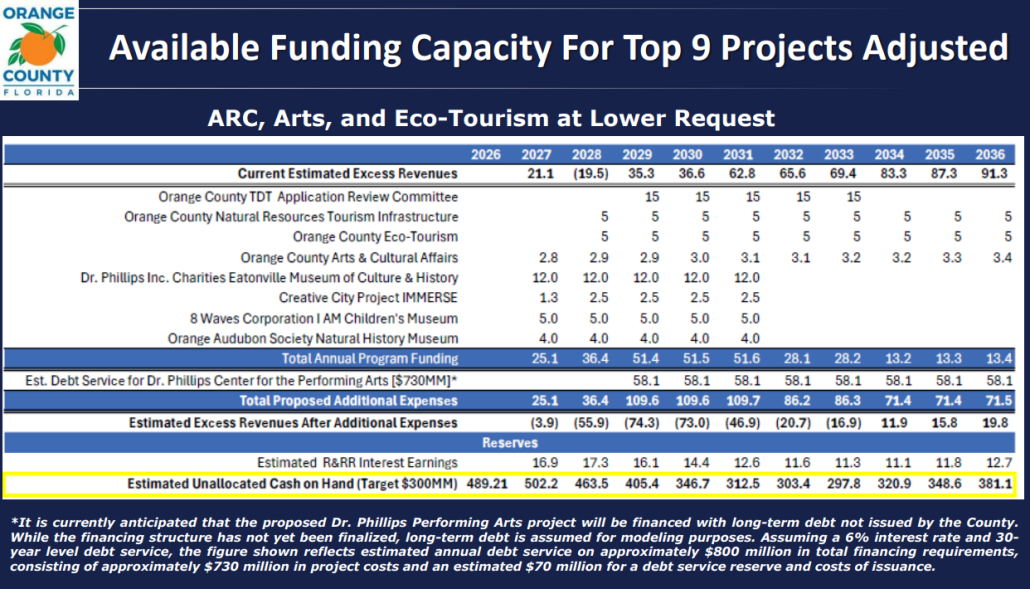
Under one scenario, a chart provided by Orange County, shows how the projects can be funded and maintain reserves. Multiple scenarios were presented at the county meeting on Aug. 25.
“There are only so many very large conventions you can bring into Orange County,” he said. “So I know we lost the Home Builders convention, and it was sort of like the sky is falling for some people, but that’s actually not the case. It’s better to be targeting two medium-sized conventions. They’ll bring more money, more business into Orange County than one large convention. One thing, though, I’ve been very public about that I would have done with the TDT dollars, is I would have looked at supporting the Dreamers in some way, shape, or fashion.”
When Chapin followed up about how the candidates would like to see Tourist Development Dollars used, Messina said he supported using them for tourist-related transportation, but not much else.
“I think we can look at an expanded definition of what tourism is, and without trying to go too far,” he said. “So, for instance, we have a world-class firefighting center, and we have a world-class SWAT team here. So why don’t we do some marketing around that and bring firefighters from around the world, SWAT teams from around the world, for a competition? That’s one thing we could do. Second thing, we can expand it to include transportation that’s focused on bringing tourists to their primary destinations, so from the airport to one of the big hotels or the theme parks. I think that’s a good use of the expanded TDT dollars. But beyond that, to affordable housing? I think that’s a stretch too far and will run us into a brick wall in terms of the legislation.”
Moore Russell was more willing to expand uses but echoed concerns expressed by Demings that the governor and state legislature could attempt to seize on the pot of money for their own use if given an opening.
“I want to marry this also with a question you asked previously about home rule,” she said during the forum. “So I am open to expanding the legislation, but I’m concerned that Tallahassee will take over the control of how we spend our TDT dollars. So we have to be very mindful and keep our eye on the control of our local dollar … But I do believe there is an opportunity to look at our statute about how we can support indirectly, or things that are impacted by tourism. So, you know, transportation — not just moving those who visit Orange County, but the people who work in this industry. There are many who ride the bus, to get to our theme parks, to get to our hotels, who are making sure that we are a great destination to visit. I believe we can justify with the data why we should invest those dollars. Workforce housing down on I-Drive for people to be able to live where they work? I think we can justify that.”
Today, the money is primarily used to pay off debt related to the convention center, as well as support its operations and maintenance, along with subsidizing advertising for the tourism industry and paying debt for the city of Orlando on the arena used by the Orlando Magic.
County officials have long pointed to a state law that governs the tax and limits its uses as the reason the pot of dollars can’t be used to pay for mass transit, public safety, affordable housing or other essential needs.
But other counties have succeeded in carving exceptions into the law when they have made a deliberate lobbying push.
For example, some beachfront counties are now allowed to use tourist tax dollars to fund lifeguards and law enforcement services “which are needed to address impacts related to increased tourism and visitors to an area.” And in 2024, the Legislature allowed local governments in the Florida Keys to use a portion of the money to purchase or build affordable housing.
A critical issue now is the timing of when the County Commission will vote on projects recommended by the task force or move to reintroduce the convention center or other proposals into the mix.
If Demings pushes the matter forward in the final months of his term, then it’s possible there won’t be any money left for the county to spend on other needs such as public transit.
Both DeCiccio and Semrad have expressed concerns about that happening.
A county spokeswoman said a date for the next vote and discussion in front of the Orange Commission has not been set, but that Demings intends to hear the matter before new commissioners and a new mayor take their posts on Nov. 17.
WinterParkVoiceEditor@gmail.com
To comment or read comments from others, click here →
by Beth Kassab | Sep 10, 2026 | City Commission, News, Zoning and Development
Plans for First Synagogue Roil Winter Park
The project, which also includes townhomes, drew 30 public speakers and failed to win enough support despite more concessions from Chabad
Sept. 10, 2026
By Beth Kassab
People affiliated with Chabad of Greater Orlando left City Hall disappointed on Wednesday night after final approval for what would be Winter Park’s first permanent synagogue was delayed until late October with commissioners saying they had too many concerns about parking, traffic and potential disruptions to those who live near the site in the heart of the bustling shopping and dining district.
Commissioner Elizabeth Ingram, who voted in favor of the project during the first hearing on the proposal on Aug. 26, said she was torn and having second thoughts after listening to more people and hearing concerns about construction related to the Rollins art museum nearby.
“We have residents who are concerned about this. And we have residents who are part of Chabad. And so I’m just trying to listen to both here,” Ingram said near the end of a more than two-and-a-half-hour discussion that drew 30 people who signed up to speak. “Going back to the current construction on the Rollins Art Museum, all of that traffic and parking impact is not being reflected in the traffic analysis right now … And I’m just hesitant now of whether this is the right time to approve this before we know what that traffic analysis would look like.”
As development debates in Winter Park so often go, the discussion featured a list of names recognizable for their careers or civic involvement and highlighted the city’s role as a home to people who wield influence across the region and beyond. Public meetings can sometimes take on an aura of a C-SPAN version of “Lifestyles of the Rich and — Locally — Famous.”
Much of the discussion centered on traffic worries from residents on or near Interlachen Avenue where homes and condominiums are valued at $2 million or far higher and where several churches already run preschools that contribute to congestion on top of the expansion of the Alfond Inn and museum construction.
Frank Santos, chief executive officer of Rosen Hotels & Resorts, lives next door to the proposed site and is concerned about parking as well as noise and disruption from a planned rooftop patio on top of the synagogue that will be rented for events and a playground for the daycare.
“I did send you all an email suggesting that you visit the site on a Saturday morning, which would be during the worship hours of the synagogue,” Santos told the commission. “I did that and sent you photographs and there was absolutely no parking in and around the area … I spoke to one merchant there, and they told me that parking beginning at 8 a.m. on a Saturday morning is non-existent with the Farmers’ Market.”

A rendering of what the proposed townhomes could look like.
Janet Robison, who lives near the Alfond Inn and said she has lived in her home on Lake Osceola for nearly 30 years, said she feared another big project in the neighborhood.
“I really enjoy living downtown,” she said. “Unfortunately, living there has been progressively more difficult, and people are always like, ‘Well, they can accept a little of this and all of that.’ But it’s adding up, all this accepting of things.”
But for some in the Commission Chambers, the logistical realities of development were outweighed by what they saw as a greater need — for Chabad to find a permanent home after it lost its Maitland building to a fire in 2024.
“Throughout this process, we’ve heard a sentiment that sounds reasonable on its face: We support a synagogue in Winter Park, just not at this location,” said Marni Stahlman, who attends the Chabad and is also chief executive of the Mental Health Association of Central Florida. “I ask you to think carefully about what those words mean in practice because there is a painful history behind telling Jewish people they’re welcome just somewhere else. This is not a hypothetical location. This is a property made possible through a donation that has been made available so that our congregation can finally a establish home.”
Ultimately, Ingram said she did not want to vote against the project and hoped that a resolution could come about to some of the concerns by the next vote. She joined Mayor Sheila DeCiccio and Commissioner Warren Lindsey, who both voted against the project previously, in a motion to table a decision until Oct. 28.
Commissioner Craig Russell also supported the delay after it became clear the development no longer had the votes to pass, but Russell said he preferred to go ahead and approve the project.
He expressed frustration at what he called “the cherry-picking and hole-poking of the engineer’s designs” when the commission can rely on city staff to vet projects and make sure they are built to code.
“The staff is going to keep them accountable, and they won’t get a [certificate of occupancy] if any of the stuff doesn’t work,” Russell said. “But none of us up here are architects or engineers.”
He also pointed to what he said was a critical fact that was being glossed over in the debate, which is that the new development will provide more parking than what exists currently for the El Cortez apartment buildings. The apartments would be razed at the corner of Morse Boulevard and Knowles Avenue just a block off Park Avenue to make way for the synagogue that includes a daycare and a rooftop patio for events and, separately, five townhomes.
Commissioner Kris Cruzada, the lone vote against tabling the matter, said he also wanted to see the project approved, noting the number of concessions Chabad made in order to satisfy concerns of neighbors and city officials. He said the Chabad proposal is less dense than a strictly residential proposal that could create up to 55 units on the lot.
“What they’re proposing is a drastic reduction in what could possibly be there,” Cruzada said. “… And here we have an applicant willing to bend over backwards to try and do this. They jumped through a lot of hoops to get here, you know, this is a difficult decision, and so in coming to a conclusion, I look at the conditions that they’re looking to go through, even to their potential detriment. The other churches don’t have caps to limit the number of kids that go there.”
Lindsey said he was struggling with the number of residents who argued for a need to limit new traffic and development.
“Everybody is in favor of the synagogue, and enthusiastically in favor of the synagogue,” he said. “And what we’re concerned about is pretty much every resident that lives in this neighborhood — I don’t know any of them that have not said this is going to create an incompatible and difficult traffic congestion problem that is going to be harmful to their enjoyment of their property. I mean, it’s been virtually unanimous.”
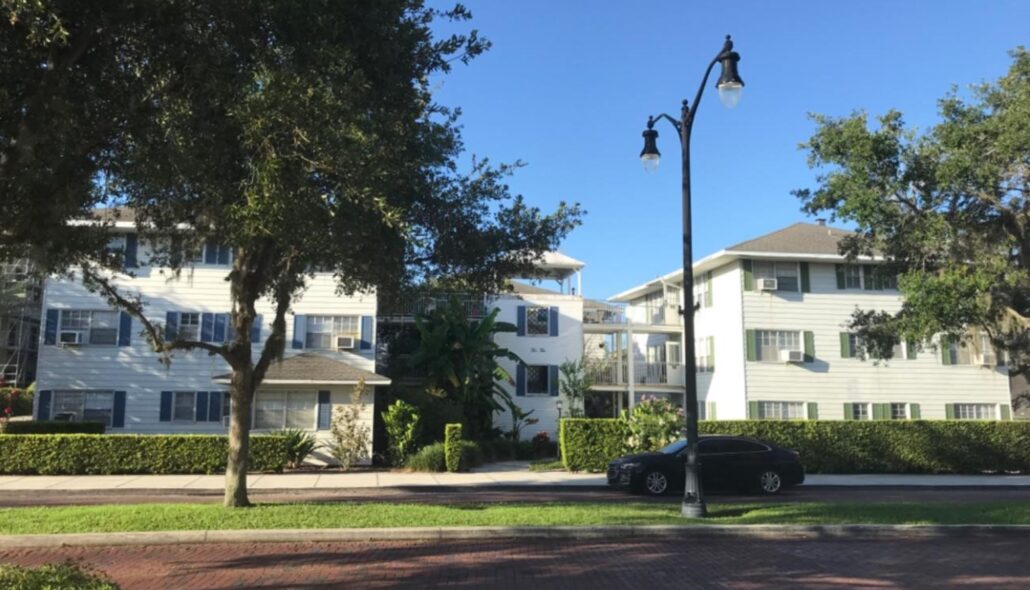
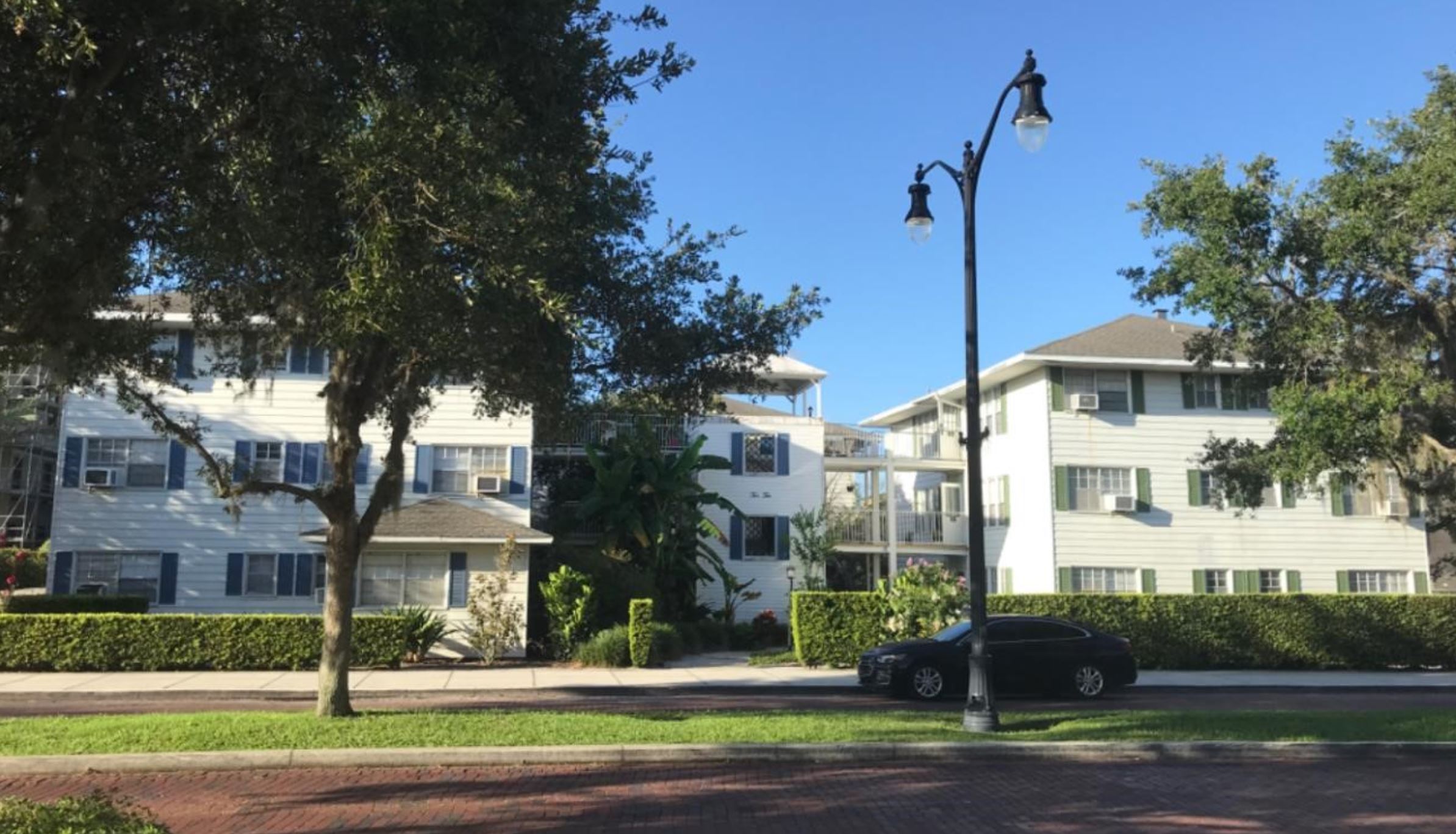
The El Cortez Apartments along Morse Boulevard.
Rabbi Dovid Dubov, who helps lead the Chabad, said the group agreed to even more conditions since the August vote such as limiting the days the rooftop patio can be rented to four per week and lowering the cap of children in the daycare from 60 to 50 as well as adding parking spots.
“Even since our last hearing, we have agreed to more, and I think the honest truth is that we have reached a point where we have extended ourselves as far as we reasonably can to make this work,” he said before the vote to table the proposal. “So, if everyone here supports a synagogue in our city, then I hope tonight we can turn that theoretical support into practical support. Theoretical support leaves us searching for a home, and practical support allows us to build one.”
DeCiccio suggested that more changes could occur to the proposal before the next vote at the end of October. She pointed to the site, which is 0.6 acres, and the amount of development the plans call for that would involve child pick-up and drop-off traffic for the daycare and catering trucks or other traffic for special events.
“No one can stand in that area and say it is not a mess now,” she said. “Plus, I am sure that the synagogue will be successful and is going to grow … For this proposal to work at this location, the developer and synagogue, I am feeling must scale back, perhaps by eliminating the townhomes or the rooftop venue or daycare. Or by limiting the project to just the synagogue alone. As proposed, the development is just too intensive for this site.”
WinterParkVoiceEditor@gmail.com
To comment or read comments from others, click here →

by Beth Kassab | Sep 8, 2026 | City Commission, County News, News, Taxes
Winter Park Steps Out Front to Challenge Status Quo on Tourist Taxes
Will other cities follow a call to push Orange County and lawmakers to use the public money for transit and other needs?
Sept. 8, 2026
By Beth Kassab
UDPATE: This story has been updated to include a comment from Winter Garden City Manager Jon Williams.
Mayor Sheila DeCiccio and others on the City Commission are already on the record saying they want to see Orange County use its gargantuan pot of tourist tax dollars to solve local problems that come along with welcoming masses of visitors each day such as fixing crowded roads and improving the local bus and rail systems.
The question the Winter Park Commission seems to be asking now is: “Who’s with us?”
On Wednesday, the Commission will take up a resolution that solidifies its position that local governments should “explore every avenue to expand alternative uses of the tax, including but not limited to transportation and affordable housing, adding additional pennies, and lowering the 40% threshold for tourism promotion, and to make this a legislative priority.”
Such an action would not only serve as a message to the Orange County Commission, and particularly whoever is elected in November as the next Orange mayor, but also as a call for other cities to follow suit.
Michael Poole, the local investment banker who DeCiccio appointed as the city’s representative to Orange County’s latest citizen task force on the tourism development tax, put the political juggernaut that is changing the status quo in stark terms to Winter Park officials.
“You know, it’s hard to do it from behind the curtain,” Poole told city commissioners at a meeting last month. “But I think if you guys would lead, I think other cities … I met other representatives … they all talk the same way that we’re talking. That we need money for different things, especially transportation … I think other cities would follow your lead, especially if you called them up and said, ‘Hey, let’s do this together.'”
Leaders in neighboring Maitland told the Voice they would consider a similar resolution.
“I can see the case for it,” said Scot French, the Maitland council member who will take over as interim mayor in November when John Lowndes resigns because he is seeking a state Senate seat. “We’ll certainly have a louder voice if we’re speaking in concert on these issues … My sense is there is a great deal of support for broadening the areas in which these funds can be spent to include transportation and county-wide problems.”
Winter Garden City Manager Jon Williams said his city, which has a population of about 46,000 people on the west side of the county, has not taken a formal position, but generally supports expanded uses of the tax.
Officials in Orlando, Apopka and other cities in Orange County did not immediately respond to questions about the uses of TDT from the Voice.
DeCiccio has emerged as an outspoken voice in favor of using the 6% tax levied on hotel rooms for infrastructure projects. She said she is grateful Winter Park-based groups such as the Rollins College art museum and the Winter Park Playhouse have received grants in recent years from a portion of TDT set aside for arts and sports organizations, but sees a greater need that still isn’t being fulfilled.
“I’m a firm believer we need to get a train from the airport to the attractions to I-Drive and to Winter Park,” DeCiccio said. “And affordable housing is so necessary right now,” she said pointing to Killarney Elementary, which serves a portion of Winter Park and lists 20% of its students as homeless, often because they are living in motels or doubling up with another family.
The projects related to the Orange County Convention Center, Florida Citrus Sports, the University of Central Florida as well as the bottom four projects on the above list were NOT recommended by the citizen task force.
Orange County collects the largest haul in all of Florida when it comes to hotel taxes — a record $385 million last year. The money is primarily used to pay off debt related to the convention center as well as support its operations and maintenance along with paying to subsidize advertising and promotion for the tourism industry and pay debt for the city of Orlando on the arena used by the Orlando Magic.
County officials have long pointed to a state law that governs the tax and limits its uses as the reason why the pot of dollars can’t be used to pay for mass transit, public safety, affordable housing or other essential needs.
But, to be clear, other counties have succeeded in carving exceptions into the law when they have made a deliberate lobbying push.
For example, some beachfront counties are now allowed to use tourist tax dollars to fund lifeguards and law enforcement services “which are needed to address impacts related to increased tourism and visitors to an area.” And in 2024 the Legislature allowed local governments in the Florida Keys to use a portion of the money to purchase or build affordable housing.
The current law also says if a county that spends at least 40% of its tourist tax revenue on tourism promotion then it can spend a portion of the tax dollars on transportation, sewer, water or “pedestrian facilities.”
Some members like Poole have suggested that, depending on how the figure is counted, Orange County might already meet the threshold.
Orange County says it’s spending 26% to 30% on tourism advertising, according to Poole, but he also said he doesn’t have the calculation for how that figure was determined.
“All I know is people have asked for it and we haven’t gotten it. Maybe people you know might be able to get it,” he told DeCiccio at a city meeting.
“I’ve tried,” she responded. ” I don’t have that much pull. I wish I did.”
The resolution Winter Park will vote on this week is based, nearly word-for-word, on one of the recommendations made last month by Orange Mayor Jerry Demings’ TDT Citizen Advisory Task Force.
DeCiccio and others including County Commissioner Kelly Semrad, who represents Winter Park, urged Demings to expand representation on the group to more people who understand what it is like to live in different parts of the county rather than be focused on a group of people who mostly represent the interests of the major hotels, theme parks and the convention center.
Tourism companies are known for pumping hundreds of thousands of dollars into political campaigns for local offices.
“In looking at the proposed makeup of the Task Force, it appears to be heavily weighted toward those who currently benefit from how TDT funds are allocated,” DeCiccio wrote in a letter to Demings in June. “I respectfully request the Task Force makeup be weighted more to the entities that represent the people of Orange County and the entities that must provide the needed infrastructure.”
As a result, Demings allowed each county commissioner to appoint two people from their districts instead of just one to serve on the task force. Each city was allowed to appoint one person to the group.
Lowndes, the current mayor of Maitland, sent Demings a letter in July urging a broader scope for the task force than evaluating capital proposals like a convention center expansion or new museums. He called on Demings to help “fairly distribute the burden” of supporting low-wage tourism workers across the county.
“Tourism is, of course, the prime engine of Central Florida’s economy,” wrote Lowndes, who is challenging Sen. Jason Brodeur for a district that includes parts of Orange and Seminole counties. “It demands strong infrastructure: roads, mass transit for tourists and tourist-corridor workers, robust public safety, and affordable housing for thousands who work in the industry, many at modest wages. The residents of Orange County now shoulder much of this burden through our property taxes. Certainly, the community benefits from tourism, but it is time to fairly distribute the burden.”

A snapshot of promotional materials on the website for Visit Orlando, which receives dollars from the TDT to subsidize industry advertising.
Together, Maitland and Winter Park represent about 50,000 people, including about 35,000 registered voters who are close to evenly split between Republican and Democrat, according to the latest voter roll statistics. That’s a small piece of the voter roll for all of Orange County, which tallies about 813,000 registered voters who lean Democrat (39%) over Republican (28%) with the remainder without a party affiliation or registered to a third party (33%).
But there is evidence the sentiment in Winter Park and Maitland is present elsewhere given the actions of the committee led by former Orange Mayor Linda Chapin and Lift Orlando President Eddy Moratin.
The 34-member task force spent much of its time evaluating 20 applications for a combined $3 billion dollars to build everything from a Zora Neale Hurston museum in Eatonville to another expansion of the convention center at a proposed $523 million and a nearly $1 billion expansion of the Dr. Phillips Center for the Performing Arts.
Ultimately, the group did not include the convention center among it’s list of recommended projects — a notable shift from a similar task force that convened just three years ago.
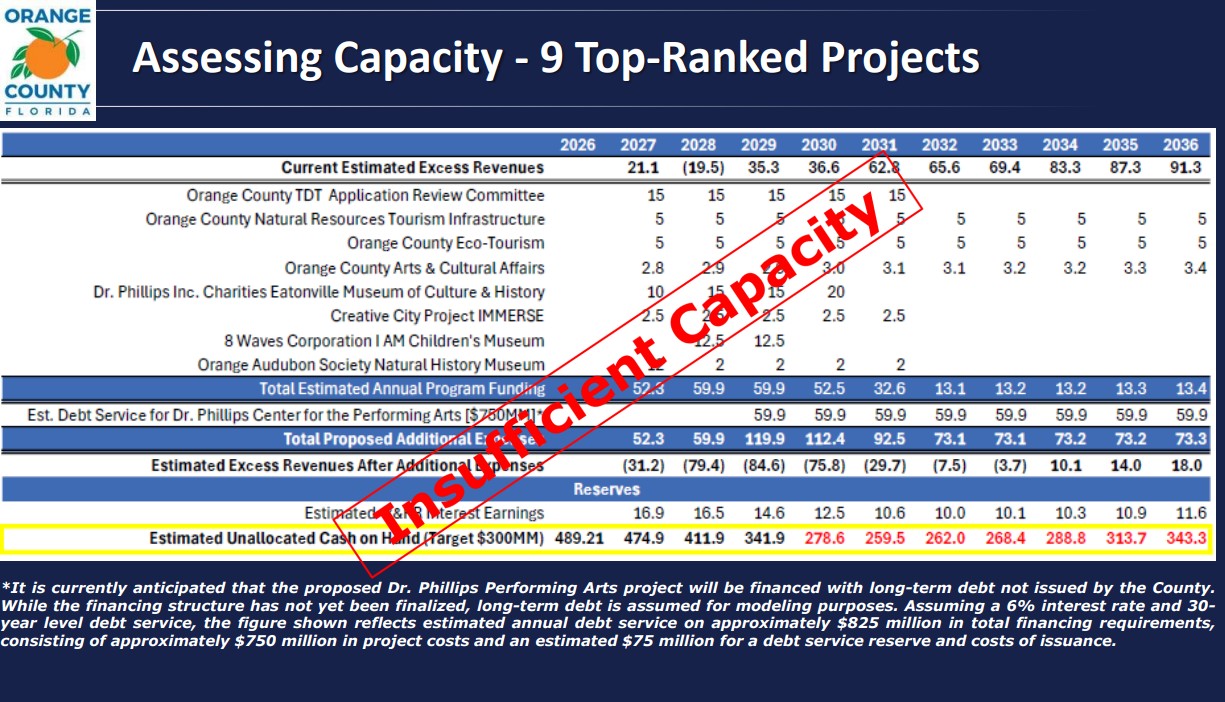
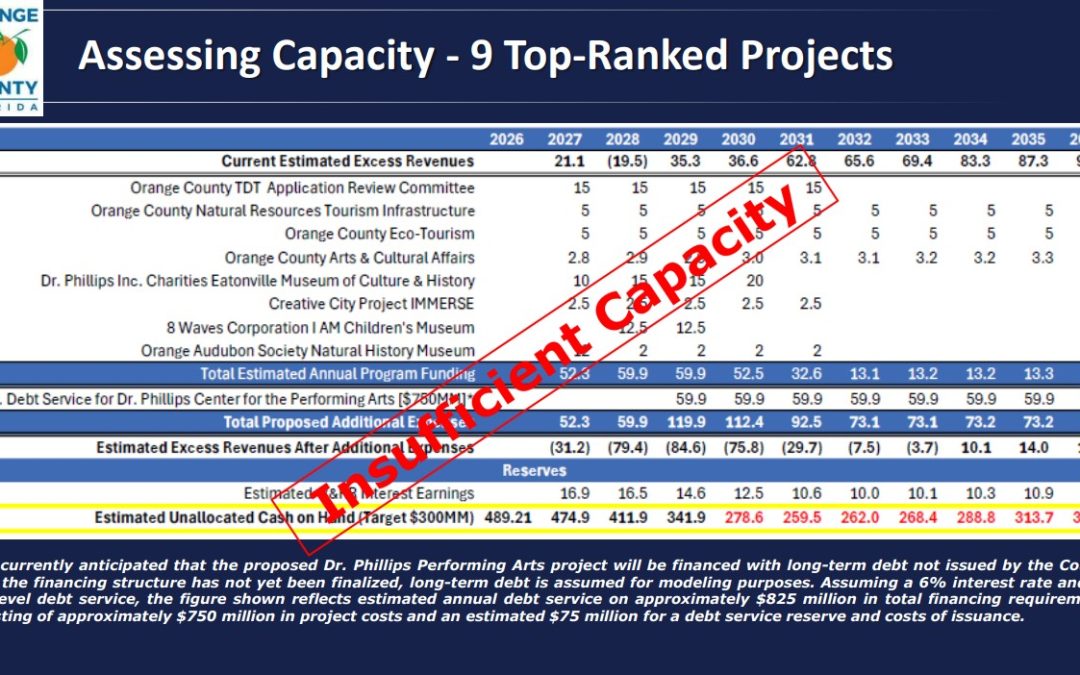
A chart from Orange County shows reserves (bottom line) dipping below the recommended $300 million by 2030 if the Top 9 projects are funded in the above scenario.
Chapin, who led the county from 1990-1998 and has a theater named for her in the convention center after overseeing previous expansions, noted that since the inception of the tourist development tax more than $3 billion was spent on the building. This time around, she said, she couldn’t support a motion to approve another addition.
“Given the opportunities we have to benefit more of the community and different kinds of visitors,” she told the group. “The idea of moving this forward when it is still under construction from the last amount they were granted … what I would like to see is that we vote the motion down, expect the County Commission to request a review of all that’s been done when the project is completed, and then decide, depending on what the circumstances are at that point in time, to either move forward with more or not. So I won’t be supporting the motion.”
And the group took extra time to discuss and include a recommendation that Orange County expand its uses of the tax — the one Winter Park is now looking to formalize in a resolution.
That motion was made by Chapin and seconded by Doug Gomber, who was the city of Ocoee’s representative to the group. Chris Mueller, a Hilton executive who represented the International Drive Chamber of Commerce and Jacqueline Bozzuto, a Lowndes law firm attorney who works with hospitality clients and represented the Central Florida Hotel & Lodging Association, voted against the recommendation.
Central to the discussion now is whether enough political will exists among leaders in Orange County to follow through with that recommendation and ask the Legislature when it convenes again next year for an exception similar to the way other areas in the state have received special permission for certain needs.
Also in question is how much money from hotel collections would be left — if any at all — for mass transit or affordable housing if the County Commission approves all or even some of the projects that the task force recommended move forward. The task force was not told how much money they had to work with so they didn’t put dollar figures to their recommendations, though those asking for the money listed a dollar figure in their requests.
The Dr. Phillips Center for the Performing Arts, for example, is asking for $750 million for new theaters and a parking garage and other improvements at its downtown Orlando campus. If the entire amount was funded it would leave little to nothing for new uses like transportation improvements sought by Winter Park and others.
“If the money for all these projects is paid out for the next 10 years, there won’t be any extra money. So, how will we be able to pay for transportation then?” DeCiccio asked at a recent City Commission meeting, noting Dr. Phillips’ request to build 11 more theaters struck her as “a little excessive.”
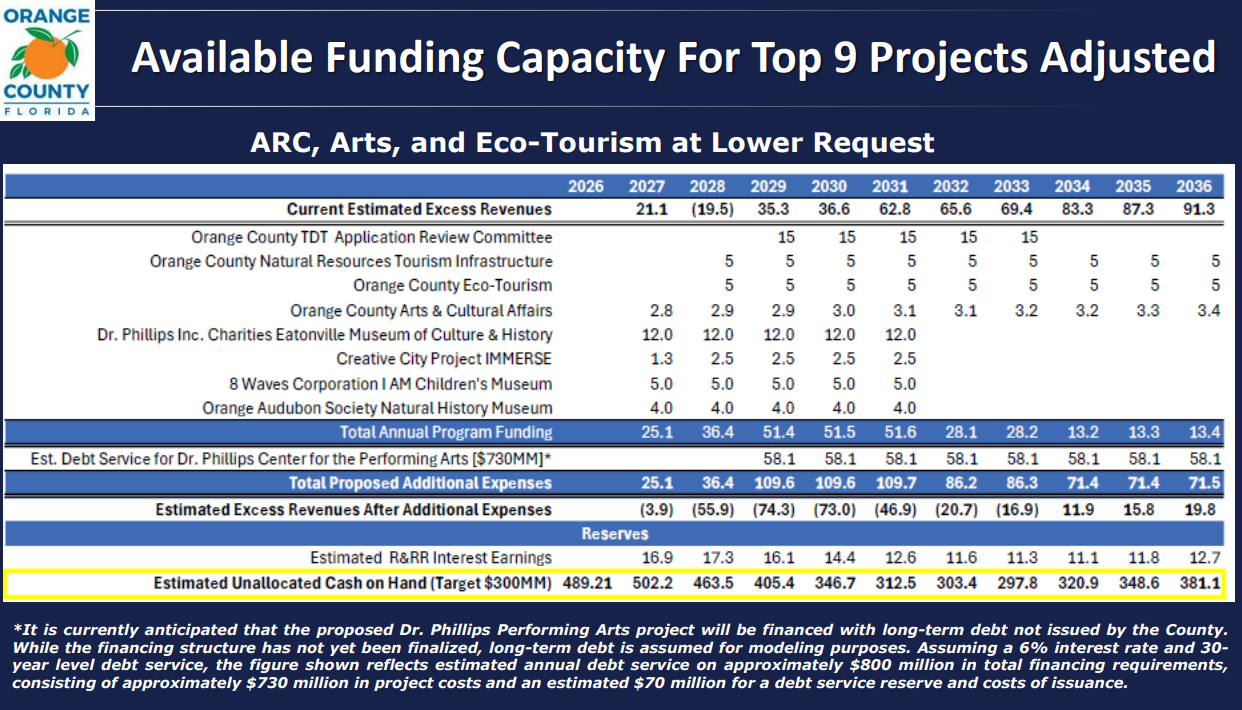
Under a different fund scenario, a chart provided by Orange County, shows how the projects can be funded and mostly maintain reserves. Multiple scenarios were presented at the county meeting on Aug. 25.
The County Commission accepted the task force’s recommendations late last month, but did not give an official a thumbs up or thumbs down to any of the projects on the list. At least two county commissioners said they even wanted to reconsider more projects, which means the convention center or Camping World Stadium could still receive funding.
Semrad, who was elected in 2024 after running on a platform of expanding the uses of TDT and refusing to take any campaign contributions from the tourism industry, called the process rushed and said she was disappointed there wasn’t more clarity surrounding how much money will be available.
A county spokeswoman said the comptroller is working on the question of exactly how much funding can be used and the timing of that funding. Then the County Commission will made a decision on who gets money and who doesn’t and whether the group will back a push to use the dollars for more community needs.
“[The Legislature]pretty much gives the changes when cities ask for them,” DeCiccio told the Voice. “We want to do it but we aren’t strong enough to do it alone. We need Orange County.”
The county commission appears to support the comptroller’s plan to keep at least $300 million from TDT reserves in case of an economic downturn so that figure is factoring into the discussion about what money is available and when.
The date for that discussion has not been set.
WinterParkVoiceEditor@gmail.com
To comment or read comments from others, click here →
by Beth Kassab | Sep 4, 2026 | Arts and Culture, City Commission, Taxes, Tree Canopy
Commissioners Propose Cuts and New Spending Ahead of Budget Vote
The first vote on the total $247 million budget is scheduled for Wednesday
Sept. 4, 2026
By Beth Kassab
In response to political pressure from state government to reduce expenditures, the Winter Park City Commission appears poised to spend less money maintaining its tree canopy as well as on code enforcement and parks programs and reduce a proposed increase to the library. But it is considering a new $45,000 payout to a local nonprofit called Men of Integrity that aims to mentor youth.
The commission is also in favor of raising more revenue for the city by adding red light cameras, starting a new program to charge non-residents for parking at the dog park at Lake Baldwin and Dinky Dock and charge credit card convenience fees on transactions with the city based on discussion at a recent work session.
The $247 million all-funds budget will be heard at the next commission meeting on Wednesday when the board is scheduled to take it’s first of two votes on the spending plan for the financial year that will begin Oct. 1. The city is expected to adopt the same property tax rate for the 19th consecutive year, though revenues from taxes have increased as a result of growing property values.
In addition to the threat of tax cuts if Amendment 3 passes in November, Winter Park leaders say they are also facing soaring costs related to police, fire and maintaining roads.
At least one commissioner pushed for more cuts to spending. Commissioner Warren Lindsey said he would prefer to reduce raises for city employees from 4% to 3.5%, but did not get consensus from other commissioners.
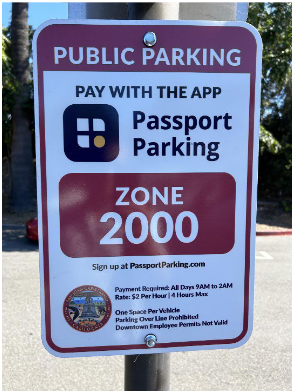
A photo of what parking signs could look like when the city begins charging for public parking in select areas to raise more revenue. The photo was included in city documents related to the program that will look to charge non-residents for parking.
Lindsey said he viewed a smaller raise as part of the “painful reality” of local governments facing significant reductions in property tax revenue if Amendment 3 passes in November.
“My recommendation is that we do it this coming year and not wait until November,” he said. “I feel it’s the responsible thing to do.”
But Mayor Sheila DeCiccio and others said they didn’t feel comfortable with reducing staff raises and pointed to an ongoing hiring freeze that will help conserve funds.
The group agreed to keep open a vacant code enforcement position ($75,000), freeze two vacant fire positions ($200,000) and cut back winter hours at city pools, which would reduce part-time parks staff ($100,000).
Commissioners said they would review the open positions mid-year and determine if there was a need to add any of them back into the budget.
In addition, the city appears poised to cut back significantly on its tree program by removing from the budget a vacant tree specialist position ($73,680); axing the vacant tree permitting position ($60,000) and cutting a watering truck as well as new tree plantings (approximately $270,000).
City Manager Randy Knight said the city is no longer saving many trees on private properties that owners or developers want to cut down because of changes lawmakers made to state law. It’s another example of pre-emption by state government to limit how local governments can make decisions.
While the city forestry department typically plants hundreds of trees per year on city right-of-way, the city is running out of public land for those plantings, Knight said.
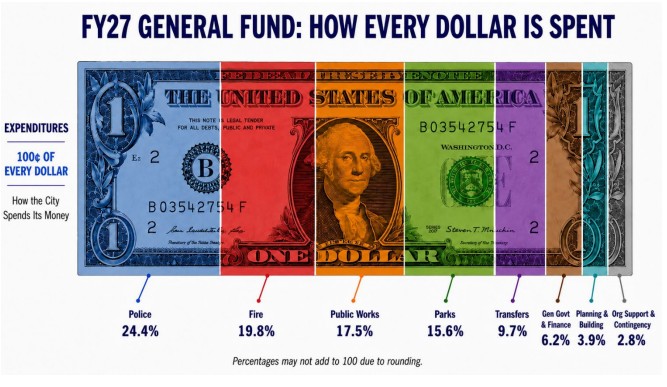
This graphic, included in city budget documents, shows how the city’s nearly $95 million general fund will be spent in the coming financial year to begin Oct. 1. The Winter Park Voice’s coverage of this year’s budget deliberations also includes the following stories linked below:
Also on the chopping block is $25,000 in funding for the library, $12,000 for an appreciation event typically held for people who serve on city boards, some Halloween and Easter events put on by the parks department some postage and printed materials that go to utility bill customers.
Even with a $25,000 reduction, the Winter Park Library is still slated to receive nearly $50,000 more than last year in support from the main city budget as well as the Community Redevelopment Agency budget for a total of $2.5 million.
Each year the city spends a quarter of one percent of gross revenues from the general fund, electric utility fund and water utility fund — or about $480,0000 total — on nonprofit community groups. This year those expenditures are proposed as:
- $105,000 for Mead Botanical Gardens, a $3,000 increase over last year
- $99,900 for the Winter Park Historical Association, also about a $3,0000 increase
- $43,800 for Winter Park Day Nursery, a $1,300 increase
- $20,000 for United Arts representing no change from last year
- $28,900 for the Polasek Museum, a $900 increase
- $0 for Blue Bamboo, a $12,500 decrease after discussion by the City Commission
- $45,000 for Men of Integrity, which had not received any funding since $18,000 two years ago
Men of Integrity is a nonprofit that operates out of the Winter Park Community Center and serves about 24 boys, including 10 in high school and 14 under the age of 12, said Antwon Carter, the group’s leader. Many of the kids attend Winter Park schools but some travel from outside the city to attend the weekly program.
Carter’s group is the only nonprofit commissioners proposed adding to the budget after wrote to the city in August and asked for the money to support his mentoring program that provides help with college readiness, STEM activities, financial literacy, fieldtrips and a hot meal during weekly meetings among other services.
An administrator for the program provided the Voice with a copy of Men of Integrity’s most recent tax form that show’s the group’s revenues are typically less than $50,000.
The group said it mostly relies on volunteers and out-of-pocket expenditures by Carter.
“This mission is also deeply personal to me,” Carter said in an email to the Voice. “I grew up in Winter Park, and I understand firsthand what can be produced when a young person is given a strong foundation. For generations, programs centered around the Winter Park Community Center have played an important role in youth development. Whether young people came directly from the surrounding neighborhood or were brought there by their parents, the Center provided a place where they could experience mentorship, structure, opportunity, and the positive influence of the broader community.”
Carter, who said he now lives in Apopka, appeared at the budget work session and told commissioners the $45,000 would provide a needed infusion of dollars to reduce the group’s need to ask for more in the future.
Some commissioners, including Lindsey and Kris Cruzada, questioned if the group should receive the full amount of its request without providing more information to the city.
But there appeared to be enough commissioners in favor of the expenditure to move it ahead to a vote on Wednesday as part of the overall budget.
The nonprofit organizations slated to received money from the city’s CRA budget are:
- $14,000 for the Enzian Theater, a $4,000 increase
- $51,500 for the Heritage Center, a $1,500 increase
- $44,300 for the Welbourne Day Nursery, a $1,300 increase
- $50,800 for the Winter Park Playhouse, a $1,500 increase
- $398,610 for the library, part of it’s overall $2.5 million in city funding
When it comes to raising more funds for the city government, red light cameras and credit card convenience fees are among the top projected generators.
Police Chief Tim Volkerson said the city is still considering where additional cameras could be placed and, if they are approved by the state, they likely would not be up and running until May or so and could generate some $750,000.
Credit card convenience fees could yield $1.2 million for the city when people buy permits, pay bills or conduct other business at City Hall.
And a pilot program to charge non-city residents to park at Dinky Dock or the dog park at Baldwin Park could bring in an estimated $100,000 or more when it begins as early as the spring.
Paid parking has long been a controversial topic in Winter Park, which offers free parking throughout the city including along busy Park Avenue. If the pilot is successful, city officials said program could expand to other areas and, once again, be aimed at non-residents.
WinterParkVoiceEditor@gmail.com
To comment or read comments from others, click here →

by Beth Kassab | Sep 3, 2026 | Arts and Culture, City Commission
Blue Bamboo Looks to Lease Space to Visual Artists
The performing arts venue has hit multiple obstacles as its rent for the old city library building increases
Sept. 3, 2026
By Beth Kassab
Beset by the death of its founder last year, construction delays and increasing rent, Blue Bamboo Center for the Arts is now facing the loss of $12,900 in annual funding from the city as it presses forward with a new plan to lease space on its second floor to visual artists.
City Commissioners appeared in agreement at a budget work session last week to end its yearly contribution to Blue Bamboo, one of seven local nonprofits that has traditionally received dollars from the city in recent years.
“Why are we funding Blue Bamboo if they are paying us rent?” asked Mayor Sheila DeCiccio at the work session called for commissioners to evaluate potential cuts to the budget as financial pressure intensifies on local governments as voters prepare to vote in November on property tax reductions.
The commission is set to take its first budget vote next week.
The day before that meeting, Todd Weaver, a former city commissioner who is now vice chairman of Blue Bamboo’s board, appeared before the group to ask for a month-long extension to secure a certificate of occupancy for the second floor of the old library building that the group leases from the city.
Weaver said construction was nearly complete and the group would begin paying the new higher rent amount this month. The commission granted the extension for the group to bring the space into compliance with the Americans with Disabilities Act and other city codes.
Weaver told the Voice the second floor will be partitioned into 21 visual art studios that artists can rent.
The plan comes about three months after a contentious meeting between Blue Bamboo Chairman Jeff Flowers and the City Commission in which Flowers was seeking changes to the group’s lease because, he said, he was having trouble finding an arts group that could afford the rent in the wake of the original tenant walking away and construction delays as well as the death last year of founder Chris Cortez.
The commission did not agree at the time to grant the group any rent reductions or allow it to deviate from keeping the building as an arts hub.
So far, the group has invested about $1.5 million into the building, including more than $900,000 in grants from Orange County’s Tourism Development Taxes.
The music venue on the first floor opened more than a year ago and boasts a calendar full of events most weeks from Thursday to Sunday.
Weaver said he could not speculate on when the visual artist spaces will open on the second floor.
WinterParkVoiceEditor@gmail.com
To comment or read comments from others, click here →
by Beth Kassab | Sep 2, 2026 | City Commission, Police and Public Safety
Winter Park to Remove Flock Cameras Per State Order
“The cameras have value in terms of investigative and security uses, but the issue is whether or not people’s privacy rights and concerns over surveillance outweigh those legitimate and positive uses,” Commissioner Warren Lindsey told the Voice
Sept. 2, 2026
By Beth Kassab
Winter Park Police Chief Tim Volkerson said all three of the Flock cameras operating in Winter Park will be taken down in order to comply with a state order to remove the license plate readers from state roads.
Volkerson said the cameras will come down within 30 days as required by the order from the Florida Department of Transportation.
“… The recent exponential increase in deployments along our roadways, coupled with concerning reports of misuse, data privacy concerns and surveillance schemes merit immediate action to preserve Floridians’ sovereignty and quality of life,” read the memorandum dated Aug. 31.
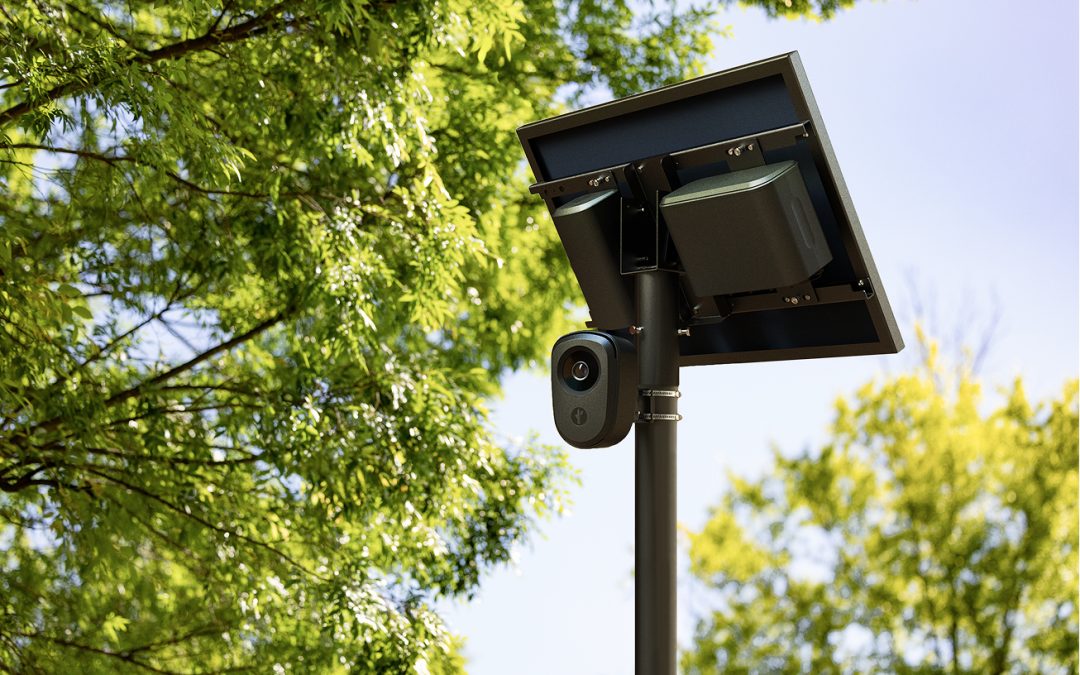
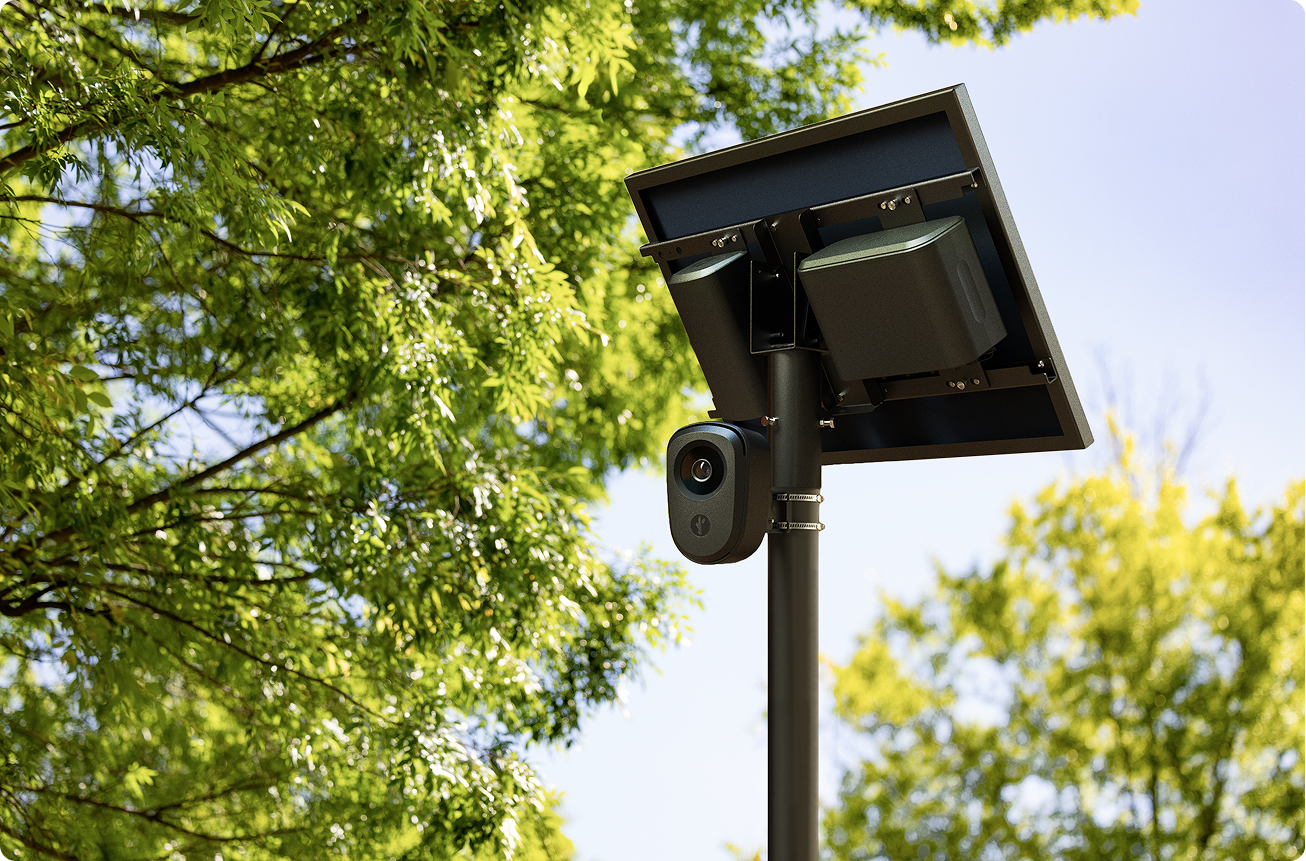
An example of how a camera appears on the road. (Photo courtesy of Flock Safety)
Winter Park has operated the cameras on Lee Road, Fairbanks Avenue and Aloma Avenue for about five years. All are on state-owned roads and must be removed to comply with the state’s order revoking permits for the devices.
Volkerson said it’s possible the cameras will be placed on city-owned roads, which would not be impacted by the state’s order. He said the original locations were selected because they cover the major roadways that lead in and out of the city of 30,000 people surrounded by Orlando, Maitland and neighboring Seminole County.
The Voice reported last month that Volkerson made changes to the way the police department used the cameras in response to increasing concerns about privacy and growing awareness about instances of law enforcement in other jurisdictions abusing the database created by the cameras. He ended direct access to Winter Park’s cameras by outside agencies and also said he planned to more strictly audit how his department was using the database.
Flock cameras, which get their name because they are manufactured by an Atlanta-based company called Flock Safety, are mounted along roadways and photograph vehicles. They create a searchable database of license plate numbers and other details such as the vehicle’s make, model and distinguishing characteristics. Police can search by inputting a description such as a blue Toyota RAV-4 with damage to the back bumper or by a tag number as part of an investigation.
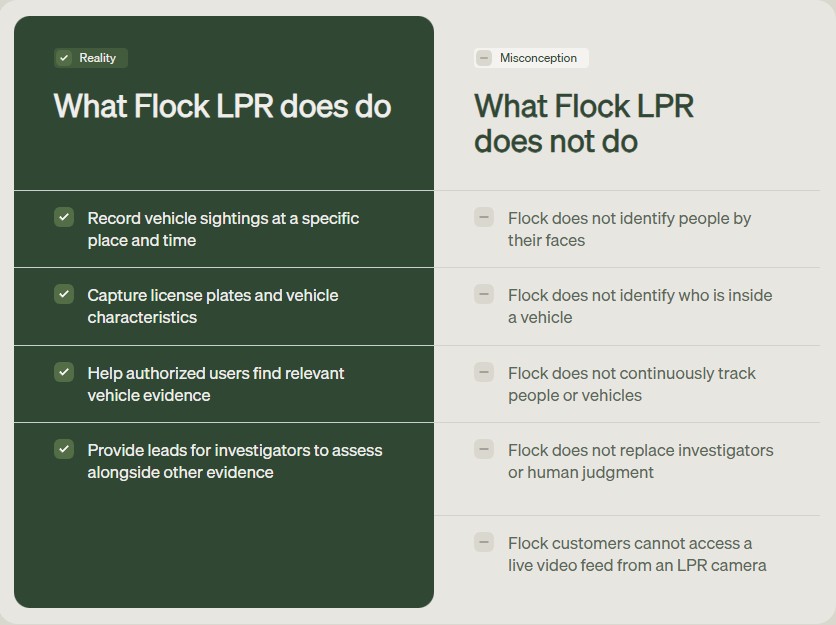
A chart from Flock Safety’s website attempts to address some concerns about the camera system.
Officers can also program the system to alert them if a vehicle with a specific description or tag number is captured by one of the cameras.
In July, his officers conducted between 50 and 60 searches using the cameras, which cost the department $7,500 a year to lease.
Volkerson previously told the Voice the network of surveillance provides a “huge benefit” for safety as a tool for solving crimes.
As an example, Volkerson said the cameras proved helpful earlier this year when there were some residential burglaries along Phelps Avenue. He said his officers pursued a suspect but lost him. About 20 minutes later, they received an alert for the vehicle from a camera near South Orlando Avenue and pursued it again but did not capture the suspect. Eventually a different agency’s camera alerted that the vehicle was near Apopka and the suspect was arrested.
But in recent months, the network of cameras has prompted nationwide backlash among people concerned about data collection and the privacy of law-abiding citizens.
Commissioner Warren Lindsey, who is also a well-known criminal defense attorney, said he has concerns about the cameras and wants to consider the risks and benefits before the city decides to continue to use them in other locations not governed by the state order.
“We need to look at it carefully,” he said. “Where does the data go and where is it used? The cameras have value in terms of investigative and security uses, but the issue is whether or not people’s privacy rights and concerns over surveillance outweigh those legitimate and positive uses.”
WinterParkVoiceEditor@gmail.com
To comment or read comments from others, click here →


Recent Comments