In Memory: Thaddeus Seymour ’82HAL ’90H
In Memory: Thaddeus Seymour ’82HAL ’90H
October 28, 2019 – by Rob Humphreys ’16MBA
This article originally appeared on Rollins360, Rollins College’s news site. It is republished here with permission.
Rollins’ 12th president was magical in every sense of the word.
 Photo by Scott Cook
Waiting in the checkout line at Publix stood a giant man with a giant penchant to charm just about anyone he met, in any capacity, at any time.
Introducing himself to the 7-year-old daughter of a friend, “Taddeo the Great” reached down, flashed a big smile, did a little hocus pocus, and poof—pulled a shiny coin from the girl’s ear.
The child’s eyes, her father recalled, “got about as big as that half-dollar.”
Thaddeus Seymour ’82HAL ’90H, Rollins’ 12th president from 1978 to 1990, possessed a genuine brand of magic that touched countless lives, from students and families to faculty, staff, and the greater Orlando community. A beloved campus icon, accomplished magician, public servant, and academic visionary who returned the College to its liberal arts roots—while famously reinstating Fox Day—Seymour died this past Saturday, October 26, at his Winter Park home. He was 91.
“Thad was a great man and a great president,” says Allan Keen ’70 ’71MBA ’10H, a member of the board of trustees since Seymour appointed him in 1989. It was Keen’s daughter, Kristen ’20 PMBA, who pocketed the 50-cent piece that day at the grocery store. “Thad had a bigger-than-life personality,” continues Keen, “and he elevated Rollins to new heights.”
 Thaddeus Seymour ’82HAL ’90H was president of Rollins College from 1978 to 1990. Photo courtesy Rollins College Archives.
Destined for Greatness
Born June 29, 1928, in New York City to Lola Virginia Vickers and Whitney North Seymour, assistant solicitor general in the Hoover administration and later president of the American Bar Association, Seymour attended Princeton and the University of California, Berkeley as an undergraduate.
A lifelong athlete who hit the gym well into his 80s, Seymour—at a muscular 6 feet, 5 inches—competed in the U.S. rowing trials for the 1948 Olympics.
After earning his master’s and PhD in 18th-century English literature from the University of North Carolina, he taught English for five years at Dartmouth, where he coached rowing and became dean of students at age 30. Prior to Rollins, he was president of Wabash College in Indiana for nine years.
“The Seymour presidency proved to be a turning point in Rollins’ history,” writes Jack C. Lane, emeritus professor of American history and college historian, in Rollins College Centennial History. “At a time when the college community was somewhat adrift, or at best standing still, Seymour instilled in the College a revived enthusiasm and provided a sense of continuity and gave it a new sense of direction. … Rollins, he proclaimed, must ‘return to its roots. Our aim is to know ourselves and to be known by others as the finest small liberal arts college in the Southeast, standing among the finest colleges in the country.’”
Thanks in large part to Seymour’s vision, Rollins has been recognized as the No. 1 or 2 regional university in the South for the past 25 consecutive years by U.S. News & World Report, among numerous other accolades.
 Photos courtesy Rollins College Archives
Firmly Establishing an Identity
In one of his earliest acts on campus, Seymour established a College Planning Committee, chaired by Daniel R. DeNicola, professor of philosophy. After 18 months, the committee produced a 500-page comprehensive plan focusing on institutional mission and structure; divisional objectives; the allocation of funds, physical resources, and personnel; and the 1985 centennial.
Through that lens, Lane writes, “the College began firmly establishing that its identity and future lay with its historical liberal education mission.” Rollins revived its dormant Department of Classics and once again issued diplomas in Latin. To the delight of students, Fox Day returned as well. First celebrated in 1956, the random spring day deemed “too pretty to have class” had been on hiatus since 1970, but Rollins’ new president was more than enthusiastic to revive the tradition in 1979.
During Seymour’s tenure, Rollins considerably raised faculty salaries, rededicated the Walk of Fame, built the Olin Library and Cornell Hall for the Sciences, and renovated Pinehurst Cottage, placing it on the Winter Park Register of Historic Places. Administratively, two of his most important hires were Dean of Admissions David Erdmann and Treasurer Jesse Morgan; together, they helped the College achieve greater financial stability by increasing enrollment, eliminating operating deficits, and overhauling bill collection and investment procedures.
“While the College had historically experienced periods of financial stress, I don’t recall any sleepless nights during his presidency,” says Harold A. Ward III, who served on the board of trustees as a member and chairman while Seymour was in office.
“It was apparent to me from the beginning that working with Thad was going to be both rewarding and a lot of fun. Perhaps it helped that he was part of a family of lawyers, but more likely it was a combination of his remarkable personality and intellect. Another vital part of his presidency was his wife, Polly, who was always involved with the College and the community, and a tremendous support for him and the entire institution.”
Ward described Seymour as a student-centered president adept at winning over constituents from all walks of life: faculty, trustees, alumni, staff, donors, potential donors, and, sometimes, angry members of the community.
“An early challenge,” explains Ward, “was the presentation at the Annie Russell Theatre of the play Equus, which included a scene involving a nude male actor. There were considerable differences of opinion about the appropriate presidential action (or inaction) that should be taken. Thad somehow managed to calm the waters by shifting the focus to the broader issues, such as the desirability of student involvement and freedom of expression. In the end, the play went on, and most of the furor subsided.”
 Photo courtesy Rollins College Archives
Presidential Acclaim
For all his professional and academic talents, Seymour’s most enduring legacy lies squarely in the human domain.
Rollins’ current and 15th president, Grant Cornwell, called him a friend and mentor from the moment they met.
“It was so good to be able to talk about the history of Rollins and current issues with someone who shared a love for the College and profound optimism for its future,” says Cornwell. “I valued Thad as a wise counselor and as one of the kindest, most good-hearted people I have ever known.”
Rita Bornstein, Rollins’ 13th president from 1990 to 2004, always admired how Seymour led by example, whether casually picking up garbage around campus or actively serving the community, most often well outside the media spotlight. When she arrived on campus, Seymour rang chapel bells, posted “Welcome Rita” signs, and threw a party at his home.
“Lion of a man and lion of a president,” says Bornstein. “He thought big, he acted big, and he had big ideas and ambitions. He was ebullient, enthusiastic, kind, generous, fun-loving. He always made me feel optimistic. I think that is true for all who know him. Thad loved ceremony, ritual, history, anniversaries. Often, he engaged the community to participate with the College. He committed himself totally and struggled valiantly to pull and push Rollins to be better and better.”
 Former Rollins presidents Jack Critchfield, Thaddeus Seymour ’82HAL ’90H, Rita Bornstein ’04H, and Lewis Duncan at the inauguration of Rollins’ President Grant Cornwell. Photo by Scott Cook.
So Much Left to Give
When Seymour stepped down in the spring of 1990, Rollins’ alumni magazine devoted 16 pages to the president they dubbed “A Man for All Reasons.” Taking a cue from Seymour’s self-deprecating wit, the secondary headline deadpanned, “Being Not an Historical Narrative but Rather an Anecdotal Account of Thaddeus Seymour, Some College President!”
Even though his tenure at the top had come to a close, that didn’t stop Seymour from channeling his boundless energy into serving the College and the community in other capacities. From 1992 to 2008, he returned to his academic roots by teaching English part-time.
Not surprisingly, “retirement” also allowed him to develop close ties with the Winter Park Public Library, serving as its chair from 1996 to 1998 and helping Polly with her favorite volunteer project, the library’s New Leaf Bookstore, now named in her honor. In 1997, the chamber of commerce named the couple Winter Park Citizens of the Year.
Seymour’s altruism carried over into several additional passions, including independent transportation for older adults, the Winter Park Health Foundation, and working to save the city’s historic Capen-Showalter House. His longest-serving volunteer work, however, started in the late 1980s when Hal George ’76, founder and master builder for Parkland Homes, approached him about becoming chairman of Habitat for Humanity’s new Winter Park-Maitland chapter. It was a position Seymour would never relinquish.
“Thad was not a figurehead by any means,” says George, who still serves as Habitat’s president. “He was very involved … the best kind of leader you could have. He rolled his sleeves up and come out to the job sites. He’d bring his family out, and Polly would make curtains for our new families at our dedications. Here’s this big guy with a booming voice who never needed a microphone. He really led with enthusiasm and passion, encouraging people all the way. He was the kind of person who made you a better person just being around him.”
George got a kick out of how Seymour, ever the technology buff, maintained the Habitat webpage and taught him how to use an iPhone. “The first thing he did was load a program that made it look like you were pouring a beer.”

Remembering Thad Seymour
Seymour is survived by Polly, his wife of 71 years, and their four children: Liz, Thaddeus Jr., Sam, and Abigail.
The couple’s daughter, Mary Seymour, died in 2015.
A celebration of Seymour’s life will be held at Knowles Chapel on the Rollins College campus at 2 p.m. on Sunday, November 3. A reception will follow. For those who are unable to attend, the service will be streamed live on the Office of the President website.
In lieu of flowers, the family requests that donations in Dr. Seymour’s honor be made to Rollins College (P.O. Box 864168, Orlando, FL 32886-4168) or Habitat for Humanity of Winter Park-Maitland (P.O. Box 1196, Winter Park, FL 32790-1196).
Talk to Hotel Developer – Farmers Market Event Tonight
Talk to Hotel Developer – Farmers Market Event Tonight
Editor's Note: Articles written by citizens reflect their own opinions and not the views of the Winter Park Voice.Talk to Hotel Developer – Farmers Market Event Tonight
This evening at 6:00 to 7:00 pm at the Farmer’s Market, developer Adam Wonus will be available to answer questions about the proposed Henderson Hotel.
Opinion by Adam Wonus, Developer of the Henderson Hotel at Lake Killarney
The Henderson Hotel at Lake Killarney takes its name from the Henderson family who owned and operated the Lake Shore Motel on the site next to the proposed Henderson Hotel at Lake Killarney. The proposed hotel site consists of approximately 2.6 acres of lakefront property. As with any new project, there are questions and concerns. Below are answers to some of the questions I have received.
- Will the Hotel Provide Lake Access to Its Guests? We will not. We will post signs warning guests to stay out of the lake. The four docks currently on the site will be replaced by a single dock, available for photos and there for people who want to enjoy the view. There will be no watercraft access to the lake from the hotel property.
- How will the Hotel Look from 17-92 and Lake Killarney? The Hotel façade on 17-92 is one story. The east and west sides of the hotel step back, increasing in height, to keep the greatest building height in the middle of the property. The hotel is set back at least 90 feet from the lake shoreline and is only two stories in height at the point closest to the shoreline and nearby homes.
- What is the size and height of the Hotel and how does that compare to the Alfond? Our architects, Baker Barrios, also designed the Alfond Inn, and we seek to emulate the quality of the Alfond. We have limited the number of rooms to 118, similar to the room count of the Alfond when it was first constructed with 112 rooms. The height is similar to the Alfond (64’-2”) — The Henderson Hotel is 65’-3”. There is an architectural feature designed to give the hotel an historical feel that extends past 65’ as seen in the rendering.
- Why are you Vacating a Portion of Fairview Ave? The Killarney neighborhood has a problem with cut-through traffic. We have provided a traffic study from Kimley-Horn, whose engineers have offered several recommendations to help alleviate the increased traffic flow through the community. One suggestion was to create a roundabout at Fairview Ave. blocking access to non-residents drivers. We have offered to pay for this portion of the improvement should the neighbors want to utilize this option. Ultimately, the Killarney neighbors will decide the traffic solution based on what works best for their neighborhood.
- What will the impact be to the Lake? The proposed hotel will help clean up Lake Killarney in several important ways. First, we will provide an exfiltration system to treat the storm water. We have committed to the City to install a filter on the existing outfall structure. Presently, untreated storm water is gathered from 17-92 and directed into Lake Killarney. The filter will remove trash and debris that currently flow into the lake from the road. Our engineer and landscape architect will create bio-swales to treat storm water near the lake. We also plan to remove the invasive species along the lakeshore and replant the littoral zone with native species.
A hotel should be more than just a place to lay your head. It should be an important part of the culture of a city and should contribute to the history of the city in a particular period of time. The Henderson Hotel seeks the opportunity to do just that.
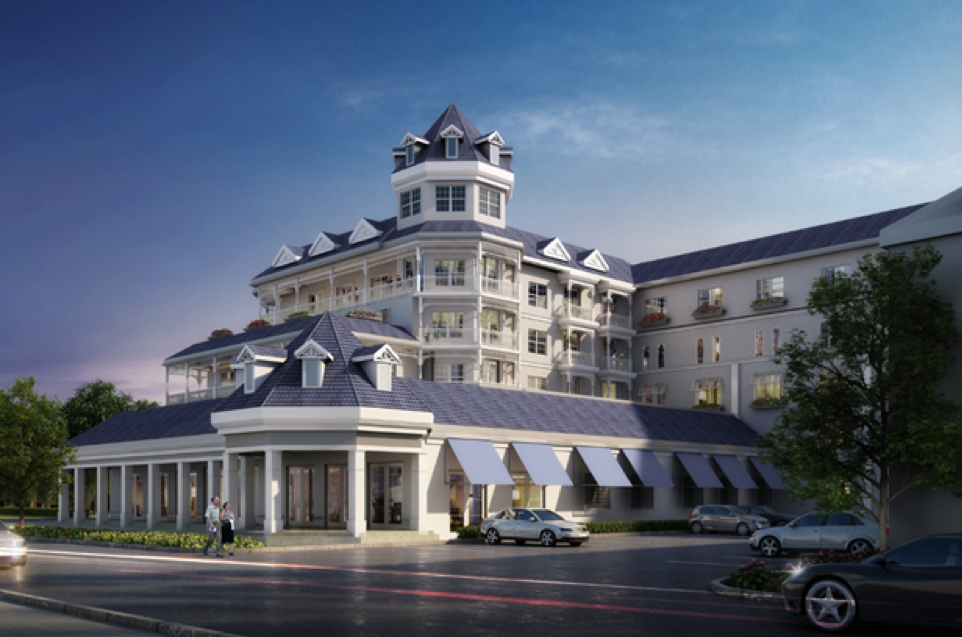
The Henderson Hotel at Lake Killarney
The Henderson Hotel at Lake Killarney
What’s Going On There?
 There is a great deal of information flying around about the 118-room Victorian style hotel proposed for a site on 17-92 that fronts on Lake Kilarney. Several meetings are scheduled for this week and next that should shed some light on what is actually happening. If this is a project that affects you – or just interests you – plan to attend one or more of the following meetings.
Tuesday, Oct. 29 — Planning & Zoning Work Session, Noon, Commission Chambers
The P&Z Board will discuss the zoning changes and conditional use requests for the proposed hotel. This is for informational purposes only. The board members will take no votes and hear no public comment – but the meeting should be informative.
Wednesday, Oct. 30 – Developer’s Information Session, 6 – 7 pm, Farmer’s Market
The developer, Adam Wonus, will host a Q&A and show the latest concept drawings at the Farmer’s Market. If you have questions about the project, here’s your chance to ask. Word on the street is the neighbors, not all of whom favor the project, plan to be in attendance.
Tuesday, Nov. 5 – Planning & Zoning Board Meeting, 6 pm, Commission Chambers
This will be the formal P&Z hearing, where the board will vote on whether or not to move the Henderson Hotel project ahead to the Commission in late November. Votes will be taken and public comment will be heard.
Recent Comments