
No Park Expansion
No Park Expansion
A 20,000-square-foot medical office building will occupy a lot once home to bowling lanes on Fairbanks Avenue near U.S. Highway 17/92.
City commissioners accepted an offer to buy the land from ComTech Properties for $3.5 million by a 4-1 vote, Commissioner Carolyn Cooper opposed. The site at 1111 W. Fairbanks Ave. has been coveted by some in Winter Park eager to expand Martin Luther King Park.
The city put the land out for bid in June, less than a year and a half after it bought the 1.63 acres from Rollins College for $2.9 million. The college had bought the bowling lanes site in 2013 for $2.85 million as part of a planned athletic field, but sold it to the city after it found another location.
The city used community redevelopment — or CRA — funds from its special downtown taxing district to pay for about a third of the purchase price to Rollins. The intent was to create turn lanes from Fairbanks Avenue onto Hwy. 17/92. There also was discussion at the CRA and city commission level about using the parcel to expand MLK Park.
Commissioner Cooper argued Monday the city should delay the sale “for now,” so it can study what effect the new city library will have on storm water drainage in the area. Hurricane Irma raised the need for more land to offset storm water, she said. Commissioner Greg Seidel voiced similar concerns, as did two residents who spoke to delay the sale. This area “was the TV stand-up spot” reporters used to show flooding from Irma, resident Charley Williams said.
Mayor Steve Leary said the agenda item was “never about park space and water,” but about needing space for traffic lanes. Arguments about stormwater were just another tactic to delay the sale, he said, and that could scare away prospective tenants in the office building and jeopardize the bid.
Power and Police Priorities
Power and Police Priorities
Winter Park’s electric utility and law enforcement emerged as partial winners in Winter Park’s budget debates. The city’s tax rate for 2018 will stay the same.
In the wake of Hurricane Irma and complaints about outages, city commissioners figured out ways to make more money available to the electric utility fund. The biggest chunk — $1 million – will be transferred to the utility this budget year from the city’s water reserves. Another $425,000 would be freed up in the utility’s 2018 contingency funding by moving street-lighting from the utility to the general fund, where it had been in the past.
Not yet known is whether that the additional $1.425 million will speed up the city’s underground wiring or how much work could be accomplished. Although several commissioners said the money was intended to move forward with undergrounding, Mayor Steve Leary said some of the $1 million could go toward other improvements necessitated by the hurricane. City Manager Randy Knight estimated the city’s total storm-related costs at $5.5 million with much of that ultimately covered by the Federal Emergency Management Agency, or FEMA.
“The City has undergrounded just over six miles with the $3.5 million provided for the FY17 fiscal year,” said Clarissa Howard, the city’s communications director Tuesday. “It is extremely difficult to determine how much could be done with additional funds as each project is different and complexity can affect the cost.”
Commissioner Carolyn Cooper voted against the $1 million transfer, saying she preferred such fund-to-fund shifts be done as loans that are paid back. Both Mayor Leary and Commissioner Pete Weldon voted against putting street lighting back in the general fund.
NO BODY CAMERAS FOR POLICE
Police Chief Michael Deal was successful in winning an $862,000 increase in his department’s budget. In earlier budget talks, Mayor Leary had asked the department to cut its request by $200,000, but on Monday commissioners decided to approve the full request. They said they wanted the department to be competitive with other Central Florida departments in hiring new officers.
Commissioners, however, declined to budget the $120,000 Deal had sought for police body cameras. In earlier budget talks, only Mayor Leary had supported that request. Commissioner Weldon didn’t want the cameras to be used to make public safety a “political football,” and Chief Deal said he had seen no complaints of excessive force or racial profiling in the year he has been chief.
On Monday, Commissioner Sarah Sprinkel noted the police department’s healthy budget and said the chief could use the money for body cameras if he saw them as a priority. If the chief “can figure out a way to do it, fine,” she said.
NO TAX RATE INCREASE
Commissioner Weldon was unsuccessful in seeking a cut in the property tax rate to 3.9942 mills. That would have removed a half million dollars from the general fund. One mill equals $1 of tax for every $1,000 in assessed property value.
Weldon argued that the city’s coffers are healthy enough to sustain a lower rate. In addition, he said, the same millage will bring in more revenue because the city’s assessed property values have increased. Commissioners voted 4-1 to keep the rate at 4.0923 mills.
Stormy Weather Ahead
Stormy Weather Ahead
Will the Lights Stay On?
Editor's Note: Articles written by citizens reflect their own opinions and not the views of the Winter Park Voice.Peter K. Gottfried, Guest Columnist
Tropical Storm Maria has now become Hurricane Maria and is battering residents of the Caribbean — even as they are still reeling from the devastation of Hurricane Irma. Too soon to tell if Maria will turn toward Central Florida, but one thing remains certain – the City of Winter Park is still not ready for a major hurricane.
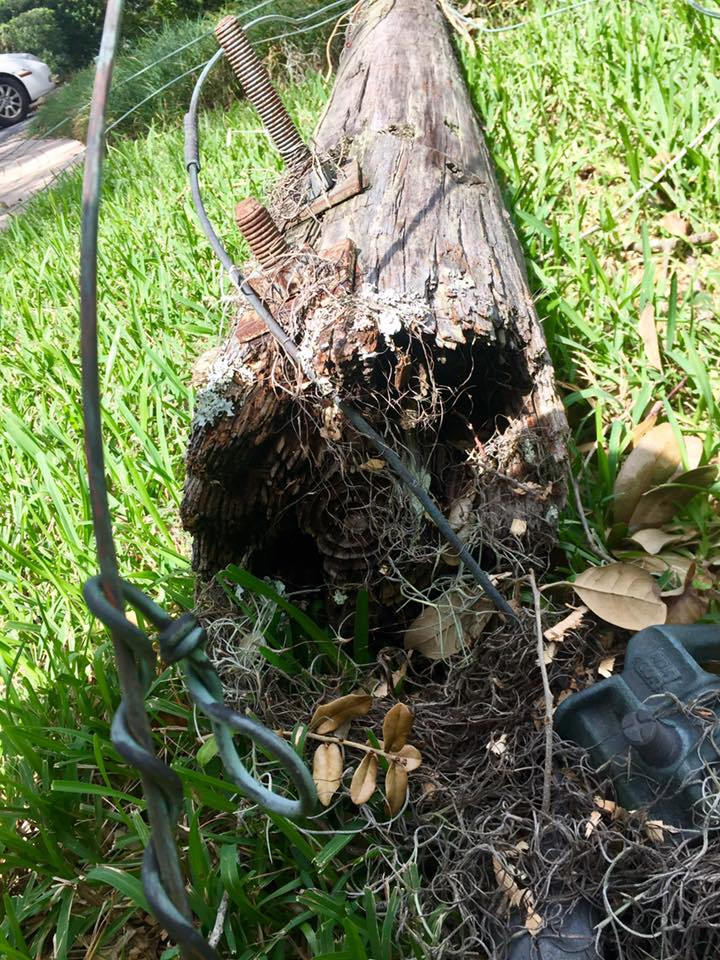
This rotten utility pole at Stovin and Park Avenue fell during Hurricane Irma.
Storm Water Has No Where to Go . . .
Flooding occurs in the same areas of the City it always has – and thanks to continuing development without proper storm water management, it is getting worse. The City knowns about these areas, but continues to take a go-slow approach to addressing them.
. . . Except Into the Roads
Lake Mendsen within Martin Luther King Park – site of the proposed $30 million library-event center — is woefully inadequate to handle existing storm water drainage from the Winter Park Village, the Paseo Apartments and the CNL Heritage Center. Even a heavy afternoon thunder storm will cause flooding on Denning Drive and Harper Street. The construction of the new library, with its associated impervious surfaces, can only make things worse. Other areas of the City that routinely flood include the intersection of Kings Way and Fawsett Road and stretches of Palmer Avenue, where water rises to the curb top after an afternoon downpour.
High Rates Alone Won’t Keep the Lights On
Reliable electric power during major storms is a significant issue. Like many other customers in Winter Park, I was without power for a week following Hurricane Irma.
Let’s Bring Our Infrastructure Into the 21st Century
Winter Park purchased the electric utility from Progress Energy/Florida Power in 2005 with a promise to underground all lines within 10 years. According to the City website, that target completion date has moved out to 2026. Progress is measured in terms of how many miles of line have been undergrounded rather than the number of additional customers served. The current debate is less about how and when to underground and more about how to pay for it. For information about undergrounding in your area, go to https://gispublic.cityofwinterpark.org/ugstatus/
Winter Park can do better. There is no reason we should scramble every time there is a major storm. Let’s bring our infrastructure up to date so we can have some peace of mind when the next storm hits.
Peter K. Gottfried is President of Natural Systems Analysts, Inc. which provides technical and scientific support to the U.S. Geological Survey, the U.S. Coast Guard, and the Bureau of Land Management. He served as a City Commissioner and on the Planning and Zoning Board, Lakes and Waterways Board and, currently, on the board of Mead Botanical Garden.
Recent Comments