Winter Park’s Finest changed their dress code for the holidays. Unaccustomed facial hair on the men and festive fingernails on the women celebrate “No Shave, Pretty Nails December.”
Unfortunately, the reason is not all mistletoe and holly and it is anything but jolly. This is a fundraising effort on behalf of Master Police Officer John Reynolds, who was diagnosed with Stage 4 cancer last spring. Many Winter Parkers know this 47-year-old husband and father of two as a Resource Officer at Lakemont Elementary School. Reynolds is a 15-year veteran on the Winter Park Police Force and well liked in the community.
He needs our help.
His earlier treatments were not effective, so Officer Reynolds now must travel to New York for treatment. The treatments are every other week, and travel expenses for Reynolds and his wife are not covered by insurance.
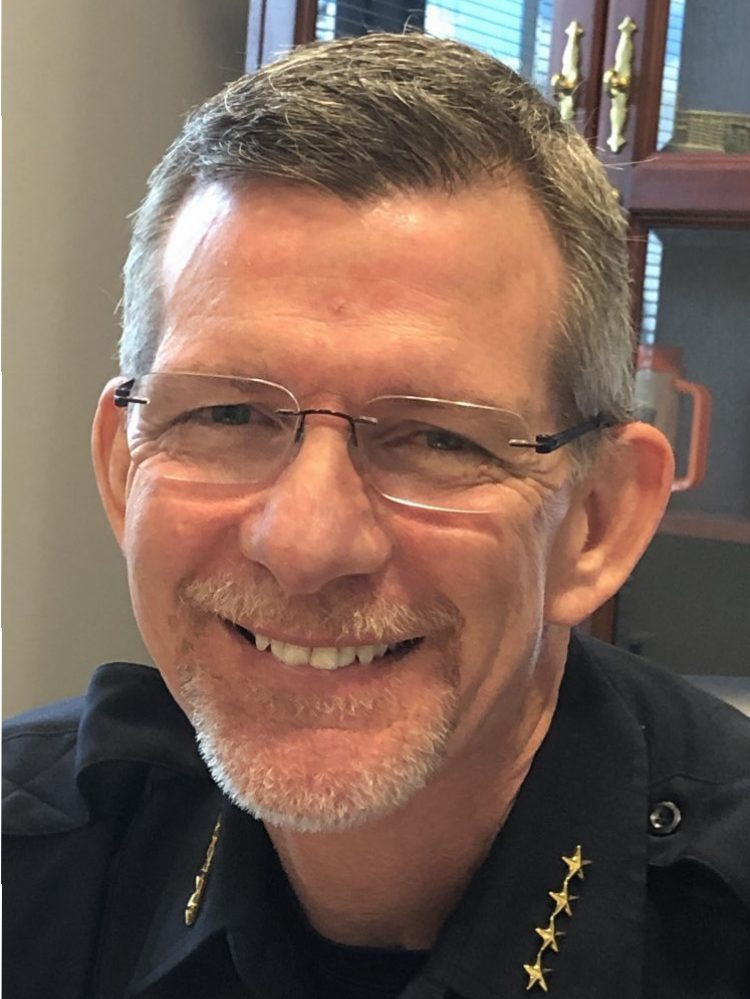
“This is a long road for the family,” said newly-bearded Police Chief Michael Deal. “They just hit a new deductible in October – and the travel will not be covered. We are doing our best to help the family – and we sure could use some help from the community.”
To support Officer John Reynolds, please click here:
You may also send donations to Officer John Reynolds c/o Captain Pam Marcum, Winter Park
Police Department, 500 N. Virginia Drive, Winter Park FL 32789.
Although it won’t begin in earnest until after the holidays, rumblings are already audible.
Commissioner Carolyn Cooper, Seat #3, Commissioner Peter Weldon, Seat #4 and challenger Todd Weaver have all declared their intention to run for Winter Park City Commission.
Weldon, originally elected in 2016, will seek a second term. Long-time Winter Park resident Todd Weaver will challenge Weldon in the race for Seat #4.
To date, no challenger has announced opposition to Carolyn Cooper in the race for Seat #3. Cooper is seeking a fourth and final term. Commissioners’ service is limited to four 3-year terms in office.
There is plenty of time for a challenger to make his or her intentions known. The official filing dates to run for Winter Park Commission are January 17 – 22, 2019.
A standing-room-only crowd filled Rollins’ Suntrust Auditorium last night as panelists engaged the audience in a lively discussion about Winter Park’s future.
An audience of Winter Park residents and Rollins students joined panelists, former Commissioner Pam Peters, Entrepreneur Steve Goldman, Architect Phil Kean and Mayor Steve Leary, to explore how our city will navigate the opportunities and the issues facing it now and in the years to come.
Videos are in two parts, below, and last about an hour total.
Applies to Park Ave. CBD, New England Ave. in Hannibal Square & Orange Ave. Corridor
Commissioners voted Monday, Oct. 22, to approve the revised parking code proposed by the City Planning Department on the first reading. The second and final reading is scheduled for the November 12 meeting.
Code revisions apply specifically to the Central Business District (CBD) along the Park Avenue corridor, the New England Avenue commercial portion of the Hannibal Square neighborhood and the Orange Avenue corridor. The revised codes are the culmination of more than a year’s work by parking consultant Kimley-Horn.
No ‘Fee-in-Lieu’
Originally, the revised ordinance contained six elements. Before their discussion commenced, however, Commissioners excluded the element that would have created a fee-in-lieu of parking, whereby a property owner could pay for required parking within a city-owned parking facility without actually having to provide dedicated parking spaces at their property. This has the effect of leveling the playing field, eliminating any advantage wealthier developers might have over less wealthy ones.
Summary of Major Changes
Under the new ordinance, anyone converting retail or office space to restaurant use in any of these areas, including Park Avenue, must provide the increased parking required for restaurant use.
The ordinance would change the distance permitted for off-site parking from 300 feet to 750 feet. To walk 750 feet takes about five minutes.
The ordinance provides for the use of the Urban Land Institute’s Shared Parking analysis as a reference for determining when and how shared parking will be permitted.
Parking requirements for new retail and general office space will change from four spaces per 1,000 square feet to three spaces per 1,000 square feet.
Finally, parking requirements for large office buildings will be four spaces per 1,000 square feet for the first 20,000 square feet of the building, then will transition to three spaces per 1,000 square feet for all floor area in excess of 20,000 square feet.
‘Grandfather’ Clause
The ordinance will include a “vesting provision,” so that anyone already in the process of designing a project who submits site plans and/or floor plans for City approval by the date of adoption of the ordinance can continue under the current parking code, provided they apply for a building permit by Dec. 31, 2018, and begin construction by March 1, 2019.
Editor's Note: Articles written by citizens reflect their own opinions and not the views of the Winter Park Voice.
Guest Columnist Jim Fitch
The September 24 Winter Park Commission meeting was an embarrassment to the City of Winter Park. Taxpayers, who fund all City operations one way or another, attend these meetings in order to be informed. The City needs to be more respectful of citizens whose taxes keep the City running and whose votes elect the Commission.
Hearing & Seeing = Believing
It is very difficult for those of us who regularly attend the twice-monthly Commission meetings to hear, to see or to understand the proceedings. It is hard to believe this is intentional – even when controversial topics like The Canopy are being discussed.
Full Names, Please
City staff making presentations frequently fail to state their full names and positions. They are known to the Commission (e.g., “Troy”), but there is often a failure to inform the audience. Most presenters address their remarks to the Commissioners and not to the public.
Don’t Ignore the Microphones
The Mayor mumbles, the City Manager mumbles and Commissioners Seidel and Cooper do not speak into their microphones. The result is that the audience must strain to hear the discussion – and is completely left out of the side banter between Mayor Leary and Commissioner Sprinkel. Only Commissioners Sprinkel and Weldon speak clearly enough to be understood.
Make the Visuals Visible
Even though the Commissioners have laptops and document packets in front of them, they sometimes seem ill-informed about what is going on. Document screen shots projected for the public are, more often than not, too small to be legible. No laser pointers are used – Mayor Leary says it would only cover one of the two screens.
If the presenter’s lectern were placed in the center of the room in front of the dais, the presenter could use a laser pointer on both screens.
Appoint a ‘Listener’
The City should also place a listener at the back of the chamber to monitor audio levels and alert the Commissioners and presenters when their remarks cannot be heard. Presenters and Commissioners alike should pay attention to the public when people in the audience signal that they cannot hear.
We Need New Mikes
The City should invest in higher quality wide angle microphones or individual lavalier microphones, rather than the uni-directional ones now in use, so that the official discussion, as well as the side banter, is clearly audible to the audience.
If It’s a Public Meeting, Citizens Deserve to Be Able to Hear & See
Not only are the current practices disrespectful to the citizens of Winter Park, they are a violation of the Sunshine Law. This is an easy fix – please do something to correct this situation.
Winter Park’s infamous 1981 sinkhole is gobbling up attention in the latest debate over the city’s planned library and civic center.
City commissioners Monday will decide if they share an advisory board’s concerns that the sinkhole – now called Lake Rose – will have to play a major role in handling stormwater from the site.
Stormwater retention was one of two major issues that gave the planning and zoning board pause last week in considering the proposed library plan. Parking was the board’s other stumbling block.
City staff asked the advisory board to make a final decision about the complete site plan, but the board gave it only preliminary approval and added two conditions. First, it wanted more detailed information about the stormwater plan once the St. Johns River Water Management District approves it, a process that could take another three weeks. Second, it wanted city commissioners to explore finding 36 more parking spaces, a move that could result in the demolition of the Lake Island Hall recreation building.
No matter how the advisory board voted, city staff said later in the meeting, the city commission this Monday could override that recommendation and give the project final approval.
At the heart of the board’s concerns is the city’s plan to run a pipeline from Lake Mendsen, which would be next to the new buildings, to Lake Rose. The idea is to allow excess water from the larger lake to drain into Lake Rose during hurricanes and heavy rains.
Board member Bob Hahn pushed for the planning board’s two conditions, saying he needed to see additional study of the water management issue to make sure the idea would work. “I’m comfortable with moving the project through in the preliminary stage, but having it come back [to us} in the final stage.”
Like other board members, he expressed support for the new library but was concerned that unanswered questions remained.
“I, too, feel we’re going too fast,” Chairman Ross Johnston said. “There’s a lot that has been predetermined, much more than is normal for a planning and zoning meeting,”
Public Works Director Troy Attaway said the pipeline would let the two lakes “function together as basically one lake” and increase its capacity to handle storm water. Attaway predicted that the connection also would help alleviate historical flooding along Denning Drive during rain storms.
Lake Rose is named after Mae Rose Williams, whose house fell into the sinkhole in May of 1981. Her heirs still own a portion of the property, as do the city and another property owner. Cheryl Thompson, her granddaughter, objected to the city’s stormwater plan during public comment, citing existing overflow problems. Resident Kim Allen wrote the city that the pipeline may not relieve Lake Mendsen’s current lack of room for stormwater. The city also should be concerned about flushing polluted stormwater down drain wells into the aquifer, she said.
Other residents noted that the plan does not comply with the language of the $30 million bond referendum, which called for a parking garage. City code requires 146 parking spaces for buildings the size of the proposed library and civic center. The city would provide 213 spaces in parking lots, plus 24 parallel parking spots on Harper Street. City Planning Manager Jeff Briggs said the city is looking into tearing down the recreation building at Lake Island to add even more parking places, but no decision has been made. The building is “not well utilized,” he said.
The project will change the look of the park in many ways. In addition to the two new modern structures that will house the library and civic center, the site will lose 63 protected trees, including most of the live oaks on the property. In the mid-1900s, the site was a mucky wetland that gradually was filled in around the edges with construction debris.
We Depend on your support, make a tax-deductible donation here.
Mission
The Winter Park Voice is a trusted nonprofit journalism site that covers our City Hall and beyond. We endeavor to engage, inform and connect citizens on all sides of issues affecting the quality of life in Winter Park.




Recent Comments